Advertisement
Kenya advances water security and irrigation amid climate challenges
Tuesday 26th May, 2026 04:32 PM|

Water Cabinet Secretary Eric Mugaa has reaffirmed the government’s commitment to strengthening food security, placing reliable water access at the centre of national development.
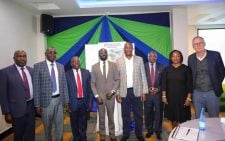
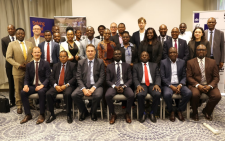
Speaking during the official opening of the two-day conference “Getting Wise: Measuring Human Experiences with Water to Support the Africa Union’s Water Vision 2063” at the UN Headquarters in Gigiri, Nairobi, on Tuesday, May 26, 2026, Mugaa emphasised the role of water in agricultural production and economic growth.
“It is a way to feed the nation, because without water, there can’t be irrigation, especially for Kenya, without water storage. Food security is key to this administration’s agenda,” he noted.
He added that access to water must go beyond availability to include infrastructure development, financing frameworks, and strategic partnerships that guarantee reliability and comfort for users.
You Might Also Like
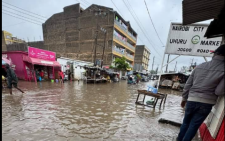
Mugaa also noted that improved access could unlock job opportunities and wider economic benefits across the country.
K-RISE initiative
Mugaa announced ongoing development of the Kenya Resilient Irrigation and Sustainable Economies (K-RISE) programme, designed to strengthen national water security through integrated planning and investment. He also highlighted the establishment of centralized data systems to improve decision-making and resource allocation in the sector.
He called for a shift in how water access is measured, moving beyond percentage connectivity to lived experiences.
“Does this tell the true story? That young woman in Turkana, Kondele in Kisumu or in Kajiado, might tell a very different story… Our major concern is about percentage connectivity, the number of beneficiaries and connections. Does anybody care to follow up how stable is that connection?”
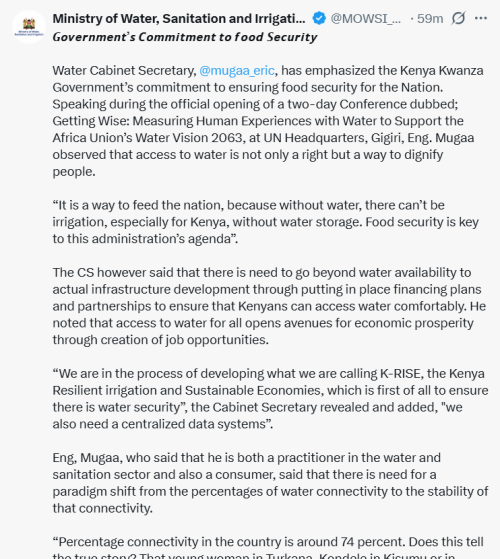
The Ministry has also partnered with Northwestern University to adopt the Water Insecurity Experiences (WISE) Scales, aimed at capturing stability, quality, and user experience in water access. Mugaa further pointed to opportunities for youth involvement in innovation, alongside collaboration with counties, development partners, and the private sector.
County challenges and technology integration
Laikipia Governor Joshua Irungu, who chairs the Council of Governors’ Water and Natural Resources Committee, highlighted persistent rural challenges in water access. He noted that in some areas,
“In some places, we have people who compete with elephants and donkeys who will take water first,” while some women walk over 15 kilometres in search of water. He stressed the need for inclusive planning that considers both upstream and downstream users.
The government is also advancing the Earth Observation for Irrigation Mapping initiative under the IrrEO Project, led by the Regional Centre for Mapping of Resources for Development in partnership with the University of Manchester.
The programme uses satellite technology to address data gaps and support irrigation planning. So far, it has mapped 50 large dams, 200 medium dams, over 2,000 small dams, and 271 irrigation schemes.
Kenya aims to expand irrigated land from 762,000 acres to 1.7 million acres, with plans to add 1 million more acres. Flagship projects include the Galana Kulalu scheme and expanded rice production under the National Irrigation Sector Investment Plan, aligning with broader efforts to strengthen food systems and climate resilience.
Author
Latest News






Advertisement
More on News