Govt moves to address Nairobi sewage menace in new plan
By Faith Lagat, May 12, 2026The Kenyan government is intensifying efforts to expand sewerage coverage and restore key river ecosystems, with major infrastructure projects nearing completion under African Development Bank support.
Principal Secretary for Water and Sanitation, Julius Korir, on Tuesday, May 12, 2026, chaired a wrap-up Implementation Support Mission meeting for the Kenya Towns Sustainable Water Supply and Sanitation Programme and the Nairobi Rivers Basin Rehabilitation Programme Sewerage Improvement Phase II (NaRSIP II).
The meeting reviewed progress made in improving wastewater management and sanitation services across urban centres.
Under NaRSIP II, sewerage coverage in Nairobi is set to increase from 48 per cent to 60 per cent. The project is expected to serve more than 400,000 residents and support treatment of up to 80,000 cubic metres of wastewater daily.
Targeted rivers include the Nairobi, Ngong, Mathare, Kiu, Riara and Gatharaini, with interventions focused on reducing pollution and restoring the basin’s ecosystem health.
“Principal Secretary for Water and Sanitation, Julius Korir, today chaired the wrap-up meeting for the Implementation Support Mission of the Kenya Towns Sustainable Water Supply and Sanitation Program and the Nairobi Rivers Basin Rehabilitation Program Sewerage Improvement Phase II (NaRSIP II), in partnership with the African Development Bank,” read the post in part.
Implementation progress reaches 95.6%
Overall implementation of the two programmes has reached 95.6 per cent, up from 93.2 per cent recorded in September 2025. The Kenya Towns Programme has attained 90 per cent completion, with 32 projects already commissioned across participating towns.
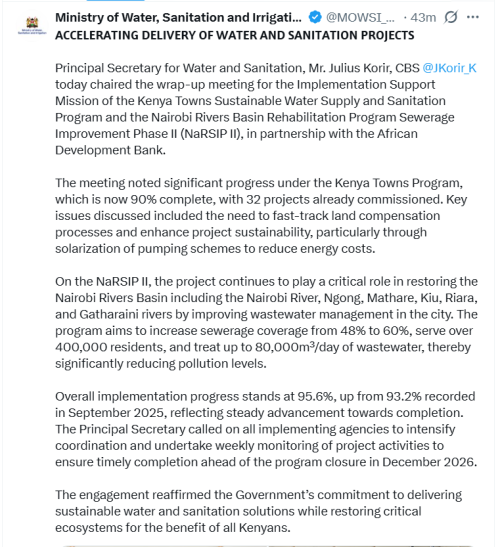
Korir directed implementing agencies to fast-track land compensation processes, solarise pumping systems to reduce energy costs, and conduct weekly monitoring to ensure completion before the December 2026 deadline.
He emphasised the need to complete the remaining works on time to avoid delays to service expansion.
The projects are part of a broader national effort to strengthen urban sanitation systems and improve environmental health outcomes in fast-growing settlements.
Nairobi water infrastructure challenges and tariff adjustments
The developments come amid ongoing operational challenges in Nairobi’s water and sewerage systems. In March 2026, the Nairobi City Water and Sewerage Company (NCWSC) restored sewer services in the Lucky Summer–Gitumba area following flood damage to a trunk line, with repairs including reinforcement and concreting of the pipeline.
Earlier disruptions were also reported along the Kabete–Kilimani transmission line, affecting supply to areas including Kileleshwa, Kilimani, Upperhill and Madaraka, highlighting the strain on ageing infrastructure.
To support upgrades, the Water Services Regulatory Board (WASREB) approved revised tariffs for the 2025/2026 financial year. Domestic water charges now range between Ksh68 per cubic metre for low consumption and Ksh117 for high usage, while sewerage is billed at 75 per cent of water consumption.
NCWSC reports that about 54 per cent of treated water is lost through leaks and illegal connections, with supply in some areas averaging nine hours daily.
The government says the ongoing investments aim to improve reliability, expand access and strengthen long-term sustainability of water and sanitation services across urban centres.