Advertisement
Govt launches digital SHA registration for children aged 7–17
Wednesday 10th June, 2026 11:11 PM|
The government on Wednesday, June 10, 2026, introduced biometric scanning for school-aged dependents under its newly overhauled state health insurance ecosystem, signalling an aggressive push toward a digitised, unified healthcare apparatus intended to combat widespread medical billing fraud.
The roll-out, which commands the mandatory enrollment of children aged 7 to 17 years into the Social Health Authority (S.H.A.) database, represents a milestone in the state’s multi-layered Universal Health Coverage blueprint.
Led by Health Cabinet Secretary Aden Duale and Public Service Cabinet Secretary Geoffrey Ruku, the initiative explicitly binds patient identity to the Digital Health Agency’s central cloud, transforming how minors access medical records and clinical care across East Africa’s largest economy.
Government planners view the deployment of digital identification for dependents as an essential preventative shield.
You Might Also Like


By registering biometric signatures for children, the state intends to enhance data security, eliminate duplicate healthcare claims, and support efficient, transparent service delivery across healthcare facilities.
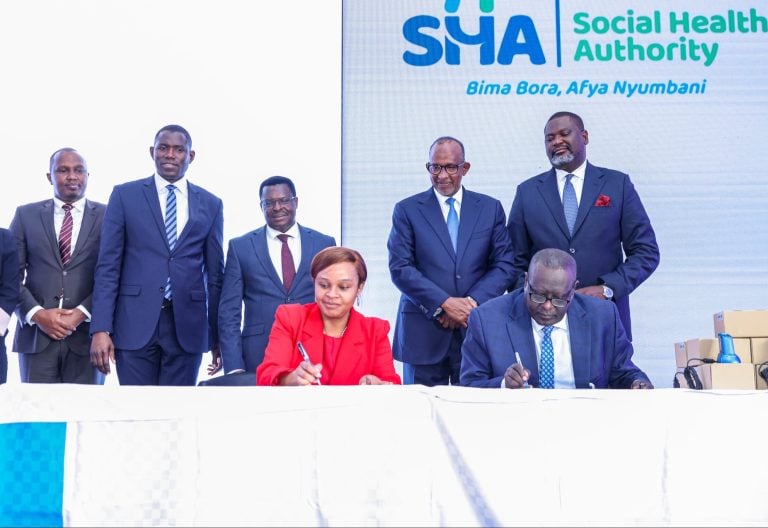
The tech rollout coincided with the formalisation of the Public Officers Medical Scheme Fund (P.O.M.S.F.), a massive, state-backed insurance framework.
Top administrative figures, alongside medical union representatives and county governors, gathered in Nairobi to sign implementation charters establishing rigid service delivery, reimbursement, and accountability frameworks with thousands of commercial, public, and faith-based hospitals ranging from Level 3 clinics to Level 6 national referral centers.
Under the revitalised P.O.M.S.F. framework, government workers and their newly biometrically verified dependents will gain unprecedented access to premium specialized medical procedures.
The comprehensive care packet covers routine inpatient and outpatient services alongside critical financial lifelines, including specialised surgeries, cancer treatment, renal dialysis, dental and optical services, overseas referrals, and advanced reproductive interventions like In Vitro Fertilisation (I.V.F.).
“The agreed tariffs eliminate unauthorised co-payments for services covered under the scheme. We caution healthcare facilities against imposing unlawful charges on beneficiaries,” Duale said.
Crucially, the rollout serves as an economic ultimatum to the nation’s heavily privatised medical industry.
For years, public servants have complained of predatory “co-payments”—out-of-pocket premiums levied arbitrarily by hospitals even when procedures are fully covered by state insurance.
Duale explicitly warned that the newly adopted tariff structures leave zero room for unexpected hospital fees, threatening strict pushback against facilities imposing unapproved charges.
SHA biometric framework
Target demographic: Dependents aged 7 to 17 years across all regions.
Technical infrastructure: Managed by the Digital Health Agency to strengthen digital health systems and improve transparency.
Coverage scale: Connects public servants to Level 3 through Level 6 healthcare facilities, including faith-based and private hospitals.
Specialised portfolios: Covers major surgical interventions, chemotherapy, long-term dialysis, and reproductive health options such as I.V.F.
Author
Martin Oduor
View all posts by Martin OduorLatest News








Advertisement
More on News