Advertisement
Fuel scandal: Company reveals how it lost Ksh3.2B after govt cancellation order
Tuesday 14th April, 2026 06:39 PM|

Fresh details have continued to emerge on the fuel importation saga that saw top energy officials step down from their roles, with President William Ruto vowing to dismantle cartels in the sector.
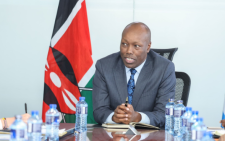
The latest information follows a detailed explanation by Oryx Energies Kenya Ltd, which told the Senate Standing Committee on Energy how the government cancelled a major fuel supply deal while shipments were already at sea.
The company told the Senate committee that it lost Ksh3.2 billion (USD 25 million) and now rejects the cancellation as invalid.
Urgent request
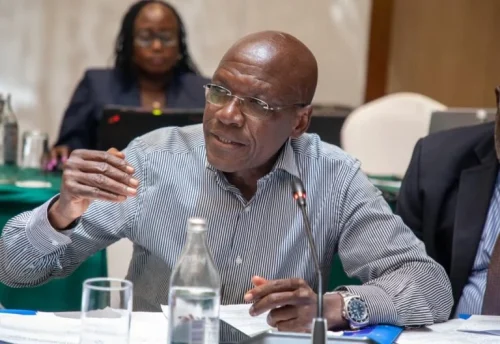
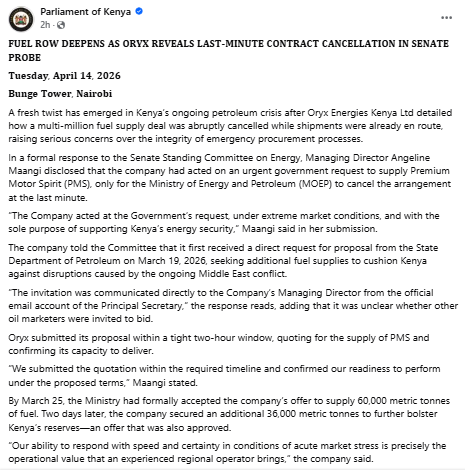
In her submission to the committee, Oryx Managing Director Angeline Maangi explained that the company responded to an urgent government request. She said the firm acted to support national energy security.
You Might Also Like

“The Company acted at the Government’s request, under extreme market conditions, and with the sole purpose of supporting Kenya’s energy security,” Maangi said.
The State Department of Petroleum sent the request for proposal directly to Maangi on March 19, 2026, via the Principal Secretary’s official email. It sought extra Premium Motor Spirit (PMS) to cushion Kenya against supply disruptions from the Middle East conflict.
The company submitted its quote within a two-hour window.
“We submitted the quotation within the required timeline and confirmed our readiness to perform under the proposed terms,” Maangi stated.
By March 25, 2026, the ministry accepted the offer for 60,000 metric tonnes. Two days later, it approved another 36,000 metric tonnes. Oryx highlighted its speed in tight conditions.
“Our ability to respond with speed and certainty in conditions of acute market stress is precisely the operational value that an experienced regional operator brings,” the company said.
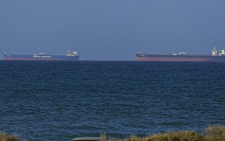
The government cancelled the entire arrangement on March 31, 2026, as the shipment headed to Kenya.
“The shipment was en route for delivery when the Ministry cancelled the offer,” Maangi said. “By that time, a binding contractual arrangement had already been established through formal correspondence.”
Oryx rejected the cancellation and urged the government to honour the deal.
“We had already committed significant operational resources in anticipation of performance,” she added.
Lawmakers question fuel contract
Senators pressed the company hard during the hearing. Danson Mungatana asked whether lawyers were consulted before entering a contract in two hours and questioned the lack of a physical meeting.
“Did you talk to your lawyers or consult widely before entering into a contract within two hours?” Mungatana posed.
He also asked:
“Would you be comfortable to jump into such an arrangement knowing the existence of government-to-government contracts with Gulf states?” and inquired about profit margins and prior experience with large deals.
Boni Khalwale focused on the cost to taxpayers.
“Listening to Madam Maangi, the taxpayer wants to know the consequences of the failed contract and who pays you for the loss of money?” Khalwale asked.
He further wanted details on the cost of routing fuel via the Cape of Good Hope.
Allan Chesang Kisang raised the cost of missing the importation. Maangi disclosed the financial hit.
“As of today, the company has lost USD 25 million in the failed deal,” she told the committee.
She defended Oryx’s record, saying the firm ranked among the top three importers before the G2G system began and has operated in Kenya for 39 years.
“It is standard practice that the State Department of Petroleum communicates to oil marketers in this manner,” Maangi told the Committee.
Oryx justified its pricing. The quoted premium of Ksh33,000 (USD 253.94) per metric tonne reflected tight global markets caused by the Middle East crisis.
“This differential reflects prevailing market conditions characterised by acute product scarcity,” the company said.
It pointed to blocked shipping routes, reduced tanker availability, higher war-risk insurance, and extra time and cost from rerouting around the Cape of Good Hope. Despite the higher price, the firm insisted it acted in good faith.
“The Company acted in reasonable and good-faith reliance on a formal written invitation from the competent authority,” Maangi said. Oryx warned that cancelling deals after inviting private firms could damage future emergency responses.
“A framework that invites participation but fails to honour resulting commitments risks eroding the private sector’s capacity to respond,” the company cautioned.
The firm said it currently has no active talks with the ministry but has reserved its legal rights.
“As matters currently stand, there are no active engagements with the Ministry regarding emergency fuel supply,” the company stated.
G2G fuel deal probe
This Oryx case forms the second major emergency deal under scrutiny. The first involved One Petroleum, whose 60,000-metric-tonne consignment arrived on MT Paloma on March 27.
Energy Cabinet Secretary Opiyo Wandayi ordered it withdrawn from the market, citing higher prices (around Ksh198,000 per metric tonne versus Ksh140,000 under G2G) that would have pushed pump prices up by about Ksh14 per litre.
One Petroleum complied and confirmed the cargo would not enter the Kenyan market.
The scandal erupted after a planned G2G shipment failed to leave Dubai due to regional disruptions. Private firms, including One Petroleum and Oryx stepped in.
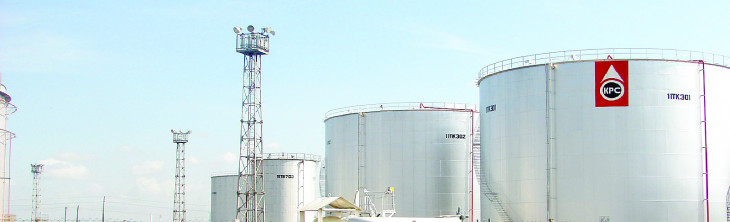
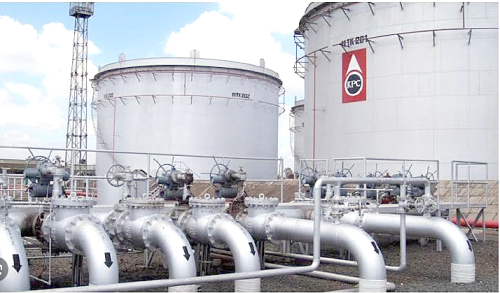
The government later blocked both cargoes to protect price stability and enforce G2G rules. KPC has since assured Kenyans of adequate stocks in its depots, though some stations still report shortages and higher fares.
The Senate committee continues its inquiry. It will hear from more stakeholders on transparency, pricing, and adherence to proper procurement rules.
The Senate committee is examining emergency fuel procurement. This follows the resignation and arrest of several top energy officials in early April 2026.
Officials, including former Petroleum Principal Secretary Mohamed Liban, Kenya Pipeline Company Managing Director Joe Sang, and Energy and Petroleum Regulatory Authority Director General Daniel Kiptoo, stepped down after accusations of manipulating fuel stock data to justify irregular imports outside the Government-to-Government (G2G) framework.
Author
Kenneth Mwenda
Kenneth Mwenda is a business, sports, and politics digital writer with over seven years of experience in journalism, covering breaking news, feature stories, and in-depth analysis across a range of beats.
For inquiries, he can be reached at [email protected]
View all posts by Kenneth MwendaLatest News



Advertisement
More on News