Advertisement
Faith Odhiambo warns Gachagua judgement could set dangerous impeachment precedent
Tuesday 09th June, 2026 12:05 PM|

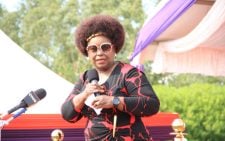
Former Law Society of Kenya (LSK) President Faith Odhiambo has raised concerns over the High Court judgement in former Deputy President Rigathi Gachagua’s impeachment case.
Taking to her official X account on Tuesday, June 9, 2026, Odhiambo warned that the ruling could create a dangerous constitutional precedent for future impeachment proceedings in Kenya.
The lawyer further questioned the coherence of a decision that found violations of Gachagua’s constitutional right to a fair hearing while still upholding the impeachment outcome.
According to Odhiambo, the three-judge bench acknowledged that the Senate violated Gachagua’s rights under Article 50 of the Constitution after declining to adjourn proceedings when he was unable to attend, leading the court to issue declaratory orders and award Ksh50 million in damages.
You Might Also Like


However, she noted that the impeachment itself remained intact despite the findings of constitutional violations.
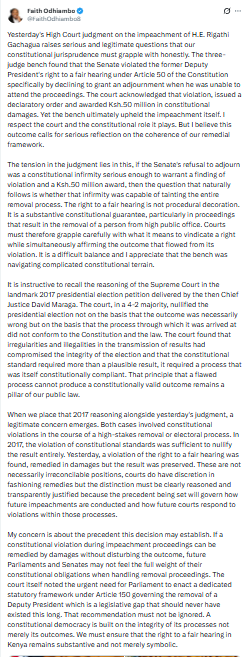
“Yesterday’s High Court judgment on the impeachment of H.E. Rigathi Gachagua raises serious and legitimate questions that our constitutional jurisprudence must grapple with honestly,” Odhiambo stated.
While expressing respect for the judiciary and its constitutional mandate, she argued that the ruling exposes tensions within Kenya’s constitutional remedial framework.
“The tension in the judgment lies in this, if the Senate’s refusal to adjourn was a constitutional infirmity serious enough to warrant a finding of violation and a KSh 50 million award, then the question that naturally follows is whether that infirmity was capable of tainting the entire removal process,” she said.
Right to a fair hearing
Odhiambo emphasised that the right to a fair hearing is a substantive constitutional guarantee and not merely a procedural technicality.
“The right to a fair hearing is not procedural decoration. It is a substantive constitutional guarantee, particularly in proceedings that result in the removal of a person from high public office,” she argued.
She further compared the ruling to the Supreme Court’s landmark 2017 presidential election judgement delivered under former Chief Justice David Maraga, where the court nullified the presidential election on grounds that constitutional and legal processes had been compromised.
According to Odhiambo, that decision established the principle that a flawed process cannot produce a constitutionally valid outcome.
“When we place that 2017 reasoning alongside yesterday’s judgment, a legitimate concern emerges,” she observed.
She acknowledged that courts possess discretion in crafting remedies but insisted that distinctions between rights violations and institutional outcomes must be clearly reasoned and transparently explained.
“My concern is about the precedent this decision may establish. If a constitutional violation during impeachment proceedings can be remedied by damages without disturbing the outcome, future Parliaments and Senates may not feel the full weight of their constitutional obligations when handling removal proceedings,” she warned.
Odhiambo also highlighted the court’s recommendation for Parliament to enact a dedicated statutory framework under Article 150 governing the removal of a Deputy President, describing the current legislative gap as problematic.
“The court itself noted the urgent need for Parliament to enact a dedicated statutory framework under Article 150 governing the removal of a Deputy President, which is a legislative gap that should never have existed this long,” she stated.
Gachagua’s impeachment judgement debate
The High Court judgement on Gachagua’s impeachment continues to generate intense legal and political debate, with lawyers and constitutional experts sharply divided over its implications for due process, impeachment law, and future parliamentary accountability.
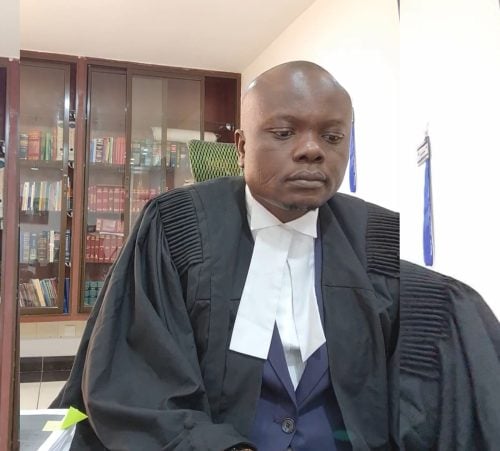
Lawyer Peter Wanyama has argued that Gachagua remains constitutionally eligible to contest the presidency despite a setback in the High Court in his impeachment case.
“The Constitution provides adequate safeguards, checks, and balances regarding the fate of the impeached Deputy President Rigathi Gachagua. His fate lies in the Supreme Court, not the High Court or the Court of Appeal,” Wanyama stated.
According to the lawyer, while Gachagua may have encountered legal hurdles at the High Court level, the Constitution protects his political rights until all available avenues of appeal have been exhausted.
Lawyer Willis Otieno has also raised major constitutional questions following the High Court judgement on Gachagua’s impeachment case, arguing that the ruling leaves unresolved legal contradictions that are likely to trigger further appeals.
“The judgement appears to leave a significant tension unresolved,” Otieno stated.
According to the Safina deputy party leader, the right to a fair hearing is a central constitutional principle that directly affects the legitimacy of any legal or quasi-judicial process.
Former Law Society of Kenya (LSK) President Eric Theuri has also strongly criticised the High Court judgement, describing it as a political rather than purely legal decision.
Taking to his official X account on Tuesday, June 9, 2026, Theuri argued that the ruling contains fundamental legal contradictions, particularly in how it addresses alleged violations of constitutional rights while still maintaining the effects of the impeachment process.
He said the Constitution clearly provides that any decision made in violation of rights is void and questioned how such a process could still be relied upon to bar a person from holding public office.
“The Gachagua judgement is a political decision at best, as it is legally absurd,” Theuri said.
Author
Mustafa Juma
View all posts by Mustafa JumaLatest News




Advertisement
More on News