Advertisement
Faith Odhiambo urges urgent action as transport strike threatens economy
Monday 18th May, 2026 10:03 AM|

Former Law Society of Kenya (LSK) President Faith Odhiambo has called on the government to urgently engage stakeholders in the transport and energy sectors, warning that the ongoing nationwide transport strike over fuel prices could push the economy into deeper instability.
Her remarks come as public transport operators across the country continue industrial action in protest against rising fuel costs, a move that has already begun disrupting movement, trade, and access to essential services in several towns.
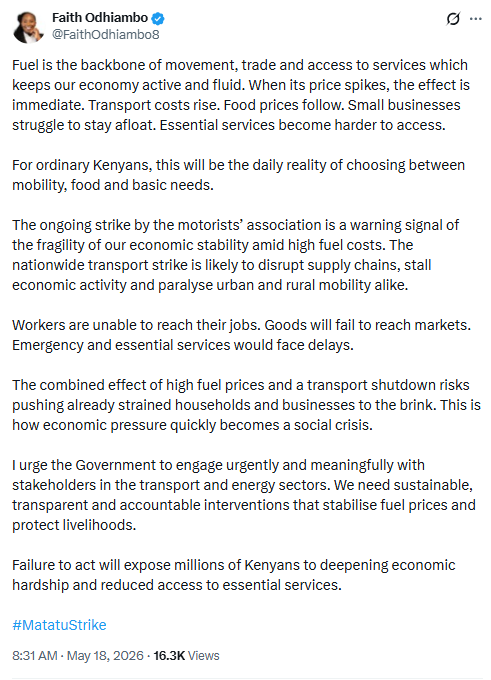
Taking to her official X account on Monday, May 18, 2026, Odhiambo said fuel remains the backbone of Kenya’s economy, directly influencing transport, food prices, and the cost of essential goods and services.
She warned that any spike in fuel prices immediately cascades across multiple sectors, leaving ordinary citizens to bear the brunt of rising living costs.
You Might Also Like


“Fuel is the backbone of movement, trade, and access to services, which keeps our economy active and fluid. When its price spikes, the effect is immediate. Transport costs rise. Food prices follow. Small businesses struggle to stay afloat. Essential services become harder to access,” Odhiambo stated.
Transport strike impact
The lawyer noted that the ongoing strike by the Transport Sector Alliance is a warning sign of growing fragility in Kenya’s economic stability.
She cautioned that a prolonged shutdown of public transport would likely disrupt supply chains, stall economic activity, and paralyse both urban and rural mobility.
“The ongoing strike by the motorists’ association is a warning signal of the fragility of our economic stability amid high fuel costs. The nationwide transport strike is likely to disrupt supply chains, stall economic activity, and paralyse urban and rural mobility alike,” she warned.
Impact on workers and businesses
Odhiambo further observed that workers are already struggling to access workplaces due to transport disruptions, while businesses face delays in the movement of goods to markets.
She added that emergency and essential services could also be affected if the situation continues unchecked.
“Workers are unable to reach their jobs. Goods will fail to reach markets. Emergency and essential services would face delays,” she said.
Call for government intervention
The lawyer urged the government to engage transport operators and energy sector stakeholders in meaningful dialogue to find sustainable and transparent solutions to the fuel pricing crisis.
She emphasised the need for accountability in fuel pricing mechanisms to protect livelihoods and stabilise the economy.
“I urge the Government to engage urgently and meaningfully with stakeholders in the transport and energy sectors. We need sustainable, transparent and accountable interventions that stabilise fuel prices and protect livelihoods,” she wrote on X.
Odhiambo warned that failure to act swiftly could expose millions of Kenyans to worsening economic hardship, with reduced access to essential services and increasing pressure on households already struggling with high living costs.
Several roads affected
Protests erupted in Kitengela town on Monday, May 18, 2026, as sections of key roads were barricaded during the ongoing nationwide matatu strike over high fuel prices, bringing transport activity to a standstill.
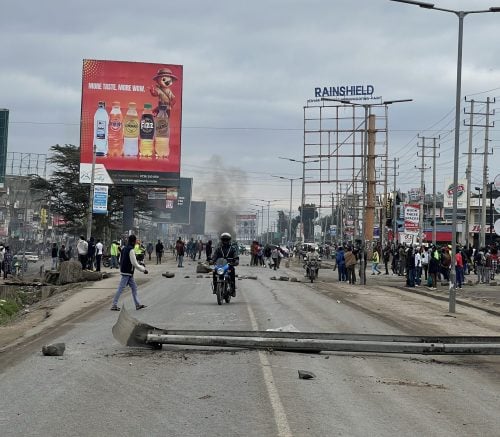
Demonstrators lit bonfires using tyres and used stones to block roads, effectively rendering several routes impassable and disrupting movement within and around the fast-growing town in Kajiado County.
The Namanga Road section stretching through the busy Kitengela town was the most affected.
A section of Thika Road was also barricaded in the morning, causing major disruption to transport along one of Nairobi’s busiest highways.
The affected stretch is around the Roysambu area, where protesters blocked the road using stones and burning tyres, bringing traffic flow to a standstill and leaving motorists stranded.
Author
Mustafa Juma
View all posts by Mustafa JumaLatest News








Advertisement
More on News