Ex-LSK president Eric Theuri dismisses Gachagua impeachment judgement as political
By Mustafa Juma, June 9, 2026Former Law Society of Kenya (LSK) President Eric Theuri has strongly criticised the High Court judgement in the impeachment case involving former Deputy President Rigathi Gachagua, describing it as a political rather than purely legal decision.
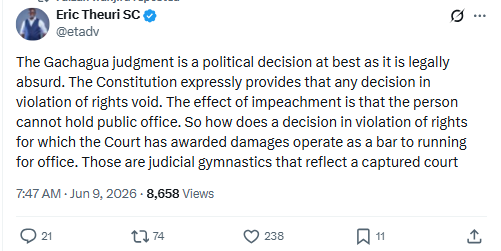
Taking to his official X account on Tuesday, June 9, 2026, Theuri argued that the ruling contains fundamental legal contradictions, particularly in how it addresses alleged violations of constitutional rights while still maintaining the effects of the impeachment process.
He said the Constitution clearly provides that any decision made in violation of rights is void and questioned how such a process could still be relied upon to bar a person from holding public office.
“The Gachagua judgement is a political decision at best as it is legally absurd,” Theuri said.
He added that where a court finds a violation of constitutional rights, the logical legal consequence should be the nullification of the impugned process rather than allowing it to stand with partial remedies.
“The Constitution expressly provides that any decision in violation of rights is void,” he stated, arguing that the court’s approach raises serious questions about consistency in constitutional interpretation.
Legal consequences of the impeachment outcome
Theuri further questioned the reasoning behind what he described as “judicial gymnastics,” suggesting that the court attempted to separate the finding of a rights violation from the legal consequences of the impeachment outcome.
“The effect of impeachment is that the person cannot hold public office. So how does a decision in violation of rights for which the Court has awarded damages operate as a bar to running for office?” he posed.
He maintained that such reasoning creates uncertainty in constitutional law and may undermine public confidence in judicial decision-making in politically sensitive cases.
The former LSK president went further to accuse the court of lacking independence in its interpretation of the law, saying the judgement reflects what he termed “a captured court”.
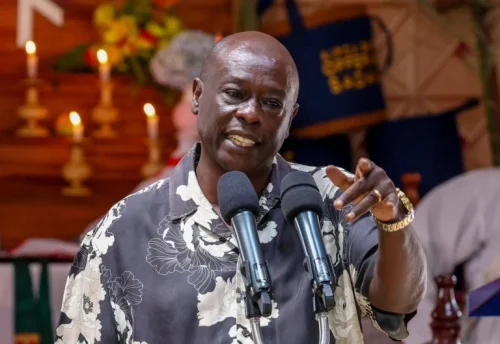
The High Court ruling on Gachagua’s impeachment has continued to generate intense debate among legal scholars, political leaders, and analysts, with differing interpretations of its implications for due process, impeachment law, and eligibility for public office.
While some legal experts have defended the judgement as consistent with constitutional procedure and the separation of personal rights from institutional decisions, others argue that it leaves unresolved tensions that may require appellate clarification.
The case is widely expected to proceed to the Court of Appeal, where further legal scrutiny will be applied to the issues of fair hearing, constitutional compliance, and the legal consequences of any identified procedural violations.
Gachagua impeachment case ruling
Theuri’s remarks come amid heightened political and legal debate surrounding Gachagua’s impeachment case, which has emerged as one of the most consequential constitutional disputes in recent years.
The High Court on Monday, June 8, 2026, upheld the impeachment of Gachagua but awarded him Ksh50 million in damages, finding that senators violated his right to a fair hearing during the proceedings.
In a judgement delivered at night, the court ruled that while the impeachment itself met the constitutional threshold and would stand, aspects of the process fell short of fair trial standards guaranteed under the Constitution.
The bench found that members of the Senate proceeded with hearings despite requests for an adjournment on medical grounds, concluding that the refusal to pause proceedings amounted to a violation of Gachagua’s right to a fair hearing.
The court said that although Parliament has broad constitutional authority to oversee and remove state officers, that power must be exercised in accordance with due process protections, including the right of an accused official to participate adequately in proceedings affecting their office and rights.