Advertisement
Duale reaffirms plans for US Ebola isolation unit in Laikipia despite concerns
Saturday 30th May, 2026 07:29 PM|

The Ministry of Health has expanded isolation and treatment capacity across the country as part of efforts to protect Kenyans from the Ebola outbreak in the Democratic Republic of Congo.
Health officials say the new facilities form the backbone of national preparedness and aim to ensure rapid response if a case enters the country.
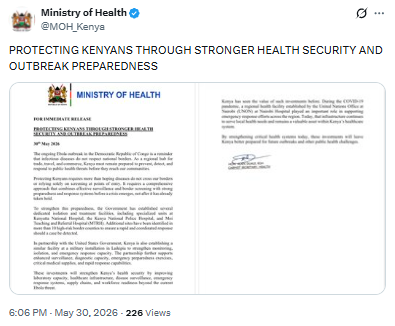
In a statement released on May 30, 2026, Health Cabinet Secretary Aden Duale said Kenya faces ongoing risk due to its role as a regional hub for trade and travel. He noted that reliance on border screening alone cannot prevent outbreaks from spreading.
“Protecting Kenyans requires more than hoping diseases do not cross our borders or relying solely on screening at points of entry,” the ministry statement read. “It requires a comprehensive approach that combines effective surveillance and border screening with strong preparedness and response systems before a crisis emerges.”
You Might Also Like
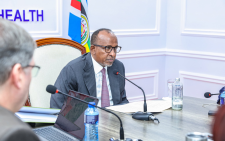

The government confirmed that dedicated isolation and treatment units now operate at Kenyatta National Hospital, the Kenya National Police Hospital, and Moi Teaching and Referral Hospital in Eldoret. Additional sites exist in more than 10 high-risk border counties. Officials say the facilities allow rapid isolation, diagnosis, and coordinated response once any suspected case appears.
Health officials added that the system aims to reduce delays that often worsen outbreaks. The network also links laboratories, emergency teams, and supply chains to ensure quick action across counties.
Partnership with US
A partnership with the United States government also supports the preparedness plan. Kenya plans to establish a similar isolation and monitoring facility at a military installation in Laikipia. According to the Ministry, the arrangement strengthens surveillance, diagnostic capacity, emergency drills, medical supply chains, and response readiness.
The ministry said these investments extend beyond Ebola response and build long-term health security. It highlighted improvements in laboratory systems, workforce readiness, and emergency coordination.
Kenya also pointed to lessons from earlier outbreaks. During the COVID-19 pandemic, a regional emergency facility at Nairobi Hospital supported response efforts across the region. The Ministry said the structure continues to serve local health needs and demonstrates the value of early investment in preparedness.
Ebola plan sparks backlash
Despite these measures, the proposal around Ebola-related facilities has sparked political and public debate.
People’s Liberation Party leader Martha Karua accused the government of prioritising external arrangements over local safety concerns. She said Kenya should not host foreign-linked Ebola quarantine plans while the health system struggles with shortages and funding gaps.
“Protect Kenyans first,” Karua said. “Wenye nchi must come first to be protected, especially now when our health system has been ravaged by Kenya Kwanza’s reckless management of healthcare.”
Karua also questioned national preparedness, citing concerns over staffing levels, medical supplies, and hospital capacity. She linked the debate to broader health reforms, including the transition from NHIF to the Social Health Authority, which she said has not improved service delivery.
“How can Kenyans be asked to trust this government with Ebola preparedness when it cannot account for resources already collected from wenye nchi?” she asked.
Doctors’ concern
Medical professionals also raised concerns. The Kenya Medical Practitioners, Pharmacists and Dentists Union warned that limited intensive care capacity, inconsistent protective equipment, and staffing shortages could weaken outbreak response.
KMPDU Secretary General Davji Atellah urged stronger focus on containment at the source of the outbreak.
“The best way of containment of any outbreak remains the epicentre”, he said, referring to eastern Congo where conflict has complicated response efforts.
Local leaders also expressed reservations. Governors in Nyeri and Laikipia opposed the establishment of an Ebola treatment facility in Laikipia County, citing cross-border movement risks. Some Members of Parliament also demanded wider consultation before implementation of any foreign-linked health arrangement.
The High Court in Nairobi issued temporary orders that block admission of Ebola-infected persons and halt related quarantine arrangements pending determination of a petition. The United States Government confirmed awareness of the case and said it continues engagement with Kenyan authorities.
The Ministry of Health maintains that Kenya remains on high alert and continues to strengthen surveillance at all entry points. Officials say early detection, isolation capacity, and coordinated response remain central to preventing any outbreak from spreading within the country.
Kenya now relies on a layered approach: expanded isolation centres, improved laboratory systems, cross-county response units, and international cooperation. Health officials argue that the system focuses on speed, coordination, and containment before any outbreak gains ground.
The government says the new facilities will remain in place beyond the current Ebola alert and support response to future public health threats.
Author
Kenneth Mwenda
Kenneth Mwenda is a business, sports, and politics digital writer with over seven years of experience in journalism, covering breaking news, feature stories, and in-depth analysis across a range of beats.
For inquiries, he can be reached at [email protected]
View all posts by Kenneth MwendaLatest News






Advertisement
More on News