Advertisement
By-elections undermined by violence, bribery and political interference – ELOG
Wednesday 03rd December, 2025 05:10 PM|

The Elections Observation Group (ELOG) has declared that Kenya’s by-elections held on November 27, 2025, across 22 electoral areas were undermined by widespread violence, voter bribery, and political interference, despite strong technical performance by the Independent Electoral and Boundaries Commission (IEBC).
In its final statement released on December 3, 2025, ELOG consolidated observations from the pre-election period, Election Day, and post-election phase.
The group deployed long-term observers ahead of the polls and 100 roving observers on Election Day to monitor areas including the Baringo County Senate seat, Mbeere North in Embu County, Mumbuni Ward in Machakos County, Purko in Kajiado Central, Narok Town in Narok County, Malava in Kakamega County, Kasipul in Homa Bay County, and Kariobangi North in Nairobi County.
Also watch: Ndindi Nyoro demands accountability over chaos in by-elections
You Might Also Like


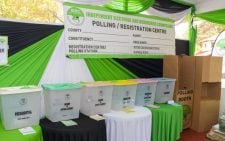
While polling stations generally opened on time, had sufficient materials, and saw KIEMS kits function with minimal issues, ELOG highlighted serious flaws in the broader electoral environment.
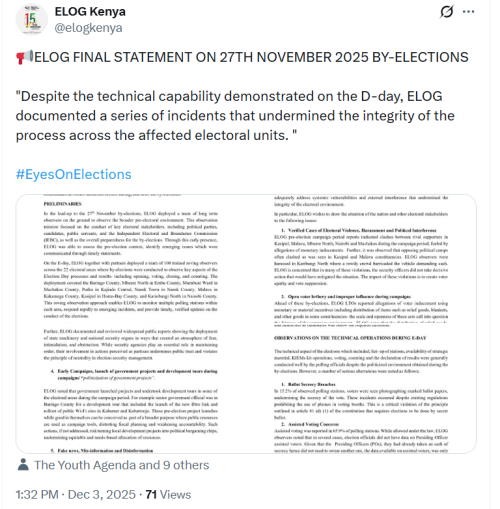
“Despite the technical capability demonstrated on the D-Day, ELOG documented a series of incidents that undermined the integrity of the process across the affected electoral units,” the statement read.
Electoral violence, bribery, and political interference
Clashes between rival supporters occurred in Kasipul, Malava, Mbeere North, Nairobi, and Machakos, often linked to allegations of monetary inducements.
ELOG observers faced harassment in Kariobangi North, where a rowdy crowd barricaded their vehicle, demanding cash. Security officers frequently failed to intervene decisively, contributing to voter apathy and suppression.
Long-term observers reported open distribution of cash, relief goods, blankets, and other items as inducements. These acts violate Article 81 of the Constitution and Section 9 of the Election Offences Act, which prohibit voter bribery and carry penalties including fines and imprisonment.
“While polling stations were generally well-prepared, verified cases of electoral violence, voter inducement, and partisan interference undermined the integrity of the elections.”
Also watch: Former LSK president criticises Malava and Mbeere North by-elections
High-ranking national and county executives, state security officials, and other public officers actively participated in campaigns, tilting the field toward governing parties. This breached the Public Officer Ethics Act and international norms on neutrality. State machinery was deployed in ways that created fear and intimidation.
Government officials launched projects, such as a new fibre link and public Wi-Fi sites in Baringo County, during the campaign period, raising concerns over misuse of public resources for electoral gain.
Media monitoring flagged significant disinformation, with 48% targeting political parties and candidates, including fake opinion polls (41%) and fake documents (37%), while 36% targeted the IEBC, including misinterpretations of voter registration and polling station changes.
Post-poll findings
On Election Day, technical operations ran smoothly, but aberrations included ballot secrecy breaches in 15.2% of stations, with voters photographing marked ballots.
Assisted voting occurred at 65.9% of stations, sometimes compromising secrecy, including one case in which nearly 90% of voters were assisted by presiding officers.
Unauthorised persons, including “super agents” and unaccredited DCI officers, entered polling stations in areas such as Malava, Kasipul, Mbeere North, and Kariobangi North.
ELOG noted limited participation by women, youth, and marginalised groups among the 181 registered candidates. No major post-election incidents were recorded, and losing candidates opted for petitions rather than protests.
ELOG Chairperson Victor Nyongesa signed the statement, emphasising that “the IEBC’s success in logistical and procedural management cannot mask its failure to safeguard the compromised integrity.” The group stressed that elections require both technical soundness and freedom from interference.
Author
Latest News








Advertisement
More on News