Advertisement
Bitter cry of rice farmers battling destructive birds
Tuesday 14th February, 2023 01:30 AM|
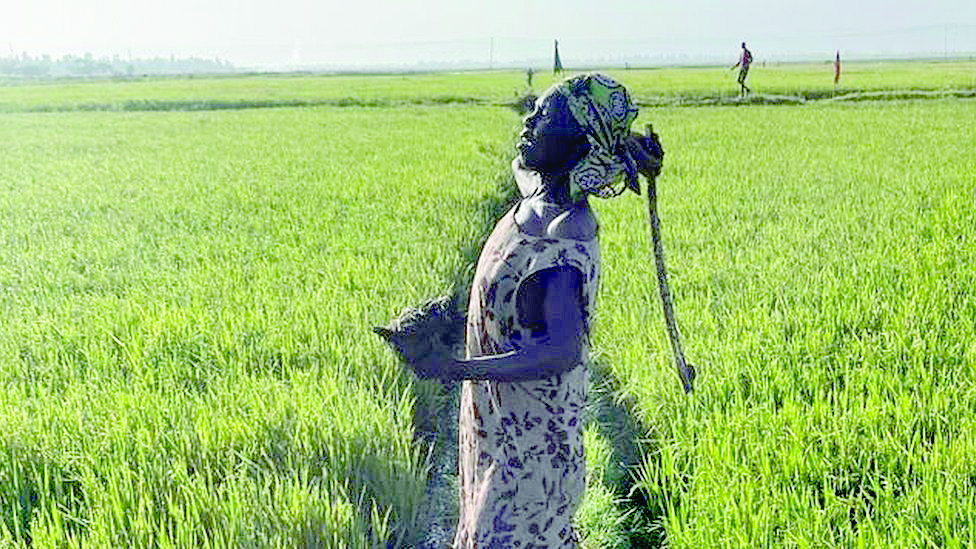
Rose Nekesa’s rice field in western Kenya has been invaded by huge swarms of voracious quelea birds.
Thousands of farmers like her near the lakeside city of Kisumu fear they will reap their worst harvest in five years.
“I’m losing my voice because I spend all day shouting, to chase the red-billed birds away. These birds are not afraid of anything,” she says, holding a huge lump of mud in one hand and a stick in the other.
“They are already used to us and everything we throw at them.”
She pelts the birds with mud to scare them away from her crop. Her small, wiry frame often allows her to run across her paddy field as more swarms descend.
“When there are no birds, I can work alone. Now, I need at least four people to work for me. It was very expensive. We are pleading with the government to intervene. This rice is the only source of income that we have.”
Lawrence Odanga, another small-scale farmer, is also at the mercy of the world’s most populous wild birds. “I can hear them. They are coming to destroy us,” he shouts in his mother tongue, Dholuo.
Impossible task
Even for the five people he has hired to protect every acre of his crop, chasing the birds away is an impossible task.
Scarecrows, the occasional blaring of vuvuzelas and bird traps have all proved ineffective.
“The birds have destroyed nearly all four acres of my farm. I won’t earn anything. How will I take my children to school?”
Sometimes referred to as “feathered locusts”, queleas are considered pests across East and Southern Africa.
An average quelea bird can eat around 10g (0.35 oz) of grain a day. Not a huge amount, but as the flocks can number two million they can collectively consume as much as 20 tonnes of grain in 24 hours.
In 2021, the UN’s Food and Agricultural Organisation (FAO) estimated that $50m (about Sh6 billion) worth of crops was lost to the birds annually, mostly in sub-Saharan Africa.
The latest quelea invasion in Kisumu, amounting to some 10 million birds, has already decimated 300 acres of rice fields. According to the county government, another 2,000 acres are still at risk during the harvest season.
Other parts of the country have also been hit. Millions of the birds invaded wheat farms in southern Narok county, destroying an estimated 40 per cent of the harvest.
Climate change
The prolonged drought in the Horn of Africa, which has meant fewer seeds from wild grasses, a primary source of food for queleas, may be behind the invasion of cultivated land as the birds look for an alternative, some Kenyan scientists have suggested.
Paul Gacheru, from the environmental organisation Nature Kenya, however, argues that climate change-induced drought is not the main driver.
He points the finger at land-use changes as “intensive farming and settlement mean that we are losing space for natural vegetation to grow. The quelea species are adapting to the current land use”.
Increased cereal crop production throughout Africa may have also increased the quelea populations, as there is a larger source of food for their super-nomadic populations.
Added to this is the fact that the birds breed very fast — three times a year with as many as nine chicks — allowing for a huge explosion in the population.
As mud, sticks and vuvuzelas have not worked to protect the crops, the authorities have turned to a mass cull through chemical spraying.
In 2019, the Kenyan government is thought to have killed eight million quelea which had invaded the Mwea Irrigation Scheme, the country’s largest rice-growing project.
Another two million were killed at Mwea in the same way last year.
This year the authorities in Kisumu began an aerial control operation aimed at killing at least six million birds. Drones are used to target the birds’ roosting grounds, where they rest and breed, with the pesticide fenthion.
Ken Onyango, in charge of agriculture in Kisumu County, said chemical spraying was the only way to save the rice fields at risk.
Fenthion is highly toxic to other species, which are not the main target. As a result, environmental scientists and animal group activists are warning that the spraying will have severe consequences on the ecosystem, other plant and animal species, as well as human health.
“The question is, how do you plan to coexist with the birds? Because you can’t kill everything, so that human beings remain,” argues Raphael Kapiyo, a professor of environment and earth science at Maseno University.
“But more than that, we are saying the act of controlling the birds with chemicals is dangerous.”
The professor wants more traditional, environmentally friendly methods — such as scaring or trapping and eating the birds — to be employed instead.
Chemical spraying, he feels, just offers an easy way out. The alternatives, though, are seen as expensive and time-consuming.
Procedures followed
Onyango, who oversees the Kisumu spraying operation, says the correct procedures were followed and approved by the National Environment Management Authority.
“We cannot be so careless as to carry out anything that has any adverse environmental impact,” he adds.
Collins Marangu, director of crop protection services, acknowledges that killing the birds is not desirable but says it is necessary.
“What we are doing is precision agriculture,” he says. “We spray the roosting grounds at night, precisely where the birds are. After that, we collect and burn them.” Two out of the three roosts have been sprayed.
But whatever method is used, for the farmers affected, the control measures have come too late as some of the crops has already been eaten. Harvests are down by more than half.
Those near Kisumu say that queleas are still causing a problem.
Rice farmer Rose Nekesa is bracing for the worst. She had hoped she would harvest at least 50 bags of rice during this season. Now she expects to gather only 30.
“We just want the government to take these birds away,” she says in desperation.
Author
Latest News







Advertisement
More on News