Anti-corruption group demands action after EACC seizes Ksh65.3M from Nairobi official
By Kenneth Mwenda, June 9, 2026The National Integrity Alliance (NIA) has called for swift prosecution, asset recovery, and full enforcement of anti-corruption laws following a major raid by the Ethics and Anti-Corruption Commission (EACC) at the home of a senior Nairobi County official.
The raid, conducted on June 4, 2026, targeted the residence of Patrick Analo Akivaga, the now-suspended chief officer for urban development and planning at the Nairobi City County Government. Investigators reportedly recovered Ksh65.3 million in cash alongside key documents believed to be linked to corruption and unexplained wealth.
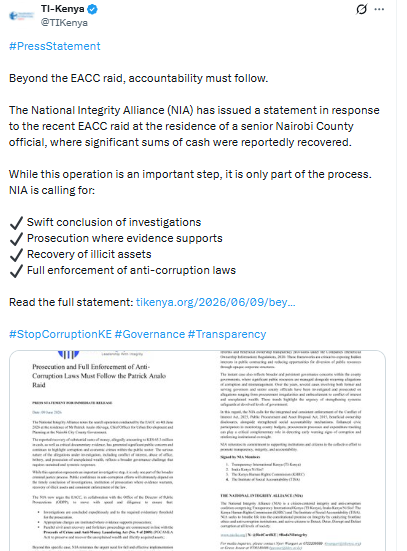
In a statement released on June 9, 2026, the National Integrity Alliance (Transparency International Kenya, Kenya Human Rights Commission, The Institute of Social Accountability, and Inuka Kenya Ni Sisi!) said the operation marked an important step, but not the end of the process.
“The reported recovery of substantial sums of money, allegedly amounting to Ksh65.3 million in cash, as well as critical documentary evidence, has generated significant public concern and continues to highlight corruption and economic crimes within the public sector,” the NIA said.
The alliance warned that public trust in anti-corruption efforts depends on what happens next, not just the raid itself. It urged both the EACC and the Office of the Director of Public Prosecutions (Office of the Director of Public Prosecutions) to move quickly and decisively.
NIA called for investigations to be completed without delay and to the required evidentiary standard. It also demanded that authorities file charges where evidence supports prosecution and begin asset recovery proceedings under the law.
The group specifically cited the need to apply the Proceeds of Crime and Anti-Money Laundering Act (Proceeds of Crime and Anti-Money Laundering Act (POCAMLA)), saying it should be used to preserve and recover unexplained wealth.
It also urged stronger use of the Conflict of Interest Act, 2025 (Conflict of Interest Act 2025), including lifestyle audits for public officials. According to NIA, weak enforcement of conflict-of-interest rules continues to allow corruption to thrive in public institutions.
“If effectively implemented, these tools would significantly enhance the ability of oversight institutions to detect and disrupt corruption pathways, especially those linked to procurement fraud, kickbacks, bribery and abuse of office,” the statement reads.
Calls for system reform
Beyond the Analo case, NIA raised concern about long-standing governance failures in county governments. It said corruption claims involving procurement fraud, embezzlement, and unexplained wealth have repeatedly surfaced among senior county officials.
The alliance also pushed for full implementation of procurement reforms and beneficial ownership transparency rules. It argued that hidden company ownership structures continue to allow public funds to be diverted through opaque contracts.
In Nairobi, the case has renewed debate about how planning and development decisions are made. The urban development department controls approvals that affect land use, construction, and investment worth billions of shillings.
Weak oversight at the county level affects service delivery. In some areas, citizens link poor infrastructure and delayed services to mismanagement of public funds. These concerns are also felt far beyond Nairobi.
NIA said stronger civic participation could help close corruption gaps. It urged citizens to take a more active role in monitoring county budgets, procurement processes, and public spending.
“Enhanced civic participation in monitoring county budgets, procurement processes and expenditure tracking can play a critical complementary role in detecting early warning signs of corruption and reinforcing institutional oversight,” the alliance said.
The group reaffirmed its commitment to support transparency and accountability across public institutions. It said Kenya needs consistent enforcement of existing laws rather than repeated policy announcements.