Advertisement
Africa urged to own AI future or risk digital dependence by 2030
Thursday 30th April, 2026 11:06 PM|

The State Department of Foreign Affairs has warned that Africa is entering a critical decade where decisions on artificial intelligence and digital systems will determine the continent’s long-term economic strength, jobs, and global influence.
In a statement shared on Thursday, April 30, 2026, the department noted that Africa’s rapidly growing youth population will shape global labour markets, making technology choices even more important for future competitiveness.
The department explained that the continent must now shift focus from simply adopting foreign technology to building its own systems, especially in areas like data management, infrastructure, and governance frameworks.
The department stressed concerns that relying heavily on external AI tools could limit Africa’s independence, especially if local systems and institutions are not strengthened in time.
You Might Also Like



“By 2030, Africa will be home to the world’s largest working-age population. The decisions made in the coming years on Artificial Intelligence and digital technologies will be consequential for the continent’s economic trajectory and global positioning,” the statement reads.
Digital sovereignty
The department further explained that discussions under the Africa Forward Summit 2026 are designed to push African countries to think beyond technology consumption and instead focus on building digital sovereignty across the continent.
The summit encouraged governments and institutions to understand the difference between using imported AI systems and developing homegrown digital ecosystems that reflect Africa’s needs and realities.
“The Africa Forward Summit 2026 addresses this directly, advancing the conversation from technology adoption to Digital Sovereignty; recognising the fundamental distinction between deploying AI tools developed elsewhere and building the infrastructure, data governance frameworks, and institutional capacity that underpin genuine digital independence,” the statement reads.
The statement further pointed out that artificial intelligence could be used to solve key development challenges facing Africa, especially in agriculture, energy distribution, and climate-related risks that continue to affect livelihoods across many countries.
It also stressed that AI governance systems must reflect Africa’s diversity, including its many languages, legal systems, and social structures to ensure fairness and inclusivity in digital transformation.
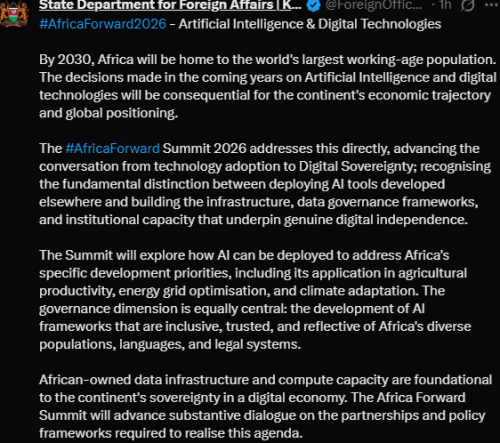
“The Summit will explore how AI can be deployed to address Africa’s specific development priorities, including its application in agricultural productivity, energy grid optimisation, and climate adaptation. The governance dimension is equally central: the development of AI frameworks that are inclusive, trusted, and reflective of Africa’s diverse populations, languages, and legal systems,” the statement reads.
The department added that Africa cannot achieve digital independence without investing in its own data infrastructure and computing capacity, warning that reliance on external systems could weaken long-term sovereignty in the digital economy.
“African-owned data infrastructure and compute capacity are foundational to the continent’s sovereignty in a digital economy. The Africa Forward Summit will advance substantive dialogue on the partnerships and policy frameworks required to realise this agenda,” the statement reads.
Foreign affairs department concluded that the success of Africa’s digital future will depend on how quickly governments act on building strong institutions, partnerships, and policies that support local innovation and technological independence.
Author
Latest News








Advertisement
More on News