Advertisement
One glass too many: Alcohol’s hidden threat to breast cancer
Friday 31st October, 2025 12:53 PM|

In the realm of lifestyle choices that influence health outcomes, few carry the subtle yet profound impact of alcohol consumption on breast cancer risk.
The connection is not shrouded in mystery but backed by consistent evidence from global health authorities. Even moderate drinking emerges as a modifiable factor that can tip the scales toward increased vulnerability, particularly for women.
This reality underscores a critical public health message: the glass poured in relaxation or celebration may harbour an unseen risk.
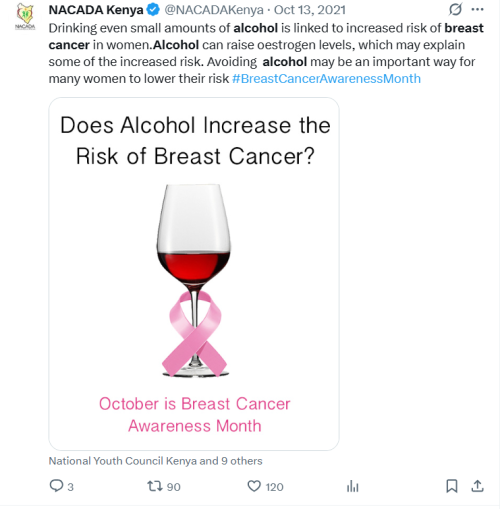
“Drinking even small amounts of alcohol is linked to increased risk of breast cancer in women. Alcohol can raise oestrogen levels, which may explain some of the increased risk. Avoiding alcohol may be an important way for many women to lower their risk,” a post from NACADA on X states.
You Might Also Like



Ethanol, the active component in alcoholic beverages, is converted into acetaldehyde, a compound that can damage DNA and promote cell proliferation. More directly, it elevates circulating estrogen, a hormone intricately tied to the development of certain breast cancers.
For hormone-receptor-positive tumours, which constitute the majority of cases, this elevation acts as fuel, accelerating growth in susceptible tissues.
Alcohol among key lifestyle risk factors
The World Health Organisation identifies alcohol intake among four key factors that can increase the chances of breast cancer.
The others include obesity in postmenopausal women, lack of physical activity, and not breastfeeding after childbirth. Yet, alcohol stands out for its widespread social acceptance and accessibility.
The infographic from the World Health Organisation further notes: “4 factors which can increase the chances of breast cancer. However, about 50% of breast cancers occur in women with no identifiable risk factors beyond age and gender. Obesity in postmenopausal women. Lack of physical activity, not breastfeeding after childbirth, and Alcohol intake. World Health Organisation.”
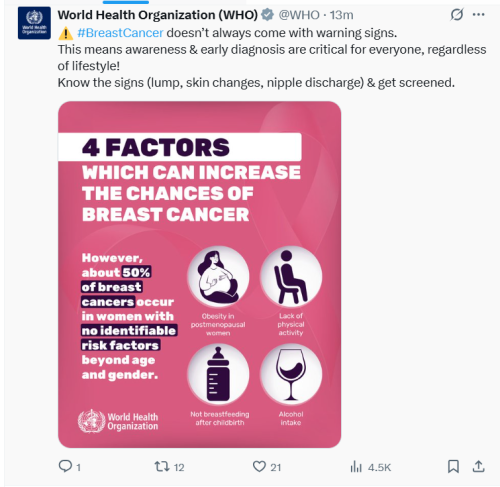
This statistic highlights a sobering truth—half of all diagnoses defy predictable patterns, occurring without additional red flags. In the remaining cases, lifestyle elements like alcohol consumption offer a tangible lever for risk reduction.
Epidemiological data reinforce this linkage. Meta-analyses pooling dozens of studies estimate that each additional 10 grams of alcohol consumed daily, roughly equivalent to one standard drink, raises breast cancer risk by 7 to 10 per cent.
This dose-response relationship holds across beer, wine, and spirits, dispelling notions that certain types confer protection. Over time, cumulative exposure amplifies cellular changes that may culminate in malignancy years later.
Beyond hormones, alcohol impairs folate metabolism, a nutrient essential for DNA repair, and induces oxidative stress, generating free radicals that inflict further cellular damage. In breast tissue, these processes converge to heighten susceptibility, particularly in the dense glandular structures more prevalent in younger women.
Prevention through awareness and action
The World Health Organisation emphasises vigilance in another post: “Breast cancer doesn’t always come with warning signs. This means awareness & early diagnosis are critical for everyone, regardless of lifestyle! Know the signs (lump, skin changes, nipple discharge) & get screened,” WHO X post.
While screening remains paramount, prevention through lifestyle modification addresses the root. Abstinence or strict moderation emerges not as deprivation but as empowerment, especially when half of the cases lack other identifiers.
Public health frameworks classify alcohol as a Group 1 carcinogen, placing it alongside tobacco and asbestos in terms of evidence for human cancer causation. Guidelines recommend limiting intake to no more than one drink per day for women, but emerging data suggest that zero consumption yields the lowest risk profile.
Behavioural shifts require awareness, not alarm. Replacing alcoholic beverages with non-alcoholic alternatives maintains social rituals without the hazard. Physical activity, postmenopausal weight management, and breastfeeding further bolster defences, creating a synergistic shield.
The narrative around alcohol often romanticises its role in culture, but health imperatives demand a recalibration. Risk reduction is incremental; eliminating one factor, like regular drinking, can meaningfully alter probabilities.
For those with a family history or genetic predispositions, this choice amplifies other preventive measures.
Embracing sobriety or minimal intake represents a proactive step, aligning daily habits with long-term well-being. Awareness, coupled with action, transforms statistics into actionable insight, potentially sparing countless women from a preventable burden.
Author
Latest News








Advertisement
More on Lifestyle