Advertisement
Why the IMF plans staff visit to Kenya in January
Thursday 11th December, 2025 09:13 AM|
Kenya is preparing for an International Monetary Fund (IMF) staff visit in January 2026 as discussions continue over a potential new funded programme.
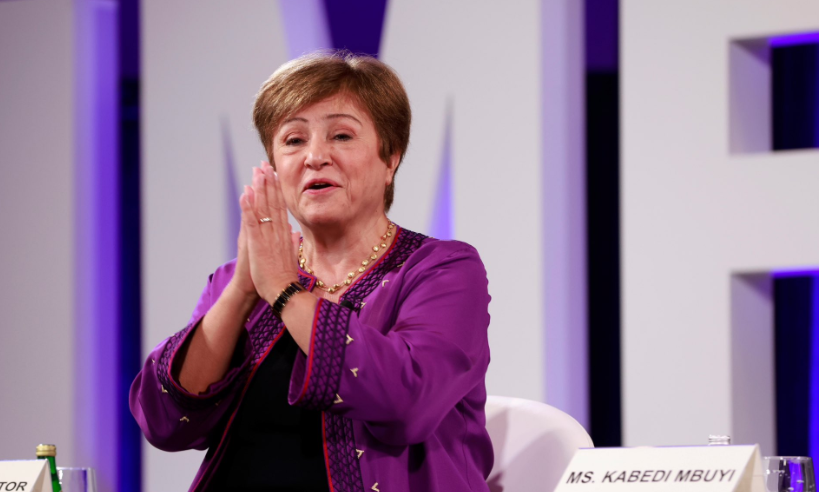
The visit comes after President William Ruto met IMF Managing Director Kristalina Georgieva in Washington, D.C., to discuss Nairobi’s ongoing efforts to stabilise public finances and strengthen external payments.
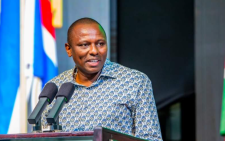
Central Bank of Kenya (CBK) Governor Kamau Thugge confirmed the timing during the Monetary Policy Committee (MPC) press briefing on December 10, 2025.
“We continue to have discussions with the IMF on getting a new funded programme. The President met with the Managing Director of the fund last week, and we do expect a staff visit from the fund sometime in January to continue the discussions,” he said.
You Might Also Like


The upcoming mission follows an earlier IMF staff visit that ran from September 25 to October 9, 2025. The team, led by mission chief Haimanot Teferra, met government officials to assess the economic situation and lay the groundwork for potential negotiations.
During that visit, the IMF reviewed Kenya’s macroeconomic developments and discussed reforms that could support a new programme.
A major issue under discussion is how Nairobi accounts for securitised revenue in its public liabilities. The government has used special-purpose vehicles (SPVs) to pay contractors and other creditors.
The IMF treats these securitisations as sovereign debt, while the Treasury argues that selling the rights to an SPV removes the risk from government accounts.
“Our position as the government is that once you sell a right to a special-purpose vehicle (SPV), then there is no risk to the government at all,” Treasury Cabinet Secretary John Mbadi explained.
IMF deal
This debate matters because it influences Kenya’s reported liabilities and determines the size of any IMF programme for which the country may qualify. The CBK notes that, under IMF rules, Kenya could access about Ksh64.8 billion ($501.4 million) under normal access limits as at the end of June 2025. Prior drawdowns have already reduced available headroom.
Officials from both the Treasury and CBK have suggested that Kenya may need to make paydowns or engage in liability management to create space for new resources. Not all government advisers agree on the need for a fresh IMF programme.
David Ndii, chairperson of the Presidential Council of Economic Advisors, has publicly questioned whether a new deal is necessary, arguing that Kenya should explore deeper engagement with capital markets as it moves toward upper-middle-income status.
Economists say that a new IMF programme, if it involves lending, would provide two main benefits. First, it would unlock immediate financing to meet external obligations. Second, it would provide a structured framework for fiscal consolidation and long-term fiscal sustainability.
Conditionality would remain a key factor, with the IMF expecting clear revenue mobilisation measures and transparent accounting for liabilities.
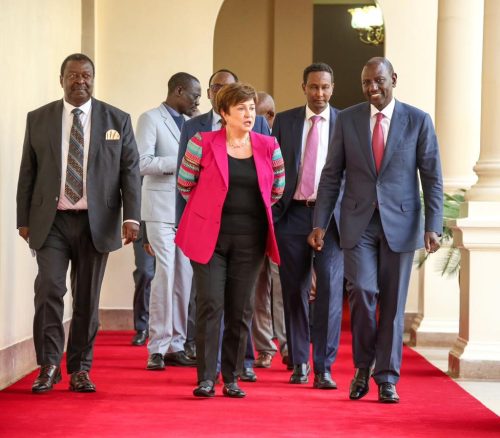
President Ruto and his team have signalled their commitment to working with the IMF. In Washington, D.C., the President described discussions with Georgieva as productive, highlighting a shared interest in transparency, mutual understanding, and sound economic governance.
A successful negotiation would give Nairobi breathing room to meet its obligations while demonstrating credibility to international creditors and local stakeholders.
Author
Kenneth Mwenda
Kenneth Mwenda is a business, sports, and politics digital writer with over seven years of experience in journalism, covering breaking news, feature stories, and in-depth analysis across a range of beats.
For inquiries, he can be reached at [email protected]
View all posts by Kenneth MwendaLatest News




Advertisement
More on Insights