Advertisement
Kenya shilling steady as demand for govt securities surges
Sunday 21st June, 2026 07:29 AM|

The Kenyan shilling remained stable during the week ending June 18, 2026, trading at Ksh129.55 against the US dollar, compared to Ksh129.48 the previous week, according to the Central Bank of Kenya Weekly Bulletin released on June 19, 2026.
The currency held steady against other major international and regional currencies, reflecting balanced demand and supply in the foreign exchange market.
Foreign exchange reserves stood at Ksh1.94 trillion, providing 5.6 months of import cover, above the statutory minimum of four months. The Central Bank of Kenya noted that this buffer continues to support exchange rate stability and external sector resilience.
Remittance inflows, a key source of foreign exchange, totalled Ksh58.2 billion in May 2026, a 0.9 per cent decline from the previous month. The 12-month cumulative inflows eased slightly to Ksh 738.2 billion (USD 5,008 million), but continued to provide steady external support.
You Might Also Like



“The Kenya Shilling remained stable against major international and regional currencies during the week ending June 18, 2026. It exchanged at Ksh 129.55 per U.S. dollar on June 18, compared to Ksh 129.48 on June 11,” read the CBK bulletin in part.
Money market remains liquid
The domestic money market remained liquid during the week, with commercial banks holding average excess reserves of Ksh28.0 billion above the 3.25 per cent cash reserve requirement. The Kenya Shilling Overnight Interbank Average Rate (KESONIA) remained stable at 8.75 per cent, aligned with the Central Bank Rate.
“The Kenya Shilling Overnight Interbank Average Rate (KESONIA) remained unchanged at 8.75 per cent on June 18, the same level recorded on June 11. During the week, the average number of interbank transactions reduced to 15 from 25 in the previous week, while the average value traded also declined to Ksh 5.6 billion from Ksh 11.0 billion in the previous week.”
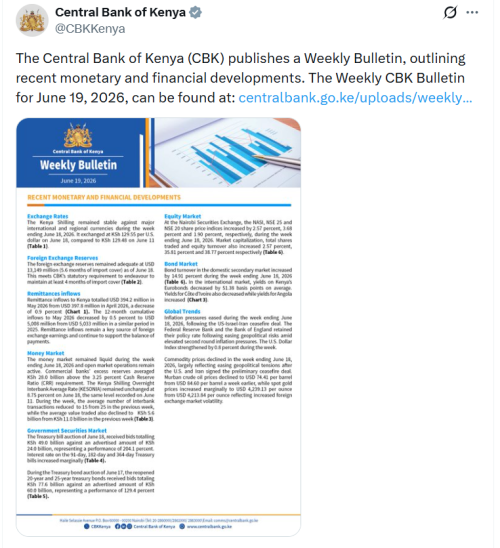
Interbank activity moderated, with average transactions declining to 15 from 25, while the value traded fell to Ksh5.6 billion from Ksh11.0 billion. Despite the slowdown, liquidity conditions were supported through open market operations, ensuring smooth market functioning.
Government securities attract strong demand
Investor demand for government securities remained strong, with the June 18 Treasury bill auction receiving bids worth Ksh49 billion against an offer of Ksh24 billion, translating to a subscription rate of 204.1 per cent.
Slight increases were recorded in yields for the 91-day, 182-day, and 364-day papers.
A separate Treasury bond auction for reopened 20-year and 25-year bonds attracted bids worth Ksh77.6 billion against an offer of Ksh60 billion, achieving a subscription rate of 129.4 per cent.
The strong performance reflected continued appetite for long-term, high-yield government instruments.
Equity markets also recorded gains, with the Nairobi Securities Exchange All Share Index (NASI) rising 2.57 per cent, the NSE 25 index increasing 3.68 per cent, and the NSE 20 index gaining 1.90 per cent. Market capitalisation, trading volumes, and turnover all improved during the week.
Secondary bond market turnover increased by 14.91 per cent, while Kenya’s Eurobond yields declined by an average of 51.38 basis points, indicating improved investor sentiment.
Globally, easing inflation pressures followed the US-Israel-Iran ceasefire, with commodity prices, including oil, retreating during the period.
Author
Latest News







Advertisement
More on Business