Advertisement
Why improved diaspora remittances could influence constituencies’ review ahead of 2027
Tuesday 06th January, 2026 01:54 PM|

Better diaspora remittances are part of the reason the Diaspora Bicameral Parliamentary Framework (DBPF) Caucus is pushing for the Independent Electoral and Boundaries Commission (IEBC) to carry out a constituency boundary review and integrate 15 diaspora constituencies ahead of the 2027 general election.
In their fresh push, beyond constitutional compliance, diaspora representation offers Kenya significant economic and strategic benefits. Diaspora remittances already exceed Ksh1 trillion annually, making them Kenya’s most stable source of foreign exchange.
Structured representation
The caucus, led by Chairman Ephraim Mwaura, adds that with structured representation and inclusive policies, these remittances could realistically triple within a decade, reaching Ksh3 trillion annually.
In the last two years, about 400,000 workers have migrated abroad for work to join millions of other Kenyans living and working abroad. This reinforces the need to fully enfranchisement diaspora voters who lack representation.

You Might Also Like



Greater diaspora engagement would attract increased investment in real estate, manufacturing, technology, and Small and Medium Enterprises (SMEs), while accelerating skills transfer and global partnerships. Representation would also strengthen Kenya’s international influence, enhance bilateral trade, and create a more resilient economy less dependent on external borrowing.
It argues that continued delay risks prolonging the political exclusion of millions of Kenyans living abroad.
”Establishing diaspora constituencies would allow voters to be reassigned to polling stations within their regions of residence, ensuring meaningful and equitable participation. For this to happen, the boundary review should be conducted promptly, completed transparently, and gazetted well ahead of the 2027 General Election,” a statement from the caucus reads.
Diaspora not well represented
It further maintains that Kenya’s last boundary review, conducted in 2012, left diaspora voters outside the country’s representative framework despite clear constitutional provisions mandating their progressive inclusion.

Although the most recent review window has passed, the group insists that the Constitution, particularly Article 89, still empowers the IEBC to act to safeguard the principle of equality of the vote.
According to the DBPF Caucus, the proposed 15 diaspora constituencies can be accommodated within the existing 290 National Assembly seats through administrative reconfiguration, without expanding the size of Parliament.
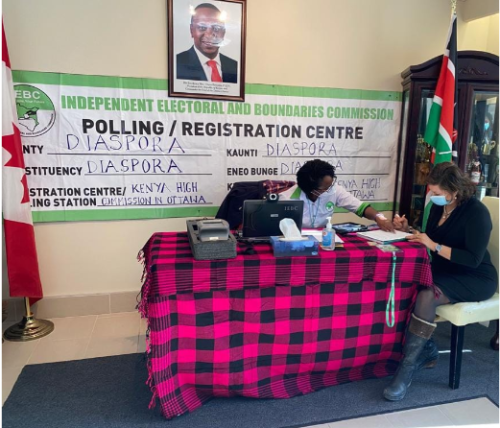
The group argues that such an approach would uphold constitutional limits while finally extending full political representation to citizens residing outside Kenya.
While Article 82(1)(e) anticipated gradual expansion of voter registration and participation for Kenyans abroad, the Caucus notes that progress has remained limited more than a decade after promulgation of the Constitution.
Party appointments
DBPF Caucus further notes that diaspora inclusion cannot be achieved through party appointments or discretionary nominations. It argues that appointments are inherently dependent on internal party dynamics, regional balancing, coalition negotiations, and political patronage considerations that have little to do with diaspora priorities.
”As a result, diaspora voices are often overshadowed by domestic political interests competing for the same limited nomination slots. Appointees, however well-intentioned, are not elected by diaspora citizens and therefore cannot claim a direct mandate from them,”
”Guaranteed representation through constitutionally recognised diaspora constituencies is the only mechanism that ensures accountability, legitimacy, and continuity. It provides diaspora citizens with a stable, predictable, and democratic channel of representation that does not fluctuate with party politics or internal power arrangements,” the statement adds.
Meanwhile, as preparations for the 2027 General Election gather pace, the DBPF Caucus continues to press for a timely, transparent, and inclusive boundary review process, warning that failure to act risks entrenching a cycle of disenfranchisement that diaspora citizens have endured for more than a decade.
Author
Latest News






Advertisement
More on Insights