Advertisement
Security spending or political instrument? Unpacking Ksh60B interior ministry boost in supplementary budget
Friday 17th April, 2026 08:12 AM|

The Supplementary Appropriation Act, 2026, signed into law on April 8, 2026, increases Kenya’s total 2025/2026 expenditure by Ksh393 billion to KSh4.69 trillion, up from Ksh4.3 trillion.
This revised budget addresses urgent priorities, focusing heavily on security (Ksh60B), education (Ksh45.28B), affordable housing (Ksh25B), and agriculture (Ksh18B), including subsidies.
This supplementary budget of Kenya has left the Ministry of Interior and National Administration in the midst of political and financial arguments, now that it was awarded an extra budget of over Ksh60 billion.
Although the government justifies the rise by arguing that it is needed to enhance national security operations, the mounting criticism is that the expenditure could be a manifestation of more political choices, financial inefficiencies and unclear governance issues.
You Might Also Like
The timing and the magnitude of the distribution have stirred controversies at a time when Kenya is faced with economic pressure, popular discontent, and an escalation of the political competition before the 2027 general election cycle.
The explanation of why security funding should be increased is uncomfortable in light of the history of corruption in the enforcement agencies in Kenya. The Ethics and Anti-Corruption Commission reports have consistently indicated that bribery is among the most frequently reported cases of corruption in the public service, and a relatively large number of them have been connected with law enforcement activities.
Meanwhile, independent oversight agencies like the Independent Policing Oversight Authority still look into complaints of police misconduct, including but not limited to power abuse, corruption and the use of force. These incidences of recurrence have strengthened the notion among the populace that corruption in the security sector is not a one-off case but a system.
The responsibility gap also shows in the results of the Office of the Auditor-General, which has been continuously pointing out the irregular procurement, unjustified spending and poor internal controls within government institutions. ]
These weaknesses are especially worrying in a sector in which a large portion of the expenditures fall under the classification of security-sensitive areas, which restricts openness and outside oversight.
Teargas politics and question of neutrality
In addition to the financial issues, another twist to the increased budget of the Interior Ministry has been presented by the current political situation in Kenya.
Opposition-linked rallies have been interrupted by tear gas-firing police, often scattering crowds and disrupting political rallies in recent months. Crowd control measures have been repeatedly used in opposition-related events in places like Kitengela and Kikuyu, with instances of uncontrolled crowds and allegations of excessive force.
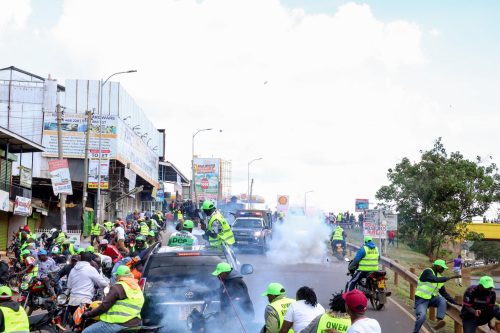
Such developments have increased the criticisms by opposition personalities and civil society members that parts of the police could be performing in a partisan fashion.
Although the government refutes these allegations, with the government insisting that police are acting in response to security threats and illegal gatherings, the trend of constant disruptions has raised the suspicion that policing is becoming more and more politicised.
Weak accountability, fiscal expansion
The main issue is not whether Kenya should fund security or not; it should, but whether more funding is being accompanied by more accountability measures.
By construction, supplementary budgets are supposed to be used during emergencies and unexpected expenses.
Numerous of the expenditures currently being funded under the Interior docket, such as operational improvements and equipment upgrades, are, however, generally perceived as routine and predictable.
This raises issues that the process addition is being applied to more and more, to avoid further budget examination.
Political forecast before 2027
Perhaps the most sensitive aspect of the debate is the fact that security expenditure is turning into a politically responsive area and not an administrative one.
As the level of opposition mobilisation is rising and the number of public protests is rising, the augmented Interior Ministry budget is now being seen by critics as part of a larger plan to enhance internal security capacity in the foreground of a politically charged electoral cycle.
This story has been only enhanced by the recurrent application of tear gas in the breaking up of opposition rallies, which have fuelled the fears of the politicisation of policing.
Although there is no official confession to this, the combination of more funding, more political involvement, and more violent crowd-control methods has caused the perception to be hard to ignore.
Author
Latest News


Advertisement
More on Insights