Advertisement
Locked out of Africa’s future: How the assistive technology gap is costing the continent its young talent
Monday 08th June, 2026 01:47 PM|
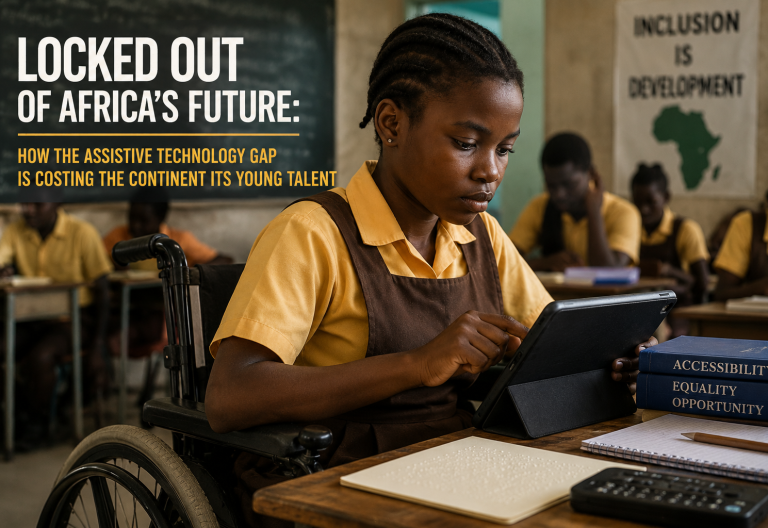
Across Africa, a silent economic crisis is unfolding not in stock markets or government budgets, but in classrooms, workplaces and communities where millions of young people with disabilities remain excluded from opportunities because they lack access to basic assistive technologies.
For many, the inability to obtain a wheelchair, hearing aid, screen reader, or Braille device means far more than inconvenience. It can determine whether they attend school, secure employment, start a business or participate in an increasingly digital economy.
The consequence is not only personal hardship. It is a growing loss of talent, productivity, and economic potential for a continent striving to harness the power of its youthful population.
New findings from the Assistive Technology Landscape in Africa Report, commissioned by the Mastercard Foundation, reveal that only one in ten Africans who need assistive technology can access it. The report, launched during the Inclusive Africa Conference in Nairobi, paints a picture of a continent where disability inclusion policies are expanding, but practical access remains painfully limited.
You Might Also Like



The findings expose a gap that experts say is denying millions of young people opportunities to learn, work and contribute to national development.
“Our goal is to ensure that we can unlock the assistive technology market across the continent, ensuring that young people remain at the center of that conversation so that young people have access to the assistive technology that they need to access education, access jobs, access economic opportunities and promote inclusive growth for African nations,” said Olusola Owonikoko, Inclusion Lead at Mastercard Foundation.
According to Owonikoko, the challenge extends beyond disability rights and has become an economic issue affecting entire countries.
“We already know that many young people with disabilities who need assistive technology across the continent do not have it and, as a result, they are excluded from education and economic opportunities. Countries across the continent lose a significant part of their GDP because of that,” he said.
The report suggests that Africa’s assistive technology challenge is not simply about a shortage of devices. Rather, it reflects deeper structural weaknesses within the continent’s disability inclusion ecosystem.
Researchers found that while many African countries have enacted policies supporting persons with disabilities, implementation remains inconsistent. Funding shortages, weak coordination among stakeholders and limited service delivery continue to hinder progress.
“We also know there’s a lot of policy gap, not just because there are no policies, but implementation of those policies is critical,” Owonikoko said.
Africa’s assistive tech gap
The study further reveals that Africa remains heavily dependent on imported assistive technologies. Most wheelchairs, hearing aids, prosthetics and digital accessibility tools used on the continent are manufactured abroad.
That dependence has consequences. Beyond increasing costs, it limits local innovation, job creation and manufacturing opportunities that could emerge from a stronger domestic assistive technology industry.
“Most of the assistive technologies that we use are imported into Africa, and that speaks a lot because there is a whole lot of value along that value chain,” Owonikoko observed.
The research also highlights a troubling reality: access remains the exception rather than the norm.
Professor Quinette Louw of Stellenbosch University said the study found that only one in ten people who require assistive technology can access it.
“We have found that only one in ten people have access to the assistive technology they need,” she said.
Yet obtaining a device does not always guarantee success.
The report found that many young people are unaware of available assistive technologies. Others receive devices but lack the training, maintenance and support services necessary to use them effectively.
As a result, many abandon the technologies altogether.
“Many young people abandoned the assistive technology because of a mismatch between the assistive technology given to them and their specific need,” Louw explained.
In some countries, nearly 90 per cent of assistive devices are donated, making it difficult to match products with users’ individual needs. Affordability remains another major obstacle.
According to Luigia Nicholas of Stellenbosch University, many young people with disabilities simply cannot afford the technologies that could improve their lives.
“The affordability of assistive devices is out of a lot of young people’s reach because out-of-pocket payment is one of the biggest barriers to young people with disabilities obtaining an assistive device,” she said.
Many users, she noted, rely on family support, loans, or personal savings to acquire devices.
The report argues that closing Africa’s assistive technology gap will require more than policy declarations. It will demand investment in local manufacturing, stronger financing mechanisms, increased awareness, and better support services.
For millions of young Africans with disabilities, access to assistive technology is not merely about mobility or communication. It is about access to opportunity itself. And for a continent banking on its youth to drive future growth, leaving that potential untapped may prove far more costly than investing in inclusion.
Author
Latest News








Advertisement
More on Insights