Advertisement
Key facts about Chagas disease, responsible for up to 10,000 deaths annually
Tuesday 14th April, 2026 12:16 PM|

Chagas disease is caused by the infection of a protozoan parasite (Trypanosoma cruzi). However, this condition is the result of a complex health problem typical of neglected tropical diseases and socially- and environmentally-determined diseases.
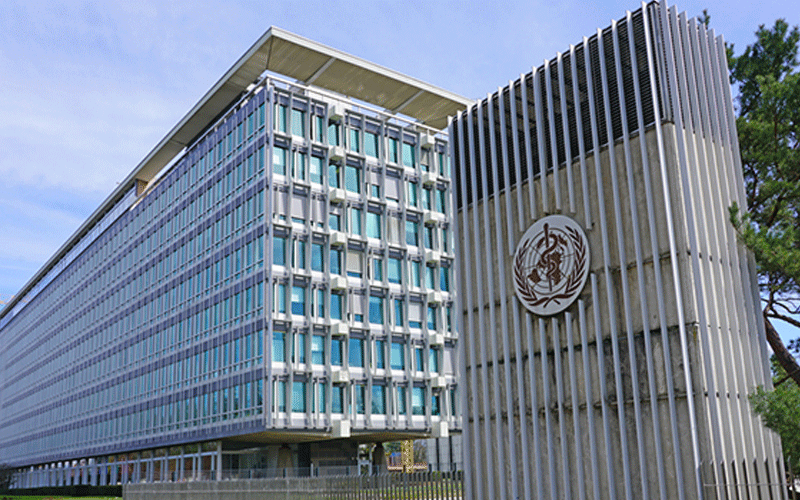
In a report by the World Health Organisation on Tuesday, April 14, 2026, the WHO has explained that the symptoms of Chagas disease are most often non-existent or mild and nonspecific.
WHO says that a missed or late diagnosis with absent or incomplete treatment and follow-up can transform this infection into a life-threatening condition.
“Approximately 8 million people worldwide are estimated to be infected with T. cruzi, leading to more than 10 000 deaths every year, and more than 100 million people are considered at risk of infection,” WHO stated.
You Might Also Like

Although a condition of increasing global presence, WHO notes that Chagas disease is found mainly in endemic areas of 21 continental Latin American countries, where transmission has been largely related to the presence of the insect vector.
In recent years, congenital transmission became the main route for transmission worldwide, with over 10 000 new cases annually.
Distribution
Chagas disease was once entirely confined to the rural areas of the Americas. Due to socioenvironmental changes and increased population mobility, most infected people now live in urban settings, and the infection has been detected in 44 countries, including Canada, the United States of America, and many European and some Western Pacific, African and Eastern Mediterranean countries.
Transmission
WHO states that the T. cruzi parasites have been mainly transmitted by contact with faeces/urine of infected blood-sucking triatomine bugs. These bugs typically live in the wall or roof cracks of homes and surrounding structures, such as chicken coops, pens and warehouses, in rural or suburban areas.
Normally they hide during the day and become active at night when they feed on animal and human blood. They usually bite an exposed area of skin, such as the face, and defecate or urinate close to the bite.
The parasites enter the body when the person instinctively smears the bug’s dejections into the itching bite, other skin breaks, the eyes or the mouth. Infection can also happen by consumption of food or beverages contaminated with T. cruzi through, for example, contact with dejections of infected triatomine bugs or common opossums; this kind of transmission typically causes outbreaks. T. cruzi can also infect a variety of mammals – wild reservoirs of infection, with opossums being one of the most important ones.
T. cruzi can also be transmitted all over the world:
- during pregnancy or childbirth;
- through blood or blood product transfusion;
- through transplants of some organs (such as heart or kidney); and
- through laboratory accidents.
Signs and symptoms
According to the WHO, Chagas disease presents in two phases. The initial acute phase lasts for about two months after infection. Although a high number of parasites can circulate in the blood, in most cases, symptoms are absent or mild and non-specific (fever, headache, enlarged lymph glands, pallor, muscle pain, difficulty in breathing, swelling, and abdominal or chest pain).
Much less frequently, people bitten by a triatomine bug show characteristic first visible signs, which can be either a skin lesion (chagoma) or a purplish swelling of the lids of one eye (Romaña’s sign).
During the chronic phase, the parasites are hidden mainly in the heart and digestive muscles. One to three decades after infection, up to a third of patients suffer from cardiac disorders and up to 1 in 10 suffer from digestive (typically enlargement of the oesophagus or colon), neurological or mixed alterations.
In later years, these patients may experience damage to the nervous system and muscles of the heart and digestive system, leading to cardiac arrhythmias, progressive heart failure, and sudden death, among other clinical manifestations and complications.
Treatment
Chagas disease can be treated with benznidazole or nifurtimox. Both medicines kill the parasite and are fully effective in curing the disease if given early, in the acute phase, including in case of congenital transmission.
Their efficacy diminishes, however, WHO notes that the longer a person has been infected; also, the more adverse reactions are more frequent and potentially severe in older age.
Treatment is also indicated for patients in whom infection has been reactivated (for example, due to immunosuppression), and during the early chronic phase, including for girls and women of childbearing age (before or after pregnancy) to prevent congenital transmission.
Adults with infection, especially those with no symptoms, should be offered treatment because antiparasitic medicines can also prevent or curb disease progression.
In other cases, the potential benefits in preventing or delaying the development of Chagas disease should be weighed against the duration of treatment (up to 2 months) and possible adverse reactions (occurring in up to 40% of adults).
At the same time, the WHO explains that Benznidazole and nifurtimox should not be administered to pregnant women or people with kidney or liver failure.
Author
Latest News








Advertisement
More on Insights