Advertisement
Kenya has highest Mpox death toll in Africa, says WHO
Thursday 02nd April, 2026 01:38 PM|

Kenya recorded four of the seven Mpox deaths reported across Africa in a recent six-week period, according to the World Health Organisation (WHO), raising fresh concern over the country’s response to the outbreak.
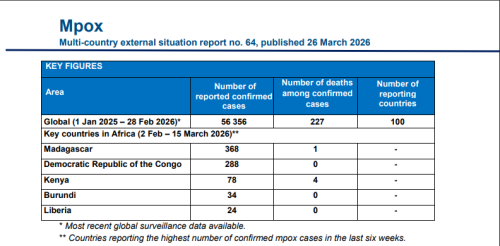
In its latest situation report, published on March 26, 2026, the WHO said 17 African countries confirmed 907 mpox cases and seven deaths between February 1 and March 15. Kenya reported 78 cases and four deaths, the highest number of fatalities during that period.
“Seventeen countries in Africa reported active transmission of mpox in the last six weeks (1 February – 15 March 2026), with 907 confirmed cases, including seven deaths (CFR 0.8%),” the WHO said.
Madagascar recorded the highest number of cases at 368, with one death, while the Democratic Republic of the Congo reported 288 cases and no deaths. Burundi and Liberia followed with 34 and 24 cases, respectively, also without fatalities.
You Might Also Like


Despite ranking third in total cases, Kenya stood out because of its death toll. The figures place pressure on health authorities to strengthen their response, especially in tracking contacts and managing severe cases.
Across Africa, the case fatality ratio during the six weeks stood at 0.8 per cent. The WHO said transmission continues mainly within sexual networks affecting both men and women, followed by spread within households. In areas where the virus has circulated for longer, all age groups remain at risk.
Rapid containment urgently needed
The agency warned that failure to contain outbreaks quickly could worsen the situation.
“Unless mpox outbreaks are rapidly contained and human-to-human transmission is interrupted, there is a risk of sustained community transmission in all settings,” the report stated.
Globally, the trend appears less severe. From January 1, 2025 to February 28, 2026, countries recorded 56,356 confirmed cases and 227 deaths across 100 countries. In February 2026 alone, 46 countries reported 1,184 cases and four deaths, with a lower fatality ratio of 0.3 per cent. Africa accounted for 58.6 per cent of those cases.
The WHO noted that a specific strain, clade Ib of the monkeypox virus, continues to spread through close human contact, often linked to sexual networks. The strain has reached new countries, including Argentina, Austria and the Central African Republic. In Europe, Spain has reported ongoing community transmission, with 87 confirmed cases of this clade.
In Africa, the longer-term picture shows 46,476 confirmed cases and 214 deaths between January 1, 2025 and March 15, 2026. Weekly cases have dropped below 200 in recent months, but the WHO cautioned that under-reporting and delays in data could mask the true scale of the outbreak.
The agency said it continues to support affected countries through surveillance, vaccination and public awareness efforts. It also distributed additional MVA-BN vaccine doses in March, including to Comoros and Cameroon, and is running studies to better understand how the virus spreads.
Author
Kenneth Mwenda
Kenneth Mwenda is a business, sports, and politics digital writer with over seven years of experience in journalism, covering breaking news, feature stories, and in-depth analysis across a range of beats.
For inquiries, he can be reached at [email protected]
View all posts by Kenneth MwendaLatest News







Advertisement
More on News