Advertisement
Kenya hosts COMESA summit as calls for unified policies take centre stage
Monday 06th October, 2025 06:55 PM|
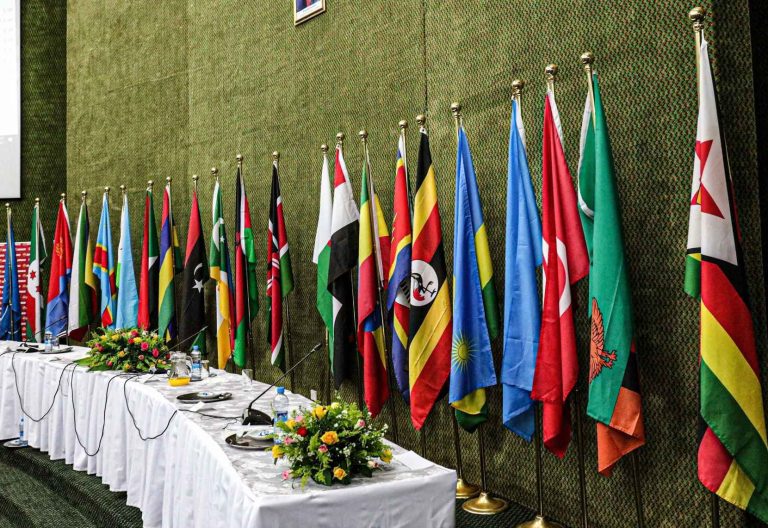
The 24th Common Market for Eastern and Southern Africa (COMESA) Summit officially began on Monday, October 6, 2025, at the Kenyatta International Convention Centre (KICC) in Nairobi.
The four-day event has brought together leaders, ministers, diplomats, and business figures from 21 member states to discuss ways of enhancing regional trade, peace, and economic integration.
This year’s summit runs under the theme “Leveraging Digitalization to Deepen Value Chains for Sustainable and Inclusive Growth.” It aims to strengthen collaboration among COMESA countries at a time when intra-African trade remains low, accounting for just around 15-18 per cent of total trade.
Kenya takes centre stage
Kenya is hosting the summit for the first time in over a decade and will assume the rotating Chairmanship of COMESA from Burundi. The country’s leadership in the bloc reflects its growing influence in shaping trade and investment policies in the region.
You Might Also Like
Trade and Industry Cabinet Secretary Lee Kinyanjui said Kenya is committed to advancing regional cooperation and market access.
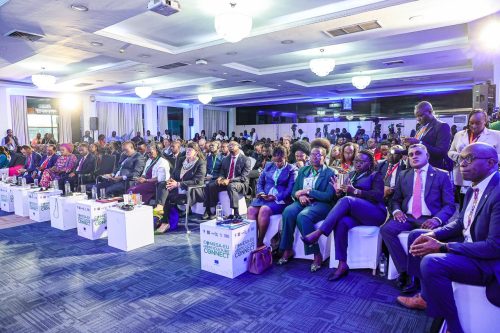
The summit opened with the COMESA–EU Horticulture Connect Forum, which drew government officials, exporters, and buyers from across Africa and Europe. The session focused on improving market linkages, harmonising trade standards, and promoting digital systems to support cross-border trade.
Focus on horticulture and digital trade
Agriculture and Livestock Development Cabinet Secretary Mutahi Kagwe opened the forum by highlighting the government’s plans to modernise the horticulture sector. He said Kenya continues to invest in digital traceability systems and trade agreements that give farmers duty-free access to European markets.
In 2024, Kenya’s horticulture exports earned Ksh137 billion from over 70 countries. More than 60 million flower stems were shipped daily to the European Union, accounting for about 40 per cent of roses sold there. The industry employs around 200,000 people directly and supports another four million indirectly.
Kagwe urged member states to harmonise pesticide and product standards to enhance safety and competitiveness within the COMESA region.
CS Kinyanjui added that the horticulture sector is one of the most promising avenues for economic growth and job creation. He emphasised the importance of integrating African small and medium enterprises (SMEs) into regional and global value chains.
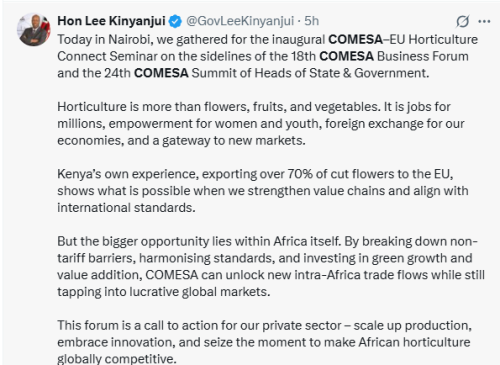
“Horticulture is more than flowers, fruits, and vegetables. It is jobs for millions, empowerment for women and youth, foreign exchange for our economies, and a gateway to new markets,” Kinyajui stated.
“Kenya’s own experience, exporting over 70% of cut flowers to the EU, shows what is possible when we strengthen value chains and align with international standards. But the bigger opportunity lies within Africa itself. By breaking down non-tariff barriers, harmonising standards, and investing in green growth and value addition, COMESA can unlock new intra-Africa trade flows while still tapping into lucrative global markets.”
COMESA’s path to stronger integration
The COMESA–EU forum forms part of the bloc’s broader efforts to strengthen economic ties and support sustainable agriculture. According to COMESA Secretary General Chileshe Kapwepwe, the region continues to benefit from digital transformation, which is improving trade logistics, customs systems, and access to markets.
“As COMESA turns 30, we have made significant progress in trade integration. Our member states are increasingly using digital platforms to trade and communicate,” said Tobias Odongo, COMESA’s focal point in Kenya.
The forum’s outcomes will be compiled into a report for presentation to the Heads of State meeting on Thursday, October 9. The report is expected to outline measures to expand digital traceability systems, promote climate-smart agriculture, and remove non-tariff barriers that hinder trade across the region.
Business, diplomacy and policy discussions
Tuesday’s programme will feature the 18th COMESA Business Forum and Trade Exhibition, which is expected to attract more than 300 exhibitors from across Africa. The exhibition will showcase innovations in manufacturing, agriculture, energy, and technology while providing a platform for entrepreneurs to forge partnerships.
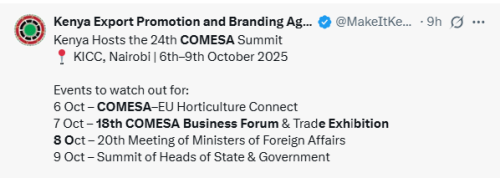
Deputy President Kithure Kindiki is scheduled to open the business forum, which will also discuss policies to improve SME competitiveness. Organisers say the forum will provide practical sessions to help local businesses meet international certification standards and access export markets.
On Wednesday, ministers of foreign affairs will convene to discuss peace and security issues affecting the region. The meeting will also review progress on regional integration, infrastructure projects, and cross-border investment.
The summit will close on Thursday with the 24th Meeting of COMESA Heads of State and Government, where leaders will adopt the main resolutions. Kenya will officially take over the chairmanship during this session.
Growing opportunities for regional trade
COMESA represents a population of more than 682 million people and a combined GDP of about Ksh129 trillion. Member states see the summit as an opportunity to deepen cooperation and strengthen the African Continental Free Trade Area (AfCFTA), which aims to create a single market for goods and services across the continent.
Regina Ombam, Principal Secretary in the State Department for Trade, said the summit comes at a time when African countries are rethinking their trade models.
“Even the Heads of States and governments have realised the value add that trade brings to an economy. With the changing global landscape in trade, COMESA member states are thinking of how do we get our intra-African trade to grow to that level where we see ourselves as competitive,” she said.
Ombam added that tripartite cooperation between the East African Community (EAC), the Southern African Development Community (SADC), and COMESA remains central to achieving continental integration.
Author
Kenneth Mwenda
Kenneth Mwenda is a business, sports, and politics digital writer with over seven years of experience in journalism, covering breaking news, feature stories, and in-depth analysis across a range of beats.
For inquiries, he can be reached at [email protected]
View all posts by Kenneth MwendaLatest News


Advertisement
More on Insights