Advertisement
Karura Forest at crossroads: Why people must stand firm
Saturday 30th August, 2025 07:23 AM|

The lush canopy of Karura Forest, a verdant oasis in the heart of Nairobi, stands at a critical juncture.
Once a battleground for Nobel laureate Wangari Maathai and her fearless Green Belt Movement (GBM) in the 1990s, this urban sanctuary is facing a new challenge.
On August 29, 2025, the Kenya Forest Service (KFS) announced that all payments for entry, parking, and other services would now be processed exclusively through the government’s e-Citizen platform. While the agency frames the shift as a modernisation effort to improve transparency, security, and efficiency, the GBM condemned the move as a “forceful takeover” that violates the law and threatens decades of community-led conservation.
Karura’s survival and transformation owe much to the vision and courage of Maathai, who, alongside ordinary citizens, faced tear gas and beatings to halt illegal land grabs.
You Might Also Like



That struggle laid the foundation for the co-management framework established with the Friends of Karura Community Forest Association (FKCFA), which has been crucial in turning Karura from a crime-ridden expanse into a thriving public resource.
In 2019, the forest’s dark past made headlines when up to 18 bodies were discovered within its confines, highlighting the urgent need for community-led stewardship.
Through decades of careful management and a $37 million investment in conservation and security, Karura now attracts over 7,000 visitors monthly, supporting vibrant biodiversity, including 200 bird species and rare mammals such as the suni and Harvey’s duiker.
Threat of centralization
The e-Citizen directive is part of a broader government initiative to centralize public services, yet its implementation at Karura has sparked widespread concern. GBM and FKCFA argue that this top-down approach undermines the co-management structure that has safeguarded the forest.
Without meaningful consultation, there is a real risk that community engagement will weaken, potentially reversing decades of hard-won gains. KFS’s public assurance that the transition has been smooth contrasts sharply with the concerns raised by conservationists who fear that the forest could slide back into insecurity and mismanagement.
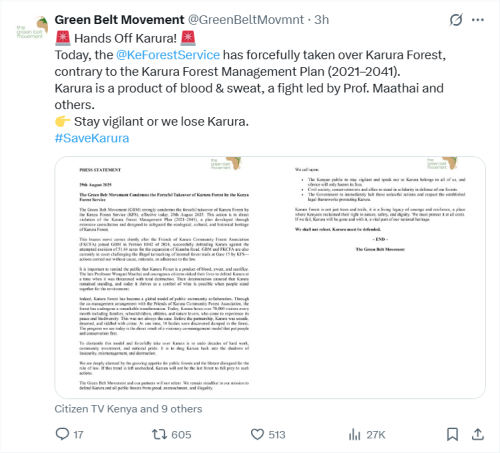
Legal disputes only heighten tensions. In 2024, GBM and FKCFA successfully blocked the excision of 51.64 acres for the Kiambu Road expansion, a landmark victory affirming community rights. Now, they are challenging KFS’s alleged illegal earmarking of internal trails at Gate 13.
This pattern of overreach mirrors wider issues in forest governance, reminiscent of the Shakahola tragedy in 2023, where centralised neglect exposed critical vulnerabilities.
Studies by the University of Nairobi and the International Union for Conservation of Nature show that community-managed forests outperform state-led ones in carbon sequestration and conservation outcomes, calling into question claims that centralisation improves efficiency.
Public scepticism is also fuelled by the perceived corruption associated with e-Citizen. Online voices, such as @amenya_nelson on X, suggest that the platform could be used to syphon revenue from the forest, further eroding trust in KFS’s motives. The Green Belt Movement, alongside other conservation allies, has urged citizens to voice their opposition, emphasising that Karura is not just a forest but a symbol of civic courage and environmental stewardship.
Stand firm
Karura Forest is more than trees and trails; it is a legacy of courage and dignity. Children learn about environmental responsibility on its paths, families find solace under its canopy, and visitors from across the world witness the success of a community-led conservation model.
To lose this forest to bureaucratic overreach would be to erase decades of struggle and achievement.
Civil society and the public have a responsibility to stand alongside GBM in defending Karura. History demonstrates the power of the people to safeguard national treasures, from the tireless activism of Maathai to contemporary community stewardship efforts.
The forest stands at a crossroads, and its future depends on collective vigilance and action. Upholding the co-management framework is not only a matter of legality but also of preserving a space that embodies resilience, pride, and sustainable environmental governance.
The time to act is now. Karura’s trails, biodiversity, and community programmes depend on it. If Kenyans fail to assert their voice, the green heart of Nairobi risks being lost to centralisation and short-term bureaucratic expediency.
Protecting Karura Forest is not just an environmental imperative; it is a defence of national heritage and the enduring legacy of courage that created it.
Author
Latest News








Advertisement
More on Insights