Advertisement
Justice on hold: How a Ksh17B budget cut could break Kenya’s courts
Sunday 23rd November, 2025 08:49 PM|

Kenya’s Judiciary is quietly slipping into a crisis that most people never witness firsthand but feel in delayed hearings, abandoned cases, and crumbling court buildings. The warning signs became clear on Sunday, November 23, 2025, when the Judiciary posted its FY 2026/27 budget on its X account.
In it, the institution requested Ksh46 billion to keep courts running and improve access to justice. The Treasury, however, has offered only Ksh29 billion. That leaves a staggering Ksh17 billion gap – a 38 per cent cut.
On paper, it sounds like another budget fight in Nairobi. But in real life, it means a magistrate in a rural court sharing one chair between two judicial officers.
It means a rape survivor in Kitui waiting eighteen months for her case to be heard because the court’s only recording system failed, and there is no money to replace it. It means a small-claims court in Garissa, promised six years ago, is still locked because there is no cash for rent or staff.
You Might Also Like

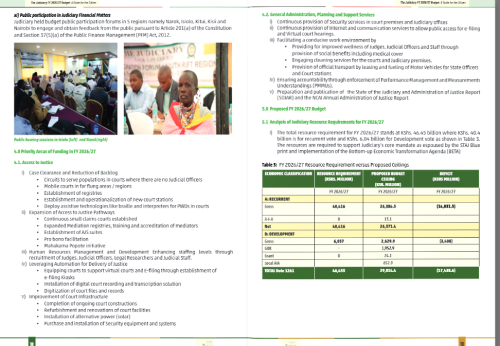
According to the Judiciary’s own budget documents, development spending will take the hardest hit. Funds meant to build new courts, install digital recording systems and connect remote stations to the e-filing platform face a 56 per cent reduction. Recurrent spending – salaries, electricity, basic operations – is down 35 per cent.
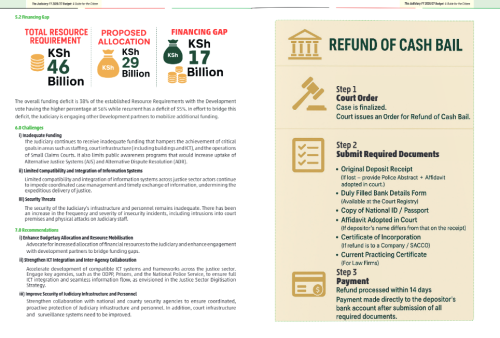
In simple terms, fewer new courts will open. Backlogs will grow. Crumbling court buildings will continue to deteriorate. And justice will move even slower.
Yet, the Judiciary has not sat quietly. Leaders have held public participation forums in Narok, Isiolo, Kitui, Kisii and Nairobi. Ordinary citizens showed up and asked for practical improvements: mobile courts for remote areas, sign-language interpreters for the hearing-impaired, safer court compounds. The Judiciary responded by including these requests in its budget proposal.
Basic rights or luxuries?
Now, Parliament must decide whether these needs are luxuries or basic rights.
Some of the requests are surprisingly modest. A single digital recording system costs under Ksh20 million but saves thousands of hours that would otherwise be spent on manual transcription.
Solar panels for a court in Turkana could prevent hearings from ending at 4 pm when the generator runs out of diesel. These vital items sit in a section labelled unfunded priorities simply because Ksh17 billion is missing.
Security is another growing concern. Over the past two years, courts have reported more break-ins and physical attacks on staff. Yet the budget for perimeter walls, CCTV and alarm systems has been slashed. Judges and magistrates now work in buildings that even petty criminals no longer fear.
To bridge the gap, the Judiciary is turning to development partners, seeking off-budget support and cutting costs wherever possible. But donors cannot pay judges’ salaries or uphold the Constitutional promise of a fair and timely trial.
Treasury officials insist that all sectors must tighten their belts. They are not wrong, but they overlook a critical point: when the Judiciary starves, the entire nation pays.
Investors hesitate when contracts cannot be enforced quickly. Citizens lose trust when justice appears reserved for the patient or the well-connected. A backlog of more than 800,000 cases is not just a bureaucratic problem – it is a slow breakdown of the rule of law.
Author
Kenneth Mwenda
Kenneth Mwenda is a business, sports, and politics digital writer with over seven years of experience in journalism, covering breaking news, feature stories, and in-depth analysis across a range of beats.
For inquiries, he can be reached at [email protected]
View all posts by Kenneth MwendaLatest News







Advertisement
More on Insights