Advertisement
Inside Kenya’s debt crisis: Controller of budget warns of vicious cycle
Tuesday 31st March, 2026 06:45 AM|

Kenya’s financial future has come under scrutiny after the Controller of Budget, Margaret Nyakang’o, said that the country is getting deeper into a dangerous debt trap driven by costly borrowing and poor coordination in project implementation.
Appearing before the National Assembly’s Committee on Public Debt and Privatization at Bunge Tower on Monday, March 30, 2026, she painted a bleak picture of the country’s finances, warning that a vicious cycle of debt accumulation is steadily shrinking fiscal space and making it harder to carry out the budget effectively.
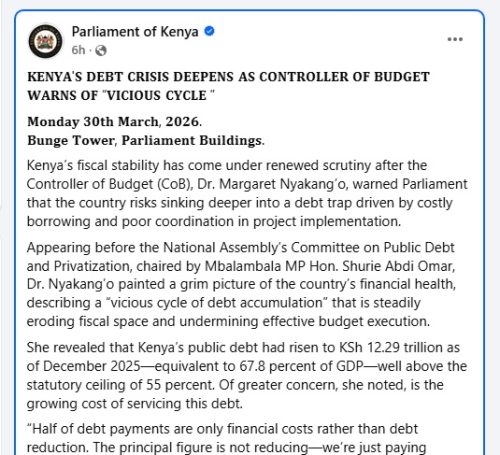
Nyakang’o revealed that Kenya’s public debt had surged to Ksh 12.29 trillion as of December 2025, representing 67.8 percent of the country’s GDP, significantly above the legal threshold of 55 percent.
Much goes to interest
You Might Also Like



“Half of debt payments are only financial costs rather than debt reduction. The principal figure is not reducing. We are just paying interest,” she told the committee.
According to a statement by the Parliament of Kenya, Nyakang’o’s presentation indicates that interest payments alone amount to Ksh 464.49 billion, accounting for 54 percent of total debt servicing, further tightening the pressure on public finances.
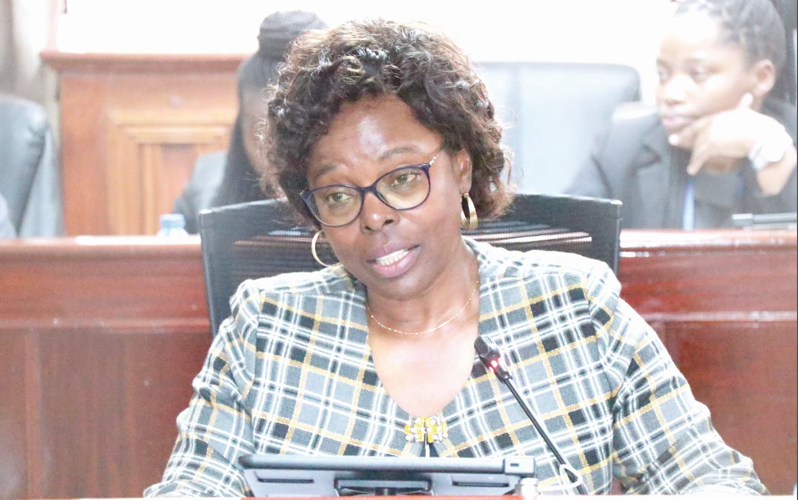
Nyakang’o also flagged what she termed hazardous borrowing, revealing that the government frequently takes on new loans to service existing debt.
She further confirmed that domestic borrowing is regularly used to settle external obligations.
“Yes. Yes. And yes… we do this all the time,” she said, answering questions pressed by legislators on whether domestic borrowing is being used to repay external obligations.
Commitment fees on loans
Members of Parliament, led by committee chair Mbalambala MP Shurie Abdi Omar, expressed concern over revelations that billions of shillings have been lost through commitment fees on loans that remain unutilised due to delayed or poorly prepared projects.
The CoB attributed the losses to a lack of coordination between the National Treasury and implementing agencies, saying funds are often secured before projects are ready for execution.
“We find ourselves in a debt trap where we sign for loans when we are not ready. Treasury mobilises funds without ensuring implementers are prepared,” she said, citing stalled projects such as Konza Technopolis and some Kenya Power initiatives dating back to 2017.

The mounting debt burden, she added, has triggered a liquidity crunch, forcing the government to ration cash and delay critical payments.k
“We are seeing a situation where even salaries are paid in bits due to cash flow constraints,” she noted.
What weakens fiscal discipline
To restore stability, she recommended a shift toward concessional borrowing, improved debt transparency, and stronger oversight mechanisms.
“We must undertake evidence-based analysis before acquiring new debt to ensure it serves the country’s best interests,” she urged.
Author
Emmanuel Rono
Rono is a digital journalist with a proven track record in newsroom leadership and content creation. Currently a Digital Writer for People Daily Digital, Emmanuel’s career is rooted in a lifelong passion for storytelling. Let's talk here: [email protected] or [email protected]
View all posts by Emmanuel RonoLatest News








Advertisement
More on Insights