Advertisement
Explainer: Govt forced to get Ksh5B subsidy as EPRA increases fuel prices
Thursday 14th May, 2026 09:02 PM|

Motorists will pay more for fuel in the latest monthly review by the Energy and Petroleum Regulatory Authority despite the government injecting billions of shillings in subsidies to cushion consumers from a sharper increase.
According to the pricing breakdown released by EPRA for the period between May 15 and June 14, 2026, the government was forced to absorb part of the actual fuel costs through the Price Stabilisation mechanism, particularly on diesel and kerosene.
“The Government will, in this cycle, cushion the consumers through the Petroleum Development Levy (PDL) Fund by utilising approximately Ksh. 5 billion to subsidise the prices of Diesel and Kerosene,” EPRA stated.
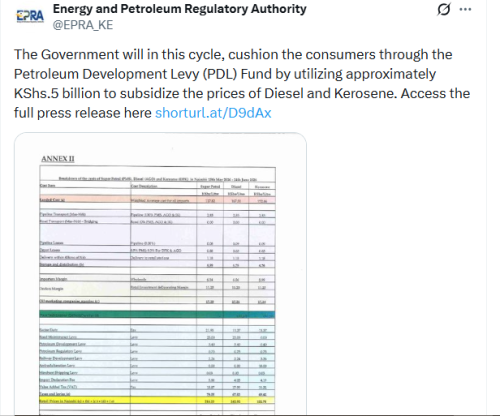
Kenyans should brace for even tougher times as the government increases retail prices for a litre of diesel and super petrol by KSh46.29 and KSh16.65, respectively.
You Might Also Like
The new prices are likely to push up production and transportation costs, a move likely to see manufacturers pass the increased bill to consumers.
The latest increase reverses last month’s relief at the pump, when motorists benefited from reduced fuel prices after the government lowered Value Added Tax (VAT) on petroleum products from 16 per cent to eight per cent through Legal Notice No. 70 issued on April 15, 2026.
During the previous cycle, Super Petrol retailed at Ksh197.60 per litre in Nairobi, while diesel sold at Sh196.63 after reductions of Ksh9.37 and Ksh10.21 respectively.
Higher fuel prices are expected to push up: Transport costs, food prices, electricity production costs and also the cost of goods and services.
Why did the government introduce a subsidy?
Without government intervention, diesel and kerosene prices would have been even higher. EPRA’s pricing sheet indicates that the government applied a “Price Stabilisation Deficit/Surplus”, which means the State absorbed part of the cost to prevent a major spike in pump prices.
Kerosene received the biggest subsidy because it is largely used by low-income households for cooking and lighting, making it politically and socially sensitive.
Energy Cabinet Secretary Opiyo Wandayi recently defended the government’s decision to cut Value Added Tax (VAT) on fuel and introduce a subsidy, saying the measures have shielded Kenyans from a sharper rise in pump prices.
Speaking on Saturday, April 18, 2026, amid concerns over the cost of living, Wandayi said reducing VAT on petroleum products to eight per cent and providing a Ksh6.2 billion subsidy in the previous cycle helped keep prices within reach for many households and businesses.
“Without these interventions, the price of super petrol would have been 217 shillings per litre, diesel 236 shillings per litre, and kerosene 261 shillings per litre,” he said.
VAT on fuel
The President assented to the bill on Friday, April 17, 2026, at the State House, Nairobi. The VAT bill seeks to cushion Kenyans against rising fuel prices.
Author
Emmanuel Rono
Rono is a digital journalist with a proven track record in newsroom leadership and content creation. Currently a Digital Writer for People Daily Digital, Emmanuel’s career is rooted in a lifelong passion for storytelling. Let's talk here: [email protected] or [email protected]
View all posts by Emmanuel RonoLatest News








Advertisement
More on Insights