Equalisation Fund: A constitutional right still waiting to be realised
By Faith Lagat, August 2, 2025Kenya’s Equalisation Fund, enshrined in Article 204(1) of the 2010 Constitution, stands as a beacon of hope for addressing historical inequalities in the country’s most marginalised regions.
Designed to provide basic services such as water, roads, health facilities, and electricity to underserved areas, the Fund aims to bridge the developmental gap and ensure these communities enjoy services comparable to those in better-resourced regions.
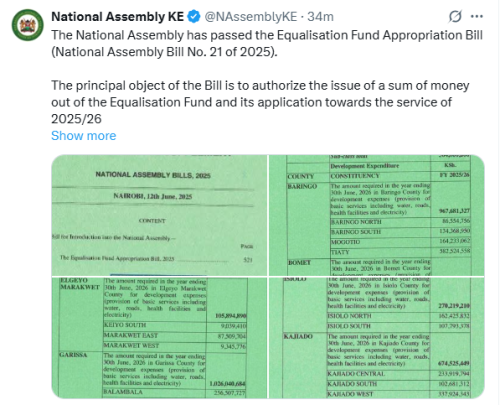
The recent passage of the Equalisation Fund Appropriation Bill, 2025, by the National Assembly, which allocates Ksh16.8 billion for the 2025/26 financial year, marks a significant step toward realising this constitutional mandate. However, persistent challenges, including underfunding, mismanagement, and debates over allocation criteria, continue to hinder the Fund’s transformative potential.
Long road to equity
The Equalisation Fund was created to rectify regional imbalances stemming from historical neglect, particularly those outlined in Sessional Paper No. 10 of 1965, which marginalised vast swathes of the country.
Initially, 14 counties were earmarked to benefit from the Fund. These included Turkana, Lamu, Mandera, Wajir, Marsabit, Samburu, West Pokot, Tana River, Narok, Kwale, Garissa, Kilifi, Taita Taveta, and Isiolo. However, the scope was later widened by the Commission on Revenue Allocation (CRA) to cover 34 counties, sparking debate over whether this expansion diluted the impact on the originally targeted regions.
The 2025 Appropriation Bill allocates Ksh. 16.8 billion to the Equalisation Fund, comprising Ksh 6.2 billion rolled over from the 2024/25 financial year and Ksh. 10.6 billion for the current fiscal year.
The latter includes Ksh7.852 billion, which is 0.5% of the most recently audited national revenue, and Ksh2.747 billion set aside for arrears. Notably, more than 60% of these funds will go to eight counties, with Turkana receiving the lion’s share at KSh. 1.86 billion. Others include West Pokot (Ksh1.7 billion), Narok (Ksh1.3 billion), Mandera and Wajir (Ksh1.2 billion each), Samburu (Ksh1.1 billion), Garissa (Ksh1.0 billion), and Baringo (Ksh 967 million).
To enhance oversight, Ksh504 million has been earmarked for administrative and oversight costs within the 3% limit set by the Public Finance Management (Equalisation Fund Administration) Regulations, 2021.
Additionally, the bill mandates that funds bypass County Revenue Funds and instead be deposited into special purpose accounts at the Central Bank of Kenya. This aims to curb misuse and ensure disbursements are made only upon written instructions from the Secretary of the Equalisation Fund Board and subsequent approval by the Controller of Budget.
Persistent gaps
Despite the legislative milestone, the Equalisation Fund continues to suffer from chronic underfunding. According to the Budget and Appropriations Committee, chaired by Samuel Atandi, as of June 2024, only Ksh 13.4 billion—representing a mere 22.4% of the cumulative Ksh 59.96 billion owed to the Fund—had been disbursed since its inception.
The arrears now stand at Ksh. 46.5 billion. Engineer Mohamed from the Equalisation Fund Board pegged the entitlement at Ksh 80 billion by June 2025, revealing that only Ksh 39.89 billion had been appropriated and just Ksh 15 billion released. He cited unpredictable disbursement schedules and pending bills as major obstacles, with delays fuelling audit concerns.
Concerns over mismanagement have also persisted. The Finance and National Planning Committee, led by Molo MP Kuria Kimani, criticised the Board for undertaking projects that fall outside its constitutional scope.
These include the installation of street lighting, paving using cabro blocks, and the construction of staff houses. Kimani questioned the value of a Ksh 6.2 million staff house at Chalaluma Dispensary in Lamu and flagged inconsistencies in irrigation project budgets. He challenged the Board’s approach, asking whether such projects truly serve the purpose envisioned by the Constitution.
Inaccurate reporting further undermines public confidence. Turkana South MP John Ariko contested the Board’s claim that a bridge in his constituency was only 2% complete, asserting it was at least 40% done. Such discrepancies have raised red flags over the reliability of project data and the transparency of the Fund’s operations.
Scope and implementation
The question of who should benefit from the Equalisation Fund remains contentious. Kakamega Senator Boni Khalwale has been among the most vocal critics of the expansion of the Fund’s coverage, arguing that it weakens the intended impact on the originally identified counties.
He expressed concern over allocations as low as Ksh 50 million to some counties, saying they were insufficient to support meaningful projects. Khalwale warned that without targeted focus, the Fund risks being reduced to the level of other devolved funds such as the Uwezo Fund and Constituency Development Fund.
At a regional workshop hosted by the Law Society of Kenya (LSK) in Nairobi, LSK President Faith Odhiambo underscored the broader issue of equitable access to justice in marginalised areas. She argued that development must be accompanied by legal empowerment. “The true test of any legal system lies not in how it serves the powerful, but in how it protects a stateless child, a detained refugee, or a mother stranded at a border post,” she said, citing a World Bank report that shows that only 20% of citizens in the Great Lakes Region have reliable access to justice.
As the 2025 Appropriation Bill moves towards implementation, the spotlight is now on the Equalisation Fund Board and the National Treasury to ensure that funds are not only disbursed but also utilised effectively.
Lawmakers have proposed extending the Fund’s constitutional lifespan beyond its initial 20-year period to give marginalised regions more time to catch up with the rest of the country. However, this extension must be matched with stronger monitoring frameworks, more transparent reporting, and stricter adherence to the Fund’s mandate.
The passage of the 2025 Bill is a promising development, but it will only be meaningful if accompanied by tangible improvements on the ground. As Senator Khalwale rightly noted, the Equalisation Fund should not be spent without proper regulations to guarantee its impact.
For the Fund to fulfill its constitutional promise, it must be managed with integrity, precision, and an unwavering commitment to justice for Kenya’s most disadvantaged communities.