Advertisement
Dissolution of Parliament in Kenya: Constitutional process and legal requirements
Saturday 06th June, 2026 12:10 PM|

Former Chief Justice David Maraga’s call for the dissolution of Parliament has stirred up the debate on the constitutional avenues that can be taken to hold the lawmakers to account and whether Kenya’s Parliament can be dismissed before its term.
The Constitution of Kenya, 2010, has been discussed, especially the conditions under which Parliament may be dissolved and the role of different institutions in relation to this.
Dissolution at the end of Parliament’s term
Each House of Parliament shall cease to exist on the day of the general election to the House of Parliament, pursuant to Article 102(1) of the Constitution.
This implies that, when Parliament’s constitutional term ends, it is automatically dissolved, thereby allowing for the holding of fresh elections for a new National Assembly and Senate.
You Might Also Like


The Constitution of Kenya provides for fixed terms of office for the Parliament by which Parliament is constituted; unlike other countries, where the executive can call for early elections, this gives some predictability and stability to the governance situation. Consequently, the dissolution takes place at the end of the term without any action on the part of the president or the parliament.
In the event of failure to carry out the constitution, the constitution can be dissolved. If the constitution is not implemented, then the constitution can be dissolved.
The Constitution also gives an extraordinary mechanism to dissolve Parliament in Article 261 beyond the end of its term.
The provision is in reference to the duty of Parliament to make laws for the implementation of the Constitution. Perhaps one of the most significant examples is the two-thirds gender principle, which has been introduced in both Articles 27(8) and 81(b), mandating that no more than two-thirds of the members in elective public bodies be of one gender.
In the absence of any law that complies with the constitutional mandate within the specified period, Article 261(5) of the Constitution gives any person the right to seek a declaration from the High Court that the legislature is failing to comply with the mandate. If Parliament has failed in its constitutional role, the court can order it to pass the laws within a given time frame.
In case Parliament does not respect the court’s order, Article 261(7) stipulates that the Chief Justice must advise the President to dissolve Parliament.
Role of the Chief Justice
The Chief Justice is a very significant figure in Article 261 of the dissolution process. If Parliament refuses to pass the law after the court has ruled that it should pass the law and lawmakers disregard the court’s ruling, the Chief Justice is constitutionally bound to advise the President to dissolve Parliament.
This has been introduced as an accountability measure to prevent Parliament from evading its constitutional duties indefinitely. It is also one of the rare cases where the Constitution explicitly provides for the dissolution of Parliament before the end of its tenure.
Is the president allowed to dissolve Parliament?
The president cannot dissolve Parliament by himself. In Kenya, the Constitution explicitly restricts the powers of the executive with regard to this to eliminate political meddling in the legislative process.
The President shall be able to dissolve Parliament only under specified provisions of the Constitution, e.g., on the advice of the Chief Justice under Article 261 or when Parliament expires under Article 102.
This is a constitutional structure that serves to uphold the principle of separation of powers and helps ensure that Parliament cannot be dissolved at will.
Extension of parliament term
The term of office for Parliament is normally five years in office, except for a narrow exception during the time of war, provided for in Article 102(3).
Under such a situation, Parliament can extend its term by passing a resolution with a majority of two-thirds of all the members of the National Assembly. If any extension is made, however, it cannot be longer than six months at a time and shall terminate within six months after the end of the state of war.
It guarantees continuity of governance during national emergencies and can also stop the possibility of endless parliamentary terms.
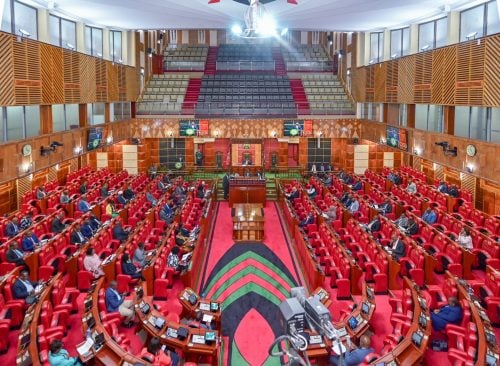
The Constitution of Kenya offers two major avenues for Parliament to be dissolved. The first is automatic dissolution from the end of Parliament’s term under Article 102. The first is that of automatic dissolution at the end of Parliament’s term.
The second is the extraordinary mechanism provided under Article 261, whereby if Parliament fails to enact laws necessary to implement the Constitution despite court directions, then the mechanism exists to dissolve the Parliament.
The provisions in the Constitution in relation to dissolution are a salutary reminder of the fact that Parliament’s powers come from and are subject to the Constitution.
The provisions on dissolution in the Constitution are very useful, as the debate around the former Chief Justice David Maraga has shown; Parliament’s powers are derived from and constrained by the Constitution.
Author
Latest News








Advertisement
More on Insights