Advertisement
A youth based political party not a far-fetched idea
Friday 25th June, 2021 12:00 AM|
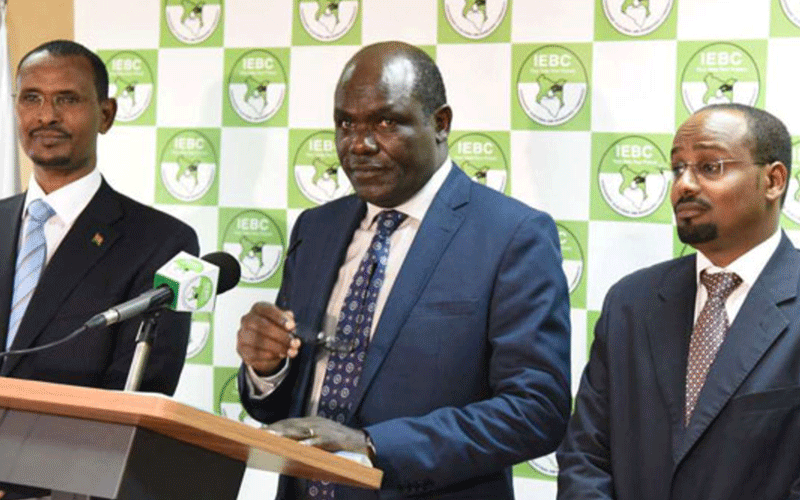
As the Independent Electoral and Boundaries Commission (IEBC) undertakes voter education, it should put a sharp focus on youth who have in recent years developed apathy not fully aware their plight is directly related to the kind of leaders they put at the helm.
IEBC has planned to sensitise Kenyans on the forthcoming activities that will culminate to the August 2022 General Election.
Educating voters is a crucial responsibility of the agency and should also be carried out regularly to reach the rest of the population who should also be encouraged to vote wisely.
Youth are particularly important because of their large numbers and increasing reluctance to take part in politics and exercise the right to vote, itself a huge threat to our cherished democracy bequeathed to us by the Constitution.
A government that has been put in place by an overwhelming support of its voting population enjoys a significantly huge legitimacy to govern.
Given that 78 per cent of the national population is below 35 years old, youth make up a voting constituency that can tilt the balance in ethnically-mobilised politics that have been divisive, characterised by animosity and have proved unhealthy for our prosperity.
A youthful population that is largely marginalised, excluded from decision-making and deprived of basic needs and rights, justifies a new perspective on politics.
The youth have always remained a ticking time bomb, which unfortunately successive regimes have failed to acknowledge through focused actions.
Today, official statistics show unemployment rate stands at 40 per cent. Sadly, seven of every 10 people who lack a job are youths, who also make up 60 per cent of the national population.
A focused leadership should re-engineer politics and economy to anchor the youth agenda in its all governance processes.
But youth should also take a share of blame for failure to mobilise themselves in a manner that insulates them from the bad tribal politics.
This has left them vulnerable and at the hands of unscrupulous politicians who lure them with generous manifestoes that are constantly reviewed when elections beckon, with little action afterwards.
The journey to inclusion is long and may not be won immediately, but it must start somewhere.
With many political mobilisations going on, forming a political party for youth may not be a far-fetched dream.
Organisations supporting youth to register as voters in large numbers such as The Youth Congress and Siasa Place must be supported and should also focus on how youth can create political formations to place them on a round table of negotiations — for that is what 2022 elections will be all about.
The youth constituent is dynamic, educated and techno-savvy, and can be made to participate in politics diversely from the conventional methods that has left us with a huge chunk of unqualified leaders at all levels. — The writer is a Public Policy Analyst — [email protected]
Author
People Daily
View all posts by People DailyLatest News






Advertisement
More on Insights