Advertisement
A step forward, but is 29.5% salary increase enough for teachers?
Sunday 20th July, 2025 10:27 AM|
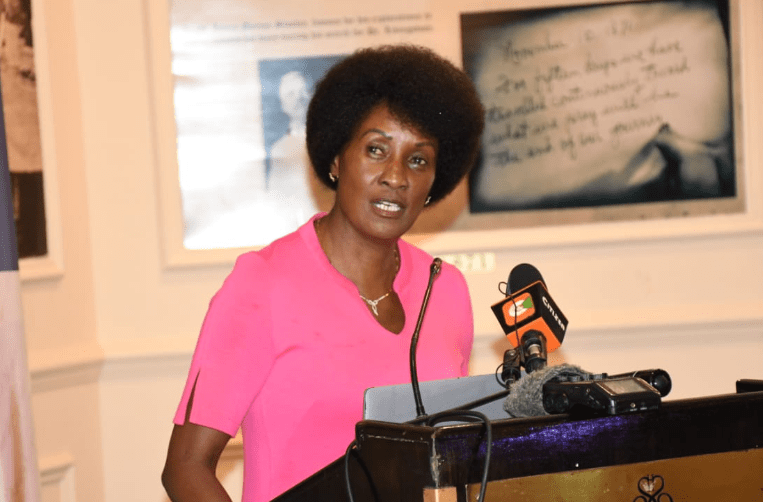
Teachers in Kenya will soon see a significant boost in their payslips following a new Collective Bargaining Agreement (CBA) signed between the Teachers Service Commission (TSC) and three major teacher unions.
The landmark agreement, signed on July 19, 2025, awards teachers a salary increment of up to 29.5 per cent across all cadres, effective from July 1. This deal covers members of the Kenya Union of Special Needs Teachers (KUSNET), the Kenya National Union of Teachers (KNUT), and the Kenya Union of Post-Primary Education Teachers (KUPPET).
According to a statement from the TSC, the salary increase is part of a broader effort to bridge the wage gap between the highest- and lowest-paid teachers in the public service—a long-standing concern raised by unions.
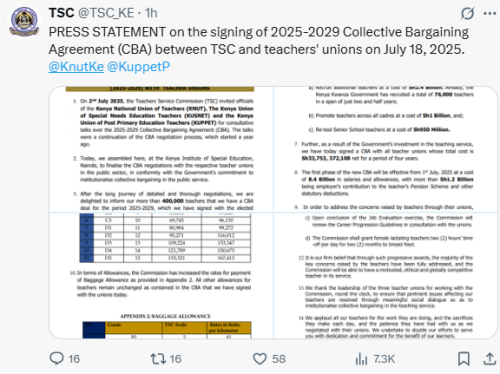
The first phase of the new CBA will cost the government Ksh8.4 billion in salaries and allowances, with an additional Ksh1.2 billion allocated to employer contributions for pension schemes and other statutory deductions.
You Might Also Like



Beyond the salary increment, the CBA includes several other financial commitments. The TSC plans to recruit additional teachers at a cost of Ksh2.4 billion, promote teachers across various cadres for Ksh1 billion, and invest Ksh950 million in retooling senior school teachers in the 2025/2026 financial year.
These moves aim to address the staffing shortages, stagnation in career growth, and the need for continuous professional development, especially with the demands of the Competency-Based Curriculum (CBC).
/X
Addressing welfare
The new CBA introduces notable welfare provisions designed to improve teachers’ working conditions. Female lactating teachers will now be entitled to two hours off per day for two months to breastfeed, a move seen as a progressive step toward addressing gender-specific workplace needs.
Another provision allows teachers dismissed from service to access pension benefits, a controversial but potentially fairer approach if implemented transparently.
The TSC has committed to conducting a job evaluation exercise and reviewing career progression guidelines in collaboration with unions, signalling the possibility of deeper structural reforms within the teaching profession.
In its statement, the TSC commended the leadership of KUSNET, KNUT, and KUPPET for their role in the negotiations, highlighting the importance of “meaningful social dialogue”. This spirit of collaboration, the commission says, has institutionalised collective bargaining within the education sector and fostered optimism for addressing future concerns affecting teachers.
While the salary increase has been widely welcomed, some observers caution that the true impact of the deal must be weighed against Kenya’s broader economic realities.
With the cost of living continuing to rise, there are concerns that the 29.5 per cent raise could be eroded by inflation, leaving teachers in a similar financial position despite the increment. Additionally, the CBC rollout has significantly increased teachers’ workloads, requiring them to adopt new teaching methods and develop fresh lesson plans, often without adequate resources.
The Ksh950 million allocated for retooling is a start, but questions remain about whether it will be enough to equip all teachers with the necessary skills and materials to handle CBC effectively.
Teacher shortages, sustainability
The recruitment of additional teachers is a critical step toward addressing the current staffing crisis in Kenya’s schools. Classrooms across the country, particularly in rural and marginalised areas, are overcrowded, with some teachers handling as many as 70 students at a time.
According to UNESCO, sub-Saharan Africa must recruit millions of new teachers by 2030 to meet education targets. Kenya is no exception.
While the TSC’s plan to hire more teachers is encouraging, it may not fully resolve the problem, especially in regions where teacher shortages are most severe. Without careful deployment strategies, there is a risk that the gap between urban and rural schools could widen further.

There is also the question of financial sustainability. Kenya’s public debt, estimated at over Ksh10 trillion in 2024, places significant pressure on the national budget.
Past CBAs have faced challenges in implementation due to funding constraints, leading to scepticism among some educators about whether the government can sustain these new commitments over the four-year agreement period. The TSC will need to ensure consistent funding and timely disbursements to maintain trust and prevent disruptions in the education sector.
Beyond salaries, broader reforms
While the financial provisions in the new CBA are substantial, Kenya’s education sector faces challenges that go beyond salaries. Many schools, especially in rural areas, lack basic facilities like libraries, laboratories, and reliable electricity.
The CBC, which emphasises practical and hands-on learning, requires materials and infrastructure that are often unavailable in public schools.
Without investments in school facilities and learning tools, the burden of CBC implementation will continue to fall on teachers who may not have the resources to deliver it effectively.
Non-monetary benefits in the CBA, such as the breastfeeding allowance and pension provisions for dismissed teachers, reflect a growing awareness of teachers’ diverse needs.
If implemented transparently, these benefits could improve morale and job satisfaction, making the teaching profession more attractive to new entrants and helping to retain experienced educators.
Kenya’s teachers are more than just instructors; they are community leaders, mentors, and nation builders. Their role in shaping the country’s future cannot be overstated.
The 29.5 per cent salary increase, coupled with recruitment, promotions, and welfare improvements, is a step in the right direction. However, to truly empower teachers and improve the quality of education, the government must match this financial commitment with investments in infrastructure, teaching materials, and support services.
The TSC and teacher unions must continue their partnership, ensuring that the gains made through the 2025/2029 CBA are not just symbolic but transformative, laying the groundwork for an education system that serves both teachers and learners effectively.
Author
Latest News








Advertisement
More on Insights