Advertisement
Willis Otieno: Ruto’s mission was never to transform the state
Saturday 13th June, 2026 07:22 AM|

Lawyer Willis Otieno has launched a fresh critique of President William Ruto’s administration, arguing that the government’s primary objective was never to transform Kenya’s governance structures but rather to consolidate power and expand elite influence.
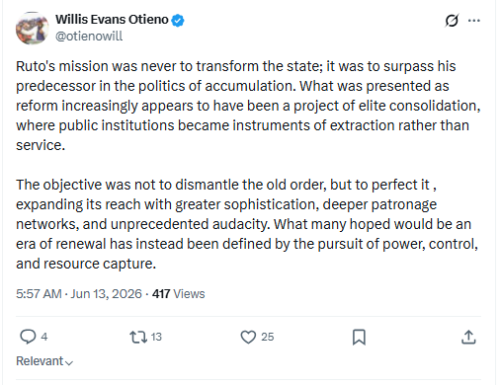
Taking to his official X account on Saturday, June 13, 2026, Otieno claimed that what was initially presented to Kenyans as a reform agenda has increasingly evolved into a project focused on political control, patronage, and resource accumulation.
According to the Safina deputy party leader, the Kenya Kwanza administration has failed to deliver the institutional transformation many citizens expected following the 2022 General Election.
Otieno argued that President Ruto’s administration did not seek to dismantle the systems that previous governments had been accused of using for political and economic advantage.
You Might Also Like

Instead, he suggested that the current administration has refined and expanded those structures.
“Ruto’s mission was never to transform the state; it was to surpass his predecessor in the politics of accumulation,” Otieno stated.
“What was presented as reform increasingly appears to have been a project of elite consolidation, where public institutions became instruments of extraction rather than service.”
The remarks are among the latest criticisms directed at the government by the lawyer, who has frequently commented on constitutional, governance, and political issues.
Claims of elite consolidation
Otieno further argued that Kenya’s governance challenges stem from a political culture that prioritises the interests of a select group of powerful individuals over broader public concerns.
According to him, many Kenyans entered the Kenya Kwanza era expecting significant reforms aimed at improving accountability, transparency, and service delivery.
However, he claimed that the administration’s actions have increasingly pointed in a different direction.
“The objective was not to dismantle the old order, but to perfect it, expanding its reach with greater sophistication, deeper patronage networks, and unprecedented audacity,” he said.
“What many hoped would be an era of renewal has instead been defined by the pursuit of power, control, and resource capture.”
Growing political criticism
Otieno’s statement comes amid increasing political activity ahead of the 2027 General Election, with opposition leaders intensifying criticism of the Kenya Kwanza administration.
Several opposition figures have accused the government of abandoning key campaign promises and concentrating excessive power within the executive.
The lawyer’s latest comments add to a growing chorus of voices questioning whether the administration has remained faithful to its original reform agenda.
Supporters of the government, however, maintain that significant progress has been made through initiatives such as affordable housing, agricultural subsidies, digital transformation programmes, universal healthcare reforms, and investments in infrastructure.
Government officials have repeatedly defended the administration’s policies, arguing that difficult economic decisions have been necessary to stabilise the economy and lay the foundation for long-term growth.
Critics, however, contend that many of the promised reforms have yet to translate into meaningful improvements in the lives of ordinary Kenyans.
Author
Mustafa Juma
View all posts by Mustafa JumaLatest News






Advertisement
More on Inside Politics