Advertisement
Ndegwa Njiru warns Mudavadi’s referendum push is legally risky
Tuesday 30th December, 2025 12:06 PM|
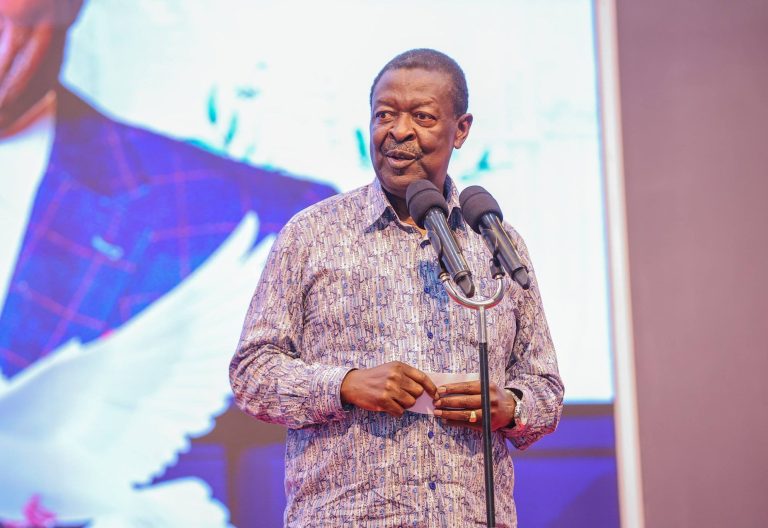
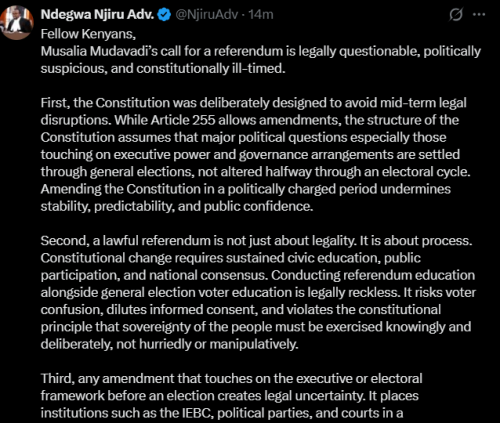
Advocate and human rights activist, Ndegwa Njiru, has raised concerns over Musalia Mudavadi’s call for a referendum, describing it as legally questionable, politically suspicious, and ill-timed.
In a statement shared on X on Tuesday, December 30, 2025, Njiru warns that attempting constitutional amendments during an election cycle could create instability and confusion among Kenyans.

“Musalia Mudavadi’s call for a referendum is legally questionable, politically suspicious, and constitutionally ill-timed. First, the Constitution was deliberately designed to avoid mid-term legal disruptions. While Article 255 allows amendments, the structure of the Constitution assumes that major political questions, especially those touching on executive power and governance arrangements, are settled through general elections, not altered halfway through an electoral cycle. Amending the Constitution in a politically charged period undermines stability, predictability, and public confidence,” Ndegwa Njiru
Njiru emphasised that conducting a referendum alongside general election preparations is legally reckless, as it could dilute informed voter consent and risk constitutional violations.
You Might Also Like

“Second, a lawful referendum is not just about legality. It is about process. Constitutional change requires sustained civic education, public participation, and national consensus. Conducting referendum education alongside general election voter education is legally reckless. It risks voter confusion, dilutes informed consent, and violates the constitutional principle that sovereignty of the people must be exercised knowingly and deliberately, not hurriedly or manipulatively,” Ndegwa Njiru
He further noted that any changes to executive powers or electoral frameworks before elections could place institutions like the IEBC, political parties, and courts in a grey zone, affecting timelines and electoral integrity.
“Third, any amendment that touches on the executive or electoral framework before an election creates legal uncertainty. It places institutions such as the IEBC, political parties, and courts in a constitutional grey zone, unsure which rules apply and when. That uncertainty threatens election timelines, administrative clarity, and ultimately electoral integrity. Courts have repeatedly warned against reforms that destabilise the electoral environment close to elections.” Ndegwa Njiru
Njiru also criticised the financial implications, warning that the referendum would cost billions while Kenyans face rising taxes and unmet needs.

“Fifth, the fiscal implications cannot be ignored. A referendum costs billions of shillings. At a time when Kenyans are burdened by rising taxes, shrinking incomes, and unmet public needs, such expenditure fails the constitutional test of responsible public finance under Article 201. Public money must serve public necessity, not political convenience.” Ndegwa Njiru
He concluded that the referendum appears politically motivated rather than necessary, urging citizens to question its legitimacy.
“In law and in logic, this referendum is not necessary. It is a political project dressed as constitutional reform. And when constitutional amendment, elite self-interest, and massive public expenditure converge, the law requires citizens to ask not whether it is legal, but whether it is legitimate.” Ndegwa Njiru
Author
Latest News






Advertisement
More on Inside Politics