Mudavadi defends Ruto-Sakaja deal amid jitters over Nairobi’s development crisis
By Aloys Michael, March 30, 2026Prime Cabinet Secretary Musalia Mudavadi has defended the cooperation agreement between President William Ruto and Nairobi Governor Johnson Sakaja amid mounting legal and governance concerns.
Appearing before the Senate Standing Committee on Devolution and Intergovernmental Relations on Monday, March 30, 2026, Mudavadi told senators the framework is a structured partnership designed to resolve Nairobi’s long-standing infrastructure and service delivery challenges, insisting it does not undermine devolution.
“This agreement represents a deliberate and structured effort by both levels of government to strengthen collaboration in the delivery of critical services and infrastructure within the Capital City,” he said.
The senate meeting comes at a time of growing pressure to fix Nairobi’s development crisis, such as floods that have caused havoc, with Mudavadi exuding confidence that the approach could mark a turning point, if legal, financial, and accountability gaps are addressed.
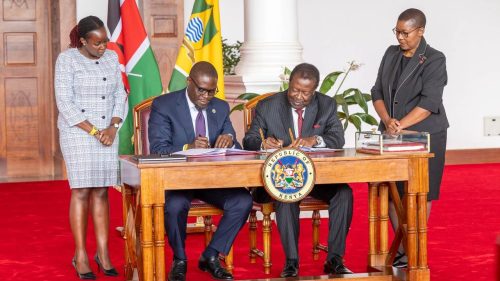
Earlier, Sakaja had attributed the city’s persistent infrastructure problems, particularly chronic flooding, to years of inadequate funding amid uproar from the citizens and a section of leaders.
Breaking his silence on Sunday evening, March 8, 2026, nearly 48 hours after floods caused widespread disruption across Nairobi, Sakaja said the county requires billions of shillings to permanently fix the capital’s drainage system and curb the recurring flood menace.
According to Sakaja, Nairobi requires at least Ksh60 billion annually to properly address infrastructure needs, maintain public services and respond to emergencies such as the ongoing floods.
“I am not overwhelmed, I am under-resourced. Nairobi needs at least Ksh60 billion every year to address the challenges and development needs in a better way,” he said in an interview on a local TV station.

Govt’s laxity?
But even as people grapple and struggle to recover from the latest deluges, an audit report has revealed that many of the losses could have been reduced if the government had acted earlier on key recommendations aimed at strengthening disaster preparedness and early warning systems.
A performance audit by Auditor-General Nancy Gathungu shows that the government’s response to flood-related humanitarian emergencies could have been significantly improved if authorities had implemented measures proposed to strengthen coordination and preparedness.
The deal commits about Ksh80 billion toward urban transformation projects targeting key sectors such as waste management, county roads, housing, markets, water, sanitation, and non-motorised transport.
Mudavadi argued that Nairobi’s strategic role as a regional economic and diplomatic hub makes coordinated intervention necessary.
Citing data from the Kenya National Bureau of Statistics, he noted that the capital contributes 27.5 per cent of Kenya’s Gross Value Added and generates over Ksh4.1 trillion annually, making its performance critical to the national economy.

However, the agreement has triggered jitters among lawmakers over its constitutional and operational implications.
Although the agreement states it does not constitute a transfer of functions, Clause 3.2 assigns joint roles in sectors that are constitutionally designated to counties under the Fourth Schedule, without invoking the required legal transfer process.
Senators also flagged the absence of a clear cost-sharing framework, noting that Clause 7.1 leaves financing modalities to be jointly agreed upon without defining ratios or funding obligations.
Further concerns include a lack of clarity on procurement authority, as Clause 4.1(vii) references procurement laws but does not specify which level of government will lead processes or own completed assets.
Lawmakers also pointed to blurred accountability structures, with Clauses 4 and 5 establishing joint committees but failing to clearly assign ultimate responsibility for outcomes.
Additionally, the agreement has been criticised for weak oversight provisions, as it does not explicitly require ratification by the Nairobi County Assembly or establish structured reporting mechanisms to it.

Accountability over the deal
In response, Mudavadi said the agreement introduces a two-tier governance system to ensure efficiency and accountability. A Joint Steering Committee, chaired by him, will provide policy direction, while an implementation committee led by Sakaja will oversee execution.
“ White papers have already been developed to outline procurement timelines, financing approaches, and delivery milestones, which will be used to track progress and enforce accountability,” he said.
“This collaborative architecture ensures continuous alignment between strategy and execution, reduces duplication, and accelerates service delivery.”
Despite the concerns, Mudavadi maintained that the framework is legally sound and necessary to address Nairobi’s rapid urbanisation, congestion, and declining service standards.
“The Cooperation Agreement is a lawful and constitutionally grounded framework that strengthens intergovernmental collaboration without undermining the principles of devolution,” he said.