Advertisement
Malala questions court decision to uphold Gachagua impeachment despite fair hearing violation
Monday 08th June, 2026 11:36 PM|

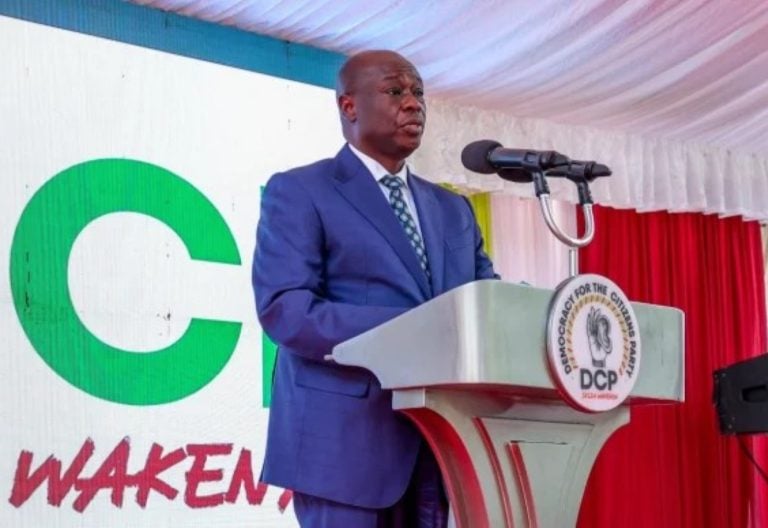
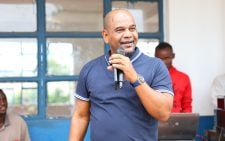
Democracy for its Citizens Party (DCP) Deputy Leader Cleophas Malala has questioned the High Court decision to uphold Rigathi Gachagua’s impeachment case, while affirming that his right to a fair hearing was violated.
“As a Deputy Party Leader, a player in my country’s socio-political dynamics and a firm believer in the rule of law, I am troubled and perturbed by the decision of the three-judge bench in the impeachment case of my Party Leader, H.E. Rigathi Gachagua, EGH,” Malala wrote.
This statement by Malala captured the growing unease among sections of the opposition and legal observers following the High Court’s ruling on Monday, June 8, 2026.
This came just after the court upheld the impeachment of former Deputy President Rigathi Gachagua but awarded him Ksh50 million in damages after finding that the Senate violated his constitutional right to a fair hearing.
You Might Also Like

The judgment, delivered by Justices Eric Ogola, Anthony Mrima, and Freda Mugambi at Milimani Law Courts, has sparked intense debate on whether procedural violations in impeachment processes can be remedied solely through monetary compensation while allowing the substantive outcome to stand.
Fair hearing violation and damages award
The bench explicitly ruled that senators proceeded with hearings despite requests for adjournment on medical grounds, breaching Article 50 protections.
Yet it concluded that the overall impeachment met constitutional thresholds and validated President William Ruto’s nomination of Prof. Kithure Kindiki as Deputy President. The Ksh50 million award was described as constitutional damages to vindicate the Constitution, restore dignity, and deter future violations.
Malala, however, argued that the right to a fair hearing is not a mere procedural formality but the cornerstone of Kenya’s Constitution. “If the process was flawed and unconstitutional, how can its outcome be allowed to stand?” he questioned.
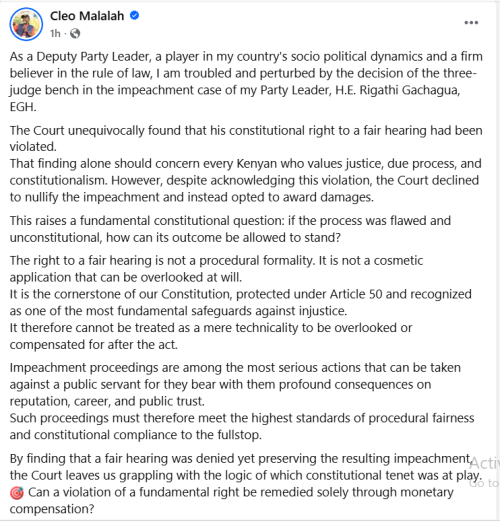
He posed pointed queries: Can a violation of a fundamental right be remedied solely through monetary compensation? Can passive substantial compliance suffice where strict adherence is demanded? And are political considerations overshadowing constitutional supremacy?
Political reactions and Malalah statement
Gachagua himself was absent from court, watching proceedings from home alongside his wife, Reverend Dorcas Gachagua, and opposition figures Kalonzo Musyoka and Eugene Wamalwa. Lawyer and Kirinyaga Woman Representative Njeri Maina explained the decision was precautionary amid reports of possible attempts to implicate him post-verdict. “He is a peace-loving Kenyan,” Maina said. “He has called upon his supporters to take whatever the outcome, knowing that we shall proceed to the Court of Appeal.”
Maina described the ruling as “gravely disappointing,” stressing that the case was never about money but the integrity of constitutional processes. “We’re not here for the money. It is about the integrity of the Constitution of Kenya,” she told journalists outside the court. The legal team plans to study the judgment and file an appeal.
Appeal and constitutional debate
The development comes a day after Gachagua urged calm during a church service at PCEA Muteero Church in Karen on Sunday, June 7, 2026. His earlier court appearances had drawn family solidarity, making Monday’s absence notable.
Analysts say the ruling underscores tensions between parliamentary oversight powers and judicial safeguards of due process. While Parliament retains broad authority to remove state officers, the court emphasised that such power must respect constitutional protections.
Malalah warned that the decision risks setting a dangerous precedent. “Today, the subject may be H.E. Rigathi Gachagua. Tomorrow, the same standard may be applied to any Kenyan citizen,” he said. He called for national reflection on whether Kenya’s commitment to constitutional rights is absolute or conditional.
Author
Latest News



Advertisement
More on Inside Politics