Lawyer Willis Otieno demands major changes to Finance Bill 2026
By Cynthia Lodite, May 24, 2026City lawyer Willis Otieno has demanded major changes to the Finance Bill 2026, as measures contained in the Bill, to finance the Ksh4.8 trillion budget, continue to spark debate across the country.
Taking to his official X account on Sunday, May 24, 2026, Otieno warned that the Finance Bill 2026 risks turning essential tools of Kenyan life into heavily taxed burdens.
According to the renowned lawyer, the Finance Bill 2026 debate is not just about taxes; rather, it is about the direction of everyday life.
At the same time, Otieno has argued that when rent rises, transport becomes costlier, phones and internet access are taxed more heavily, and small digital transactions attract more charges.
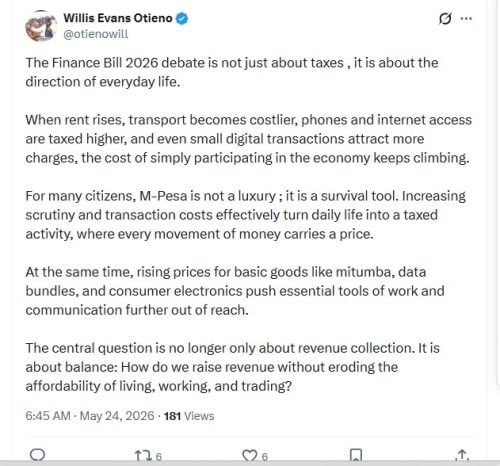
“The Finance Bill 2026 debate is not just about taxes; it is about the direction of everyday life. When rent rises, transport becomes costlier, phones and internet access are taxed higher, and even small digital transactions attract more charges, the cost of simply participating in the economy keeps climbing,” Otieno said.
On his part, for many citizens, M-Pesa is not a luxury; instead, a survival tool, hence increasing scrutiny and transaction costs effectively turn daily life into a taxed activity, where every movement of money carries a price.
At the same time, Otieno has argued that rising prices for basic goods like mitumba, data bundles, and consumer electronics push essential tools of work and communication further out of reach.
“The central question is no longer only about revenue collection. It is about balance: How do we raise revenue without eroding the affordability of living, working, and trading?,” he added.
CS Mbadi defends Bill
Otieno’s remarks come days after Treasury Cabinet Secretary John Mbadi defended the proposed Finance Bill, saying the government is focusing on widening the tax base and improving tax collection efficiency rather than introducing new tax burdens on Kenyans.
Mbadi said the National Treasury had deliberately avoided increasing tax rates following concerns raised by Kenyans during the 2024 Finance Bill debates.
“Because of the history and because of the experience of 2024, we took a decision that we are not going to increase the tax rates for Kenyans because Kenyans have complained and justifiably so that the taxes that are being levied on them are too much,” Mbadi said.
Speaking during an interview aired live during a media engagement on the Finance Bill 2026 at the University of Nairobi, the CS said the current Finance Bill mainly focuses on administrative reforms aimed at sealing loopholes and ensuring more Kenyans contribute to the tax system.
Mbadi added that the Treasury had adopted a more open and consultative approach in developing the bill, insisting many of the proposals originated from public submissions.
“For the first time in the history of this country, and I think we from the Treasury have lived up to it, we have been more open and transparent. We have communicated to Kenyans from the beginning,” he said.