Advertisement
Inside IEBC’s procedure for accessing sealed ballot boxes during tallying amid rigging claims
Monday 01st June, 2026 03:43 PM|

A tightly controlled procedure meant to safeguard election integrity has now become part of a wider political conversation about trust, suspicion, and the credibility of the electoral process ahead of 2027.
The Independent Electoral and Boundaries Commission (IEBC) has issued fresh directives spelling out how and when sealed ballot boxes may be opened during tallying, in rare cases where critical election materials are mistakenly locked inside after polling and counting.
The guidelines, contained in a May 29, 2026, Gazette Notice signed by Chairperson Erastus Ethekon, seek to remove ambiguity in a process that has previously been vulnerable to suspicion whenever ballot boxes are accessed after sealing.
Important in the directive is a firm boundary: retrieving materials must never translate into reopening results already declared at polling stations. The commission is categorical that the integrity of results remains untouched even when physical materials inside sealed boxes are accessed.
You Might Also Like



“There shall be no recount or change of already announced results at the polling station,” the notice stated.
The rule reflects a core tension in election administration, balancing operational corrections with strict safeguards against interference claims.
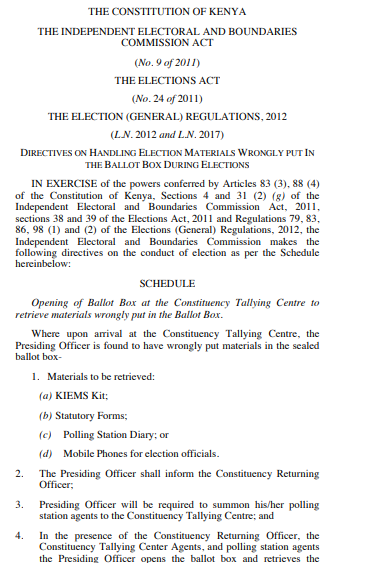
The guidelines
In this case, IEBC is drawing a procedural line to prevent what it views as potential misinterpretation of necessary administrative steps as opportunities for manipulation.
The directive limits what can be retrieved from sealed ballot boxes to specific items: KIEMS kits, statutory forms, polling station diaries, and mobile phones used by election officials. Ballot papers and result records are explicitly excluded from any form of re-examination.
The process itself is designed as a multi-layered accountability chain. Once a Presiding Officer realises that essential materials were mistakenly sealed, they must notify the Constituency Returning Officer, triggering a controlled process at the Constituency Tallying Centre.
The Presiding Officer is then required to summon polling station agents to witness the exercise. The ballot box can only be opened in the presence of the Constituency Returning Officer, tallying centre agents, and polling station agents, reinforcing a system of collective observation rather than unilateral action.

After retrieval of the permitted materials, the ballot box must be resealed immediately. The new seal numbers are recorded in the Polling Station Diary, creating a traceable audit trail. All agents present are required to sign as witnesses, while the Returning Officer documents the incident in an official report.
In cases where polling station agents are unavailable, the Constituency Returning Officer is required to escalate the matter to the Commission for further direction, underscoring the IEBC’s insistence that no step proceeds without oversight.
The legal foundation for the procedure is drawn from the Constitution, the IEBC Act, the Elections Act, and the Elections (General) Regulations, framing it as part of a broader effort to standardise election-day contingencies.
While technically administrative, the timing and tone of the directive place it firmly within a charged political environment where every procedural detail is increasingly being interpreted through the lens of electoral trust.

Kalonzo on votes manipulation fears
That tension was visible in IEBC’s parallel warning against public statements suggesting manipulation of election outcomes.
The commission has condemned remarks by political actors implying that elections could be influenced, arguing that such claims weaken confidence in democratic processes.
The backdrop is a growing political dispute over the claimed normalisation of electoral malpractice rhetoric.
Opposition leaders have accused the commission of failing to act on what they describe as openly worrying statements from senior politicians. One of the strongest criticisms has come from Wiper Patriotic Front leader Kalonzo Musyoka, who questioned why individuals making controversial remarks about elections had not been held to account.
Speaking during an interview with Kameme TV, he raised concern over what he termed silence from the electoral body.

“Kama jamaa anaweza sema uchaguzi unaokuja hata kama kura hazitatosha tutaongeza, huyo ni mtu wa aina gani?” Kalonzo posed.
“Hajashikwa, na hatujasikia IEBC ikimkemea mtu kama huyo. And he has not been taken to write a statement.”
His remarks were directed at comments attributed to Kapseret MP Oscar Sudi, who has been quoted in public remarks suggesting that electoral outcomes could be adjusted to secure victory in 2027.
“Nataka nikwambie wewe Wamunyoro [Gachagua], hakuna mtu anaongoza Kenya hii kwa miaka mitano. Hiyo kura isipojaa tutajaza na tutajaza na hawa wananchi hawa,” Sudi said.
The exchange highlights a deeper political sensitivity: even rhetorical references to adding votes or manipulating margins carry weight in a country where electoral disputes have historically triggered institutional crises and public distrust.
The controversy has not been isolated. Other leaders aligned with the Kenya Kwanza political formation have also drawn criticism for similar remarks. Wajir Woman Representative Fatuma Jehow previously stirred debate after suggesting during a public event that leaders from the Northeastern region would ensure President William Ruto’s re-election regardless of numerical voter strength.

In another instance, Tiaty MP William Kamket reinforced the controversy after remarks implying that electoral victory could be secured even if votes were insufficient.
“Sometimes, MP Sudi and I are harsh, and I always hear him say we are going to add votes,” Kamket said on August 3, 2025.
“I’m also saying the same. If the votes are not enough, we’ll ensure they are enough; whatever comes may.”
Such statements, whether framed as political rhetoric or provocation, have intensified scrutiny of the electoral environment.
They also feed into a broader climate where procedural reforms, such as IEBC’s new ballot box access rules, are read not just as administrative clarifications, but as safeguards against perceived risks of interference.
In effect, the commission is attempting to reinforce a technical system while operating in a politically charged space where trust is already contested.
IEBC has said the strict conditions governing access to sealed ballot boxes reflect an effort to close off any procedural grey areas that could be exploited or misinterpreted during tallying.
Author
Latest News







Advertisement
More on Inside Politics
