Advertisement
Billow Kerrow pushes back on Sakaja’s Nairobi revenue claims
Tuesday 10th February, 2026 07:47 AM|

Former Mandera senator Billow Kerrow has joined the debate over how Kenya shares national revenue, offering a counterpoint to claims by Nairobi Governor Johnson Sakaja that the capital is short-changed despite its huge economic output.
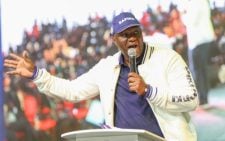
Sakaja recently criticised the current revenue-sharing formula, arguing that Nairobi generates about $28 billion (Ksh3.6 trillion) in gross domestic product (GDP) every year but struggles to deliver services because allocations do not reflect that contribution. He made the remarks during a church service in Embakasi on February 8, 2026.
“The GDP of Nairobi is about 28 billion dollars. When you leave it only to the formula in terms of resource sharing, it suffers,” Sakaja said.
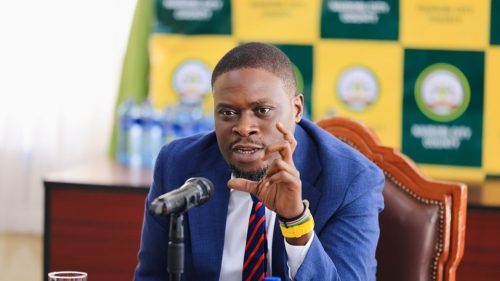
He explained that Nairobi County receives about Ksh1.7 billion each month from the equitable share. According to the governor, Ksh1.5 billion goes to salaries for roughly 19,000 county workers, while Ksh200 million is spent on the county assembly.
You Might Also Like



“If you leave Nairobi to only that formula, we will just be glorified cashiers,” Sakaja warned. He called for a special funding arrangement that reflects Nairobi’s economic role and the pressure placed on its services.
Kerrow questions revenue allocation
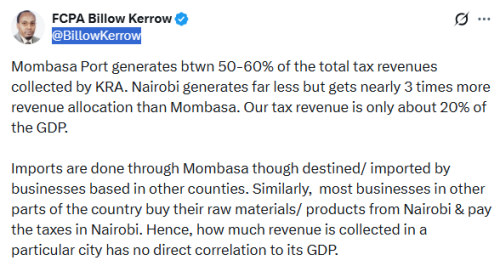
Kerrow responded in a post on X, shifting attention to how tax revenue is collected and what it really represents. The former senator, who also served as chair of the Senate Finance and Budget Committee, pointed to Mombasa Port, saying it handles a large share of customs and import-related taxes collected by the Kenya Revenue Authority (KRA).
Despite this, he noted, Nairobi receives nearly three times more in county revenue allocation than Mombasa.
Kerrow argued that the place where taxes are collected does not reflect where economic value is created.
“Imports are done through Mombasa though destined or imported by businesses based in other counties,” he wrote.
He added that many firms across the country buy goods and raw materials from Nairobi and pay taxes there.
“Similarly, most businesses in other parts of the country buy their raw materials or products from Nairobi and pay the taxes in Nairobi,” Kerrow said.
“Hence, how much revenue is collected in a particular city has no direct correlation to its GDP,” he concluded.
The exchange highlights a key tension in Kenya’s devolved system. The Commission on Revenue Allocation (CRA) designs the formula used to share the equitable portion of national revenue among the 47 counties, with Parliament approving it every five years. The current fourth basis covers the 2025/26 to 2029/30 period.
The formula places the biggest weight on population, at about 42 per cent, alongside equal share per county, poverty levels, fiscal effort, land area, and other factors meant to support service delivery and reduce inequality. It does not directly factor in GDP or where taxes are collected.
Author
Kenneth Mwenda
Kenneth Mwenda is a business, sports, and politics digital writer with over seven years of experience in journalism, covering breaking news, feature stories, and in-depth analysis across a range of beats.
For inquiries, he can be reached at [email protected]
View all posts by Kenneth MwendaLatest News







Advertisement
More on Inside Politics