Advertisement
Willis Otieno warns Safaricom share sale risks foreign capture
Friday 05th December, 2025 05:38 PM|

Lawyer Willis Otieno has issued a strong warning over the Safaricom share sale, arguing that Kenya risks surrendering control of one of its most strategic national assets.
In a detailed statement on Friday, December 5, 2025, he questioned the economic logic and long-term implications of allowing Vodacom to expand its stake, saying the country must confront what such a deal means beyond textbook theory.
He began by sharply criticising the defence of the sale offered by National Treasury CS John Mbadi.
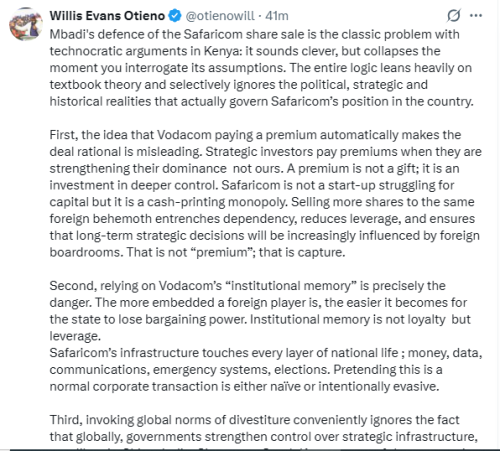
“Mbadi’s defence of the Safaricom share sale is the classic problem with technocratic arguments in Kenya: it sounds clever, but collapses the moment you interrogate its assumptions,” he said.

You Might Also Like



Otieno argued that the reasoning behind the sale selectively ignores deeper political and historical realities that shape Safaricom’s role in Kenya’s economy. He insisted that Vodacom’s premium pricing is not proof of a good deal for Kenyans.
“Strategic investors pay premiums when they are strengthening their dominance, not ours. A premium is not a gift; it is an investment in deeper control,” he said.
He went on to describe Safaricom as a cash-printing monopoly, saying surrendering more shares to the same foreign entity risks weakening the country’s leverage over a company that sits at the centre of national life.
“Selling more shares to the same foreign behemoth entrenches dependency, reduces leverage, and ensures that long-term strategic decisions will be increasingly influenced by foreign boardrooms. That is not ‘premium’; that is capture,” he noted.
Otieno added that relying on Vodacom’s institutional memory is not a safeguard but a vulnerability.
“Institutional memory is not loyalty but leverage,” he warned.
Sensitive data
He listed Safaricom’s influence over sensitive national systems, from money and data to emergency services and elections, insisting the sale cannot be treated as an ordinary corporate transaction.
He further criticised attempts to justify the sale using global examples, saying they ignore the fact that major economies protect their digital infrastructure rather than dilute control.
“Globally, governments strengthen control over strategic infrastructure, not dilute it,” he said.
Otieno concluded by questioning whether Kenya has the capacity to enforce protections around data and national interests.
“There are no enforceable safeguards in Kenya. None,” he said.
Author
Latest News







Advertisement
More on Business