Advertisement
Wamuchomba faults KQ over costly cargo charges, shrinking exports
Wednesday 31st December, 2025 08:51 AM|

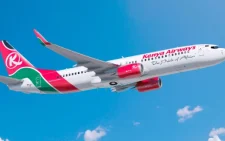
Githunguri Member of Parliament Gathoni Wamuchomba has raised fresh concerns over the handling of Kenya’s export cargo, questioning the role of Kenya Airways (KQ) in what she says is the growing strain faced by exporters.
In a statement shared on X on Tuesday, December 30, 2025, Wamuchomba pointed to high cargo charges, limited space, and what she described as missed opportunities by the national carrier, at a time when key export sectors are struggling.
“KQ, our sole national carrier, handles only 15 per cent of our export cargo produced in Kenya; that is meat, fresh vegetables, fish, fruits and flowers,” she stated

Wamuchomba questioned why, despite the large volume of exports that rely on air transport, there has been no clear move to expand cargo capacity. She suggested that the shortage of space has left exporters exposed to high costs, with many forced to seek alternatives outside the national carrier.
You Might Also Like

“Even with this gap of over 70 per cent of production not factored, we still don’t see the need to purchase a cargo plane?” she asked
The lawmaker went on to suggest that the limited cargo space may not be accidental, arguing that the situation has created room for excessive charges. She said exporters are bearing the burden as agents take advantage of the shortage, further squeezing already thin margins for farmers and traders.
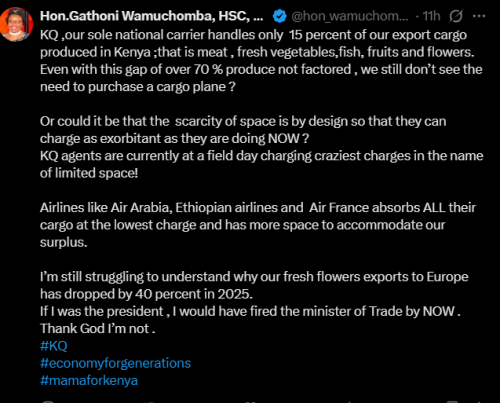
“Or could it be that the scarcity of space is by design so that they can charge as exorbitantly as they are doing now? KQ agents are currently at a field day, charging the craziest charges in the name of limited space!” she wrote
In her statement, Wamuchomba compared Kenya Airways with foreign carriers, saying some international airlines have been more responsive to exporters’ needs by offering more space at lower costs. She argued that this contrast raises hard questions about competitiveness and the future of Kenya’s export sector.
“Airlines like Air Arabia, Ethiopian Airlines and Air France absorb all their cargo at the lowest charge and have more space to accommodate our surplus,” she noted

Wamuchomba also linked cargo challenges to the decline in flower exports, a key foreign exchange earner for the country. She said the drop in exports should worry policymakers and prompt urgent reflection on leadership and policy direction in the trade sector.
“I’m still struggling to understand why our fresh flowers exports to Europe have dropped by 40 per cent in 2025. If I were the president, I would have fired the Minister of Trade by now. Thank God I’m not,” she wrote
Author
Latest News







Advertisement
More on Business