Treasury defends Ksh4.78T budget amid MPs’ revenue and spending scrutiny
By Faith Lagat, May 28, 2026Cabinet Secretary for the National Treasury, John Mbadi, has defended the proposed Ksh 4.785 trillion budget for the Financial Year 2026/27, even as lawmakers raised concerns over revenue projections, spending priorities, and fiscal sustainability during a session before the Budget and Appropriations Committee.
Appearing before the committee chaired by Samuel Atandi, CS Mbadi, alongside Treasury Principal Secretary Chris Kiptoo and Director General Albert Mwenda, presented a fiscal framework projecting total revenue, including Appropriations-in-Aid (A-I-A) of Ksh 3.629 trillion, against expenditure of Ksh 4.785 trillion, leaving a deficit of Ksh 1.111 trillion, equivalent to 5.3 percent of GDP.
He said the framework is anchored on reforms under the National Tax Policy and the Medium-Term Revenue Strategy.
“The Budget and Appropriations Committee, chaired by Hon. Samuel Atandi, has engaged the Cabinet Secretary for the National Treasury, Hon. John Mbadi, Treasury PS, Mr. Chris Kiptoo and DG, Budget and Fiscal Economic Affairs, Mr. Albert Mwenda on the FY 2026/27 Budget Estimates and the Medium-Term Fiscal Framework,” read the post in part.
Revenue and fiscal concerns
Members of Parliament questioned the realism of the revenue projections and the effectiveness of ongoing tax reforms. David Ochieng raised concerns over the county’s own-source revenue collection, saying significant losses persist due to weak enforcement and coordination.
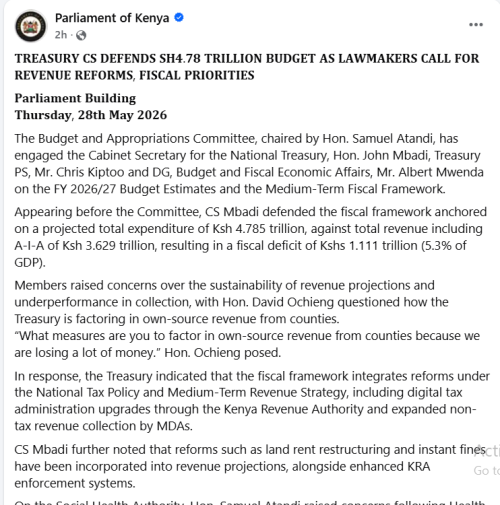
In response, CS Mbadi cited ongoing reforms at the Kenya Revenue Authority, including digital tax administration upgrades, expanded non-tax revenue collection by government agencies, restructuring of land rent systems, instant fines, and strengthened enforcement mechanisms aimed at improving compliance and widening the tax base.
Health, education and accountability issues
The Social Health Authority (SHA) dominated discussions, with Atandi and John Chikati seeking clarity on enrolment and benefit utilisation.
Mbadi said SHA has enrolled over 27 million Kenyans, with about 5 million active contributors, including 4 million payroll contributors and up to 1 million voluntary contributors. He noted that detailed beneficiary data is held by the SHA Board and the Ministry of Health.
On education financing, lawmakers raised concerns over pending bills and capitation funding. The Treasury acknowledged delays in exchequer releases but reported progress in clearing arrears, stating that payments to counties, NG-CDF and NGAAF are nearly up to date. The ministry also confirmed plans to recruit 24,000 intern teachers.
On procurement and fiscal reforms, MPs questioned the Electronic Government Procurement (EGP) system and Single Treasury Account implementation. CS Mbadi said most ministries and agencies have onboarded the EGP platform, while work is ongoing to strengthen cash management and integrate county revenue systems through the Intergovernmental Budget and Economic Council.
Budget framework and economic outlook
The Treasury said the budget remains anchored on the Bottom-Up Economic Transformation Agenda (BETA), focusing on agriculture, MSMEs, housing, digital economy and healthcare. Key targets include over 214,000 affordable housing units, more than one million title deeds, expansion of 80,000 kilometres of fibre optic infrastructure, 404 digital hubs, and training of 1.5 million youth under the Ajira programme.
CS Mbadi projected 5.0 percent economic growth in 2026 despite global economic pressures, citing Public-Private Partnerships in projects such as the Nairobi Expressway, Galana Kulalu and Menengai geothermal as key to easing fiscal pressure. The Budget and Appropriations Committee is expected to table its report in the National Assembly next week.