Tea Board breaks silence over farmers’ uproar on proposed tea levy
By Aloys Michael, June 1, 2026The Tea Board of Kenya has responded to growing opposition from tea farmers and industry stakeholders over the proposed tea levy, maintaining that the new charge will not reduce farmers’ earnings and will instead strengthen the tea sector through targeted reinvestment.
In a post on Monday, June 1, 2026, the board said concerns that the levy would burden farmers are misplaced, explaining that the charge will be paid by tea exporters and not producers.
“Under the proposed regulations, tea exports will attract a levy equivalent to 0.8 per cent of the auction value or customs value for direct sales. Imported bulk tea will attract a levy of 100 per cent of the auction value or customs value,” the board said.
Farmers, tea factories, domestic traders, aggregators and value-added tea products will be exempt from the levy.
The Tea Board has launched a public awareness campaign to address what it describes as widespread misconceptions about the proposal, particularly claims that the levy will lower farmers’ incomes.
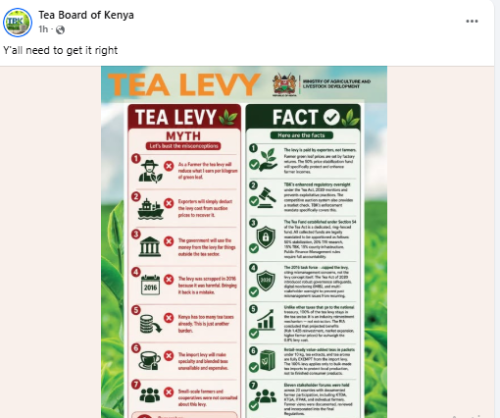
According to the board, 50 per cent of the revenue collected will be channelled into a tea price stabilisation fund aimed at protecting farmers from market fluctuations and improving their returns.
“Another 20 per cent will support research and development through the Tea Research Institute, while 15 per cent will finance the board’s regulatory functions. The remaining 15 per cent will be used to improve infrastructure in tea-growing counties,” the post read.
One of the key concerns raised by stakeholders is the possibility that exporters could transfer the cost of the levy to farmers through lower auction prices.
However, the board argues that regulatory safeguards under the Tea Act, 2020, together with the competitive tea auction system, will help prevent such practices.
The board has also dismissed fears that the funds could be diverted to unrelated government programmes. It noted that the Tea Fund established under the Tea Act, 2020, is a protected fund with legally defined allocations for farmer support, research, regulation and infrastructure development.

Concerns over the Tea Act
Defending the reintroduction of the levy, the board acknowledged that a 2016 task force had recommended its removal but said the concerns at the time centred on governance and accountability issues rather than the levy itself.
It added that the Tea Act, 2020, introduced stronger safeguards, including digital monitoring systems and multi-stakeholder oversight mechanisms, to ensure transparency.
The board further rejected claims that the tea industry is already overburdened by taxes, arguing that, unlike other levies paid to the National Treasury, all proceeds from the tea levy will remain within the tea sector.

According to impact assessments cited by the board, the anticipated benefits, including increased investment, market expansion and improved farmer returns, outweigh the cost of the levy.
“The proposed 100 per cent import levy is intended to protect local tea producers from competition posed by imported bulk-made tea,” the board clarified.
However, value-added teas packaged in units below 10 kilogrammes, tea extracts and tea aromas will remain exempt.
The Tea Board also defended the public participation process, saying it conducted 11 stakeholder forums across 20 counties involving tea farmers, factory representatives, the Kenya Tea Development Agency (KTDA), the Kenya Tea Growers Association (KTGA), the Independent Tea Producers Association of Kenya (ITPAK) and other industry players.
It said feedback collected during the consultations was reviewed and incorporated into the final draft regulations.