Advertisement
Study reveals how EAC is becoming China’s new steel frontier as global manufacturing shifts
Friday 05th June, 2026 11:53 PM|
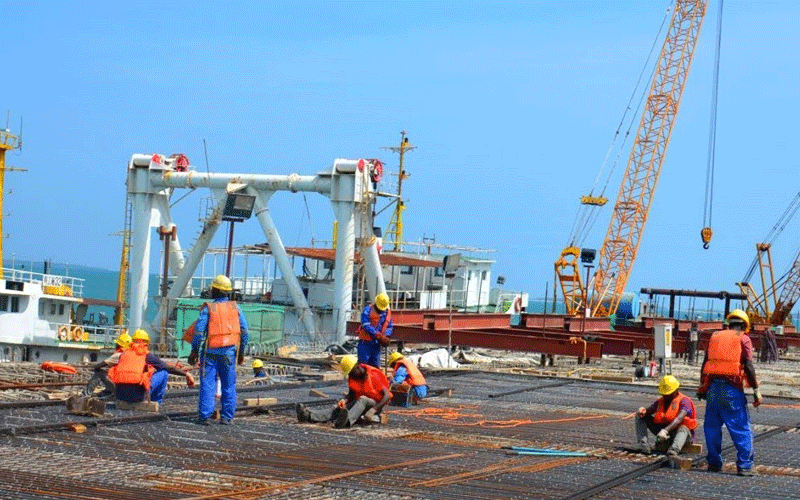
As China’s property slowdown deepens and steel demand weakens at home, a new industrial strategy is quietly taking shape across Africa: exporting factories instead of steel.
A new OECD Steel Outlook 2026 report suggests East Africa could become an important battleground in this global restructuring, with Chinese steel companies increasingly investing abroad as they seek new markets, production bases and strategic access to fast-growing economies.
For Kenya, Tanzania, Uganda and Rwanda, the implications could be profound.
The report reveals that cross-border investments now account for approximately 21 per cent of all future steelmaking capacity investments globally. More than half of these projects involve Chinese companies, either independently or through joint ventures, many of them state-owned enterprises.
You Might Also Like



“China has been particularly active in investing abroad,” the OECD notes, adding that most of these investments are concentrated in Asia, with the remainder increasingly directed toward Africa.
The trend signals a major shift in global manufacturing.

For decades, China exported steel products around the world. Today, faced with growing trade barriers, anti-dumping investigations and weakening domestic demand, Chinese firms are increasingly investing directly in overseas steel production and processing facilities.
The strategy allows manufacturers to maintain access to international markets while positioning themselves closer to emerging sources of demand.
And few regions offer stronger long-term growth prospects than East Africa.
The OECD projects that Africa will remain one of the fastest-growing steel-consuming regions globally through 2030, driven by urbanisation, infrastructure development and industrialisation. Steel demand across the continent is expected to continue expanding as governments invest in housing, roads, railways, energy infrastructure and manufacturing zones.
That growth is attracting attention from global investors.
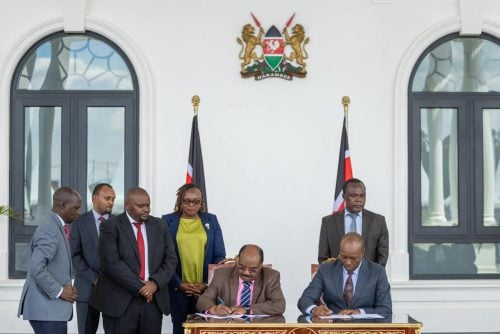
Across East Africa, governments are aggressively developing Special Economic Zones, industrial parks, logistics corridors and port infrastructure designed to attract manufacturing investment.
Kenya’s Dongo Kundu Special Economic Zone, Naivasha Industrial Park and Lamu Port-South Sudan-Ethiopia Transport (LAPSSET) Corridor are among projects positioning the country as a regional industrial hub.
Tanzania is expanding port infrastructure and industrial parks linked to the Standard Gauge Railway (SGR) network, while Uganda continues to develop mineral-processing and manufacturing zones tied to its growing energy sector.
The question increasingly facing policymakers is whether the next generation of steel plants serving African markets will be built in East Africa rather than East Asia.
The OECD report points to another factor driving the shift: trade tensions.
It warns that traditional steel-exporting nations are facing increasing restrictions as governments attempt to shield domestic industries from global overcapacity. New tariffs, safeguard measures and anti-dumping duties are making it harder for producers to rely solely on exports.
Foreign investment offers an alternative.

The SGR project
“By investing in steelmaking or processing facilities in third countries, firms can maintain market presence and shift exports between jurisdictions as trade actions evolve,” the report says.
For East African economies, the potential benefits are significant. Large-scale steel investments can create thousands of jobs, support infrastructure development, deepen manufacturing supply chains and reduce dependence on imported industrial materials.
The region also possesses another strategic advantage: access to critical minerals increasingly needed for industrial production.
From iron ore deposits in Uganda and Tanzania to emerging logistics corridors connecting ports, railways and industrial zones, East Africa is steadily building the foundations required for large-scale manufacturing.
However, the OECD also raises cautionary flags.
The report notes that approximately 86 per cent of Chinese cross-border steel investments are focused on blast furnace-based facilities, which generally operate at larger scales and produce higher carbon emissions than newer electric arc furnace technologies.
That creates difficult policy questions for African governments seeking industrial growth while pursuing climate commitments.
There are also concerns about whether local economies capture sufficient value from foreign investment.
Will East Africa become merely a production platform for overseas companies, or can governments leverage investment to build domestic industries, transfer technology and create regional manufacturing champions?
Author
Latest News








Advertisement
More on Business