Advertisement
SHA faces huge losses as SHIF spends far more than it collects
Thursday 30th April, 2026 07:28 AM|

The Social Health Authority (SHA) faces serious financial pressure after its main contributory fund paid out far more than it collected in its first full year of operation.
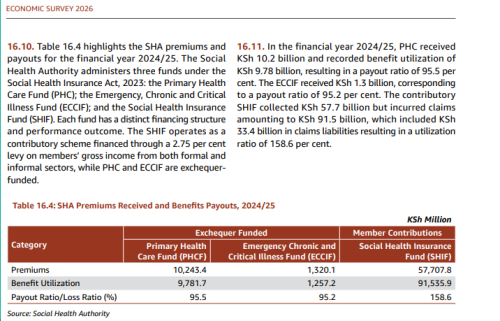
Figures released in the KNBS Economic Survey 2026 show the Social Health Insurance Fund (SHIF) recorded a utilisation ratio of 158.6 per cent in the 2024/25 financial year. The fund took in Ksh57.7 billion from member contributions but faced claims and liabilities of Ksh 91.5 billion. This left a shortfall of Ksh33.8 billion.
The government introduced SHIF in 2024 to replace the National Health Insurance Fund (NHIF). It operates as a contributory scheme financed by a 2.75 per cent levy on members’ gross income from both formal and informal sectors. Yet claims quickly overwhelmed income.
By contrast, the two exchequer-funded schemes performed close to the target. The Primary Health Care Fund (PHCF) received Ksh 10.2 billion and paid out Ksh 9.78 billion, giving a payout ratio of 95.5 per cent. The Emergency, Chronic, and Critical Illness Fund (ECCIF) achieved a 95.2 per cent ratio after receiving Ksh1.3 billion and utilising Ksh1.26 billion.
Membership growth, funding strain
You Might Also Like

SHA now runs three separate funds under the Social Health Insurance Act 2023. Officials designed SHIF to stand on its own feet through member contributions. The heavy overspend raises immediate questions about its long-term sustainability.
The authority registered nearly 21 million members by the end of 2024/25. Women made up 51.7 per cent of those who declared their sex, while men accounted for 47.3 per cent. Some 212,800 members did not state their gender.
Nairobi City, Kiambu, Nakuru, Mombasa and Kakamega led registrations, while arid and semi-arid counties such as Isiolo, Lamu, Tana River, Samburu and Marsabit each contributed less than one per cent.
This uneven coverage adds to the challenge. Many members live in urban areas with easier access to hospitals, which drives higher claims. At the same time, collection from the informal sector – the majority of Kenya’s workforce – remains difficult.
The Economic Survey notes that the Ksh 91.5 billion in SHIF claims included Ksh33.4 billion in liabilities carried forward. This suggests hospitals submitted bills that the fund has not yet settled in full.
Health infrastructure grew modestly in 2025, with operational facilities rising to 16,713. Hospital beds increased to 104,300. Yet the rapid rise in claims shows demand for services outpaced the money flowing into the contributory fund.
SHA officials must now find ways to increase contributions, control costs and reduce the backlog. Without changes, the government may need to inject more money from the exchequer to keep services running. The 158.6 per cent ratio sends a clear signal: Kenya’s flagship health insurance scheme delivered more care than expected in its first year, but the financial model needs urgent fixing.
Author
Kenneth Mwenda
Kenneth Mwenda is a business, sports, and politics digital writer with over seven years of experience in journalism, covering breaking news, feature stories, and in-depth analysis across a range of beats.
For inquiries, he can be reached at [email protected]
View all posts by Kenneth MwendaLatest News



Advertisement
More on Business