KPC assures Kenyans of adequate fuel supply
By Kenneth Mwenda, April 8, 2026The Kenya Pipeline Company (KPC) has reassured the public that there is sufficient fuel in all its terminals and depots across the country. The company says the products meet both national and international quality standards.
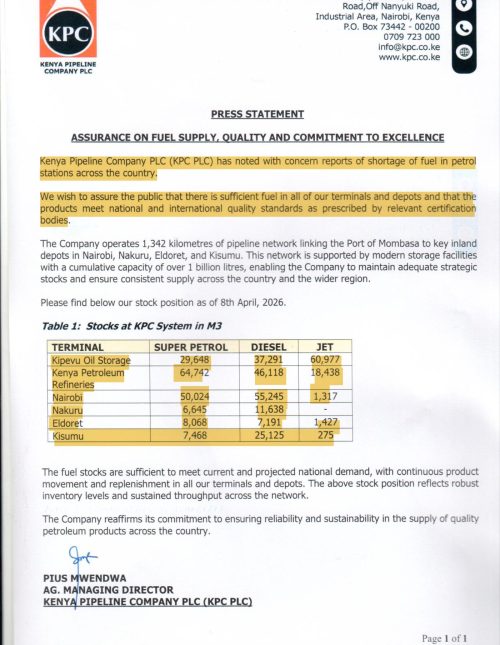
In a statement released on Wednesday, April 8, 2026, KPC highlighted that it operates a 1,342-kilometre pipeline network linking the Port of Mombasa to major inland depots in Nairobi, Nakuru, Eldoret, and Kisumu. The network is supported by modern storage facilities with a combined capacity of over one billion litres, enabling the company to maintain strategic stocks and ensure consistent supply.
“Kenya Pipeline Company PLC (KPC PLC) has noted with concern reports of shortage of fuel in petrol stations across the country. We wish to assure the public that there is sufficient fuel in all of our terminals and depots and that the products meet national and international quality standards as prescribed by relevant certification bodies,” KPC stated.
The table of KPC’s stock shows that Kipevu Oil Storage holds 29,648 cubic metres of super petrol, 37,291 cubic metres of diesel, and 60,977 cubic metres of jet fuel. The Kenya Petroleum Refineries depot has 64,742 cubic metres of super petrol, 46,118 cubic metres of diesel, and 18,438 cubic metres of jet fuel. Nairobi, Nakuru, Eldoret, and Kisumu depots also maintain substantial quantities.
Fuel shortages push fares up
KPC’s assurance comes amid reports of fuel shortages in several petrol stations nationwide. Long queues, rationing, and stock-outs have been reported in regions including Nairobi, Nakuru, Eldoret, Kisumu, Karatina, and Nyeri.
Motorists and transport operators have expressed frustration. James Gitonga, a private motorist travelling from Mwea to Nakuru, said:
“Many petrol stations in Karatina and Nyeri do not have fuel. I had to buy V-Power because the regular petrol was unavailable, and it is expensive,” Gitonga said.
Kelvin Chumo, an official at Satima Sacco in Nakuru, said matatu fares have risen sharply due to the shortage.
“Fares that usually stand at Ksh450 have climbed to Ksh600. Operators have no choice but to pass the higher costs to passengers,” he said.
The government has also intervened in a controversial fuel shipment imported outside the Government-to-Government (G-to-G) framework. Energy Cabinet Secretary Opiyo Wandayi ordered One Petroleum Limited to remove a 60,000-metric-tonne consignment of super petrol, citing irregularities and a threat to price stability.
“This consignment was priced at Ksh198,000 per metric tonne compared to Ksh140,000 per metric tonne under the G-to-G framework. This would have raised pump prices by about Ksh14 per litre,” the CS said.
Following the directive, One Petroleum confirmed it had acted to ensure the cargo, delivered on 27th March aboard MT Paloma, would not enter the local market. The ministry instructed oil marketing companies not to pay invoices related to the shipment and to exclude the consignment from monthly fuel cost calculations.
Analysts and transport operators warn that continued disruptions could further impact commuter fares and the cost of goods. Martin Chomba, chair of the Petroleum Outlets Association of Kenya, said fuel prices may rise between Ksh30 and Ksh60 per litre when new rates are reviewed on April 14.
The public now faces uncertainty as they travel longer distances to access fuel, with some stations closed and others only stocking premium fuel. Panic buying has been reported in parts of the country, reflecting growing concern despite KPC’s assurances.