Advertisement
KNBS: Lists of items whose prices increased in November 2025
Friday 28th November, 2025 09:13 PM|

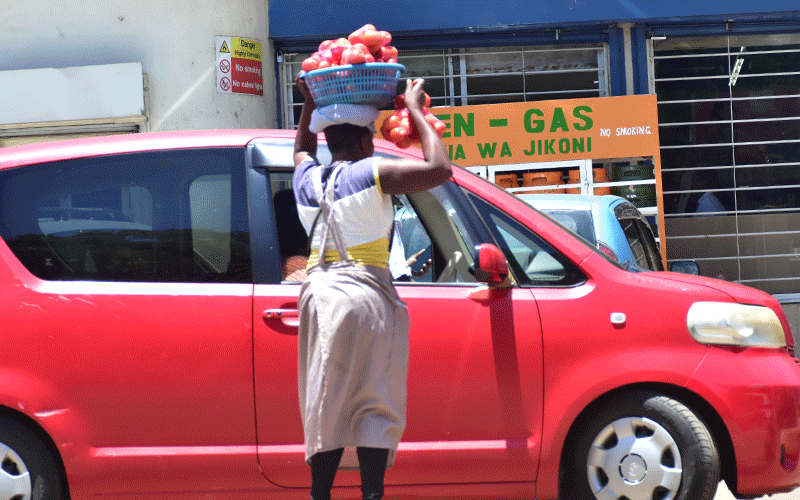
Kenyan households are feeling renewed pressure on their budgets after the Kenya National Bureau of Statistics (KNBS) released fresh inflation data showing that the prices of several basic goods increased between October and November 2025, with food items making the biggest jump.
A report released by KNBS on Friday, November 28, 2025, shows that inflation rose slightly in November, driven by increases in the cost of food, transport and household utilities. According to KNBS, these three categories account for more than half of the weight used to measure the cost of living in the country.
“The price increase was primarily driven by a rise in prices of items in the Food and Non-Alcoholic Beverages (7.7%); Transport (5.1%), and Housing, Water, Electricity, Gas and other fuels (1.9%) over the one-year period. These three divisions together account for over 57 per cent of the total weight across the 13 major expenditure categories,” the statement reads.
Slight increase in inflation
The bureau added that the overall inflation rate had declined slightly from 4.6 per cent in October 2025 to 4.5 per cent in November 2025.
You Might Also Like


“The overall index increased from 146.84 in October 2025 to 147.08 in November 2025, resulting in a monthly inflation rate of 0.2%. The year-on-year inflation rate stood at 4.5% in November 2025, a slight decline from an inflation of 4.6% in October 2025,” KNBS stated.
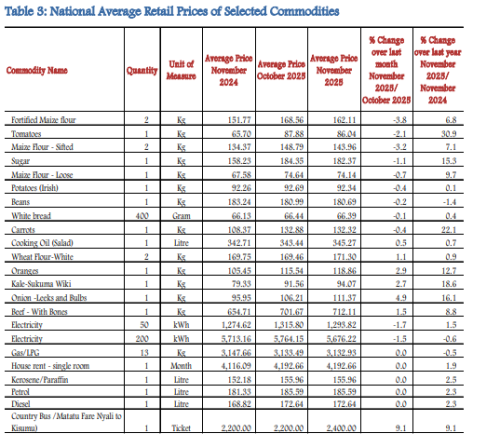
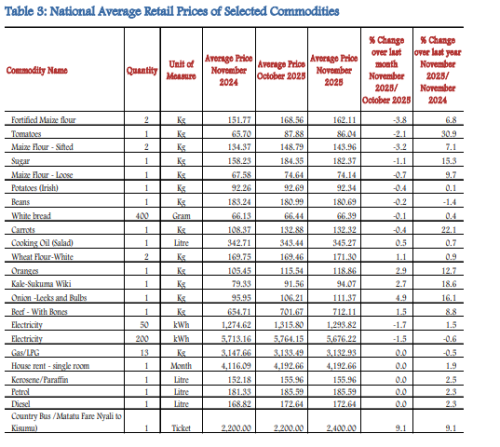
A closer analysis of the commodity tables shows that several essential items recorded notable price changes between October and November 2025.
Sugar dropped from Ksh184.95 per kilo in October to Ksh182.23 in November. Sukuma wiki climbed from Ksh 91.56 to Ksh 94.07, while onions moved from Ksh 106.21 to Ksh 111.37, adding pressure on households already coping with tight food budgets.
Carrots, despite showing a drop compared to 2024, dropped marginally month-on-month from Ksh132.88 to Ksh132.32. Oranges also went up from Ksh115.53 to Ksh118.86.
Cooking oil rose slightly as well, from Ksh343.44 to Ksh345.27 per litre, continuing a trend of steady increments in household cooking essentials.
However, not everything went up. Tomatoes dropped significantly to Ksh86.04 from Ksh87.88, offering relief to many households. Potatoes remained relatively stable at Ksh92.34, while maize flour (sifted) decreased slightly from Ksh148.79 to Ksh143.96.
Oranges cost 12.7% more than in 2024, while onions, a staple in almost every meal, increased by 16.1%.
Changes in the consumer price indices
Electricity prices saw mixed movements. The 50 kWh tariff fell from Ksh1,315.80 to Ksh1,293.82, but the 200 kWh bracket softened only marginally.
Transport costs increased by 0.4 per cent month-on-month, reflecting fuel prices that remained high. Diesel and petrol prices held steady, but the cost of travelling between cities rose, with long-distance fares increasing by 9.1 per cent over the year.
While the overall inflation rate may appear modest, the rise in the cost of food, which carries the heaviest weight in the inflation basket, continues to shape how Kenyan families adjust their shopping priorities month to month.
The KNBS data shows that food and non-alcoholic beverages, which carry the highest weight in the inflation basket at 32.9 per cent, rose by 7.7 per cent, making them the biggest contributor to rising household costs.
Author
Latest News








Advertisement
More on Business