Advertisement
Kenya’s exports fall sharply as debt surges in second quarter of 2025
Sunday 05th October, 2025 08:23 PM|
Kenya’s balance of payments for the second quarter of 2025 paints a worrying picture of an economy under pressure. Data from the Kenya National Bureau of Statistics (KNBS) shows that the country’s current account deficit widened sharply, exports tumbled, and external debt climbed, even as financial inflows and remittances offered temporary relief.
Current account woes
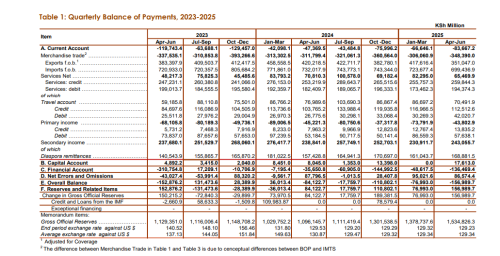
The current account deficit ballooned by 76.6 per cent, reaching Ksh83.7 billion in Q2 2025, compared to Ksh 47.4 billion a year earlier. KNBS attributed this to a wider merchandise trade deficit, which grew by 11.7 per cent to Ksh348.4 billion.
Exports fell steeply by 16.5 per cent, dropping from Ksh420.2 billion to Ksh351.0 billion, while imports decreased by a smaller 4.5 per cent, from Ksh732.0 billion to Ksh699.4 billion, from April to June.
This means Kenya’s trade balance worsened by Ksh36.6 billion, a direct reflection of exports declining far faster than imports.
You Might Also Like



The services account also weakened, with its surplus shrinking from Ksh70.8 billion to Ksh65.5 billion. KNBS noted that service expenditures grew faster than earnings, while the travel account, a key contributor through tourism, saw its surplus drop from Ksh77.0 billion to Ksh70.5 billion, following a 57.0 per cent rise in debit payments to Ksh42.0 billion.
On the positive side, the primary income account deficit narrowed slightly from Ksh 45.2 billion to Ksh 43.8 billion, while the secondary income account benefited from rising remittances. Diaspora inflows grew by 7.3 per cent to Ksh168.9 billion, lifting the secondary income surplus to Ksh243.1 billion from Ksh238.8 billion, cushioning the impact of the trade decline.
Financial account strength
Kenya’s financial account provided much-needed support to the economy. Net financial inflows surged nearly fourfold to Ksh136.5 billion, up from Ksh35.7 billion in Q2 2024.
The turnaround was mainly driven by portfolio investments, which flipped from outflows to inflows, reflecting renewed investor confidence.
At the same time, gross official reserves rose by 40.0 per cent to Ksh1,534.8 billion, buoyed by a buildup of Ksh157.0 billion in reserve assets.
As a result, the overall balance of payments swung to a surplus of Ksh157.0 billion, compared to Ksh84.1 billion the previous year.
The reserves-to-imports ratio, a key measure of external resilience, stood at 6.6 months, well above the global safety benchmark of four months. This means Kenya could cover over half a year of imports using its reserves, offering a strong buffer against external shocks.
External debt concerns
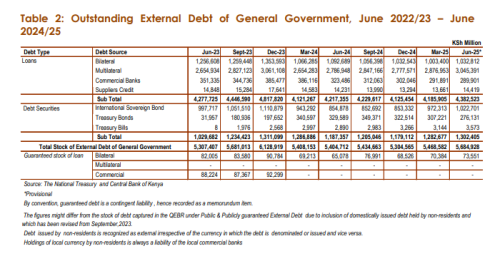
Kenya’s external debt continues to rise, reaching Ksh5,684.9 billion by June 2025, up 5.2 per cent from Ksh5,404.7 billion in 2024.
Loans make up the bulk of this debt at 77.1 per cent, totaling Ksh4,382.5 billion. Within this, multilateral loans, mostly from international financial institutions, rose by 9.3 per cent to Ksh 3,045.4 billion, while bilateral and commercial loans fell by 5.5 per cent and 10.4 per cent, respectively.
2024/25
. PHOTO/Screengrab by People Daily Digital
Debt securities increased to Ksh1,302.4 billion, driven by a 19.6 per cent rise in International Sovereign Bonds to Ksh1,022.7 billion, though treasury bonds held by non-residents dropped by 16.2 per cent to Ksh276.1 billion.
Kenya’s total stock of external debt for the general government stood at Ksh5,684.9 billion by June 2025, up 5.2 per cent from Ksh5,404.7 billion a year earlier. Based on a nominal GDP of Ksh17,034.1 billion (131.7 billion USD at Ksh129.34 per USD), this implies an external debt-to-GDP ratio of 33.4 per cent.
For context, total national debt, which includes domestic obligations in addition to external borrowing, is higher. Statista reports Kenya’s overall debt-to-GDP ratio at around 68.34 per cent in 2025, highlighting the difference between external debt and total government liabilities.
Trade dynamics
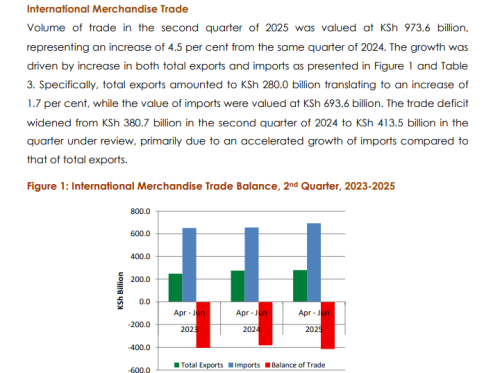
KNBS data shows total merchandise trade rising 4.5 per cent to Ksh973.6 billion. However, this was driven largely by imports.
Exports rose by a marginal 1.7 per cent to Ksh280.0 billion, buoyed by coffee (up 69.0 per cent to Ksh19.7 billion), horticulture (up 19.1 per cent to Ksh55.0 billion), and animal and vegetable oils (up 53.5 per cent to Ksh12.9 billion).
In contrast, titanium exports plunged due to depleted Kwale deposits, while salt and cement exports dropped by 28.1 per cent and 42.3 per cent, respectively.
Imports increased by 5.7 per cent to Ksh693.6 billion, driven by industrial machinery (up 18.0 per cent), iron and steel (up 84.0 per cent), and road motor vehicles (up 38.0 per cent). Reduced imports of petroleum products (-13.2 per cent) and fertilizers (-38.2 per cent) helped moderate the overall bill.
Regionally, Africa remained Kenya’s top export destination, accounting for 37.7 per cent of total exports (Ksh 105.7 billion), with Uganda and the DRC posting strong growth. Europe’s exports rose 21.4 per cent to Ksh72.5 billion, while Asia’s exports dipped to Ksh73.5 billion, reflecting lower jet fuel re-exports to Gulf countries.
Asia, however, dominated imports with Ksh461.1 billion (66.5 per cent), led by China and India.
The African Growth and Opportunity Act
Kenya’s export performance is also being shaped by shifting trade dynamics beyond Africa. The recent one-year extension of the African Growth and Opportunity Act (AGOA), confirmed by President William Ruto on October 4, 2025, offers temporary relief for exporters whose products depend heavily on U.S. market access.
Under AGOA, Kenya’s apparel, textile, coffee, tea, and horticultural exports continue to enter the U.S. duty-free until September 2026. In 2024 alone, the country exported apparel worth $470 million (Ksh 60.7 billion) to the United States, sustaining more than 66,000 jobs in export processing zones.
However, analysts caution that a single-year extension may only serve as a stopgap measure. The uncertainty makes it harder for factories to plan long-term investments, while delays in securing a bilateral trade deal with Washington could hinder export stability.
As Ruto noted, Kenya is pursuing a direct trade agreement with the U.S. to ensure lasting access to one of its most critical markets.
Agricultural sectors
The challenges facing Kenya’s export base are mirrored in its key agricultural sectors. The Kenya Tea Development Agency (KTDA) recently attributed this year’s drop in tea bonus payments to weak international demand and currency shifts.
In a September 30, 2025, statement, KTDA explained that the average exchange rate strengthened from Ksh144 per dollar in 2024 to Ksh129 in 2025, reducing returns in local currency despite stable global prices.
Regionally, farmers across both the East and West of Rift Valley saw earnings fall sharply, with factories in Kericho and Bomet reporting drops of over Ksh 80–100 per kilo of made tea. The situation underscores the vulnerability of Kenya’s agricultural exports to exchange rate movements and external market conditions.
KTDA has pledged to diversify into orthodox teas and push for value addition to stabilise farmer incomes. Yet, for now, the sector’s struggles feed into the broader current account pressures highlighted by KNBS, with lower agricultural earnings directly reducing foreign exchange inflows.
Author
Kenneth Mwenda
Kenneth Mwenda is a business, sports, and politics digital writer with over seven years of experience in journalism, covering breaking news, feature stories, and in-depth analysis across a range of beats.
For inquiries, he can be reached at [email protected]
View all posts by Kenneth MwendaLatest News








Advertisement
More on Business