Advertisement
Kenya shilling holds steady amid robust treasury bill demand
Sunday 22nd February, 2026 08:07 AM|

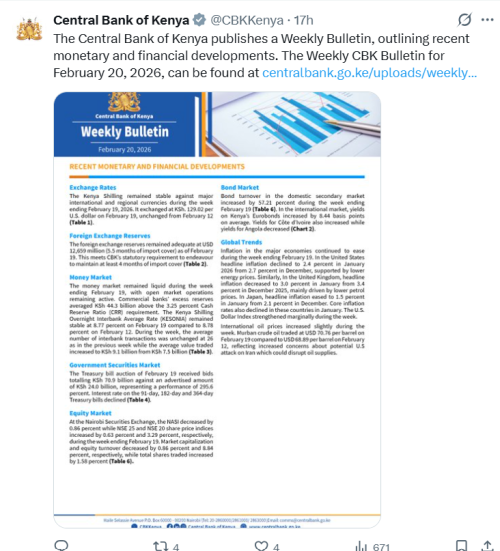
The Kenya shilling maintained stability against key international and regional currencies during the week ending February 19, 2026.
Data from the Central Bank of Kenya (CBK) shows the shilling exchanged at Ksh129.02 per U.S. dollar on February 19, unchanged from February 12 and consistent across the period from February 6 to 19.
Minimal fluctuations were also observed against the sterling pound, closing between Ksh174.00 and 176.33, the euro at Ksh152.12–153.75, and regional currencies, including the Ugandan and Tanzanian shillings.
Market analysts say this steadiness reflects continued confidence in the foreign exchange market, supported by robust liquidity and investor activity in government securities.
You Might Also Like



“The Kenya Shilling remained stable against major international and regional currencies during the week ending February 19, 2026. It exchanged at Ksh129.02 per U.S. dollar on February 19, unchanged from February 12,” read the CBK bulletin in part.
Treasury bill auction sees overwhelming demand
The stability of the shilling coincided with strong activity in the government securities market. The latestTreasury bill auction, held on February 19, had an advertised amount of Ksh24.0 billion and received bids totalling Ksh70.9 billion, representing an oversubscription of 295.6 per cent.
High participation was recorded across all tenors, with the 91-day, 182-day, and 364-day bills attracting significant investor interest.
Average interest rates on the bills declined slightly compared to previous auctions, reflecting a favorable liquidity environment and continued investor confidence in short-term government debt.
The high demand for Treasury bills signals that investors view these instruments as safe and predictable avenues for returns, even amid mixed signals in other market segments such as equities and Eurobonds.
Money market liquidity and reserves support stability
The domestic money market remained liquid during the week, with commercial banks holding excess reserves averaging Ksh44.3 billion above the required Cash Reserve Ratio.
The Kenya Shilling Overnight Interbank Average Rate (KESONIA) held at 8.77 percent on February 19, slightly lower than the previous week’s 8.78 percent. Interbank transaction values increased to an average of Ksh9.1 billion from Ksh 7.5 billion, while the number of deals remained steady at 26.
Backing this stability are foreign exchange reserves of approximately Ksh1.633 trillion, equivalent to 5.5 months of import cover, which iswell above the CBK’s statutory minimum of four months. These buffers help shield the shilling from external shocks and support predictable planning for importers and businesses.
Overall, the combination of strong Treasury bill demand, ample liquidity, and solid reserves highlights a resilient domestic financial environment as Kenya enters early 2026.
Author
Latest News








Advertisement
More on Business