Kenya gives markets regulator oversight of crypto firms under new law, CMA reveals
By Aloys Michael, July 25, 2026Kenya has placed cryptocurrency exchanges, brokers and digital asset investment firms under the oversight of the Capital Markets Authority (CMA), marking one of Africa’s most significant regulatory overhauls of the virtual assets sector as the country seeks to strengthen investor protection while complying with global anti-money laundering standards.
The change follows the enactment of the Virtual Assets Service Providers (VASP) Act, 2025, which, according to the CMA’s Annual Supervision Report 2025, establishes “the legal and regulatory framework for the licensing and regulation of virtual assets service providers in Kenya.”
The report says the new law designates the CMA as the regulator of virtual asset exchanges, virtual asset brokers, virtual asset investment advisers, virtual asset managers and virtual asset offering providers, ending years in which Kenya’s fast-growing cryptocurrency industry operated without a dedicated legal framework. It adds that the National Treasury, the CMA and the Central Bank of Kenya (CBK) are developing regulations that will set out detailed licensing and supervisory requirements.
The reforms position Kenya among a growing number of jurisdictions introducing dedicated oversight for digital assets as governments seek to encourage financial innovation while reducing risks linked to money laundering, terrorist financing and fraud.
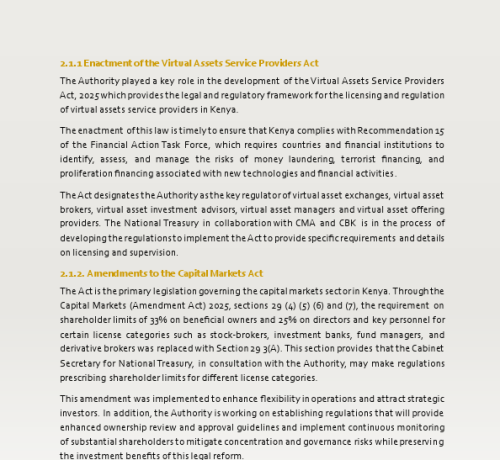
“The enactment of this law is timely to ensure that Kenya complies with Recommendation 15 of the Financial Action Task Force, which requires countries and financial institutions to identify, assess, and manage the risks of money laundering, terrorist financing, and proliferation financing associated with new technologies and financial activities,” the report states.
The legislation represents a significant expansion of the CMA’s regulatory mandate, bringing the country’s cryptocurrency ecosystem under the same supervisory framework that governs Kenya’s capital markets.
The crypto reforms are part of a broader package of regulatory changes unveiled in 2025 to modernise Kenya’s financial markets. The report says the Authority overhauled its licensing framework to respond to “changing technological and other developments in the capital markets sector requiring more elaborate licensing and prudential requirements.”
Among the changes are new licensing requirements for over-the-counter trading platforms, intermediary service platform providers, custodians and corporate trustees. The regulations also introduce licensing requirements for investment advisers providing algorithm-driven investment advice, reflecting the growing use of artificial intelligence in financial services.
The report suggests the reforms are intended to strengthen market integrity while supporting innovation. They also align Kenya’s regulatory framework more closely with international standards at a time when digital assets are attracting greater scrutiny from regulators worldwide.

Kenya has emerged as one of Africa’s leading digital finance markets, supported by widespread mobile money adoption, a vibrant fintech ecosystem and growing retail participation in cryptocurrencies. Until now, however, the country lacked a comprehensive legal framework governing businesses that facilitate trading, investment and fundraising through virtual assets.
The crypto legislation coincides with wider efforts by the CMA to strengthen cross-border regulatory cooperation. During 2025, the Authority became the 28th signatory globally and only the second African regulator to join the International Organization of Securities Commissions’ Enhanced Multilateral Memorandum of Understanding (EMMoU), a framework designed to improve information sharing and enforcement cooperation among securities regulators.
According to the report, the agreement is expected to “strengthen financial market integrity and investor protection” by enhancing cooperation among regulators in responding to increasingly global and technology-driven financial markets.
The CMA also says Kenya’s capital markets are becoming more integrated into regional and international financial systems through regulatory cooperation and cross-border investment initiatives. It works with the National Treasury, the CBK and other domestic financial regulators to promote financial stability, investor protection and orderly market development.
The effectiveness of the new crypto regime will now depend on the implementing regulations being prepared by the Treasury, CMA and CBK. Those rules are expected to determine how virtual asset businesses will be licensed, supervised and monitored, potentially providing long-sought regulatory certainty for investors while strengthening safeguards against financial crime and bringing Kenya’s digital asset sector into line with global regulatory standards.