Advertisement
Justina Wamae explains how Africa can reduce dependence on foreign trade frameworks
Tuesday 07th October, 2025 10:56 AM|

Former Roots Party deputy presidential aspirant Justina Wamae has urged African countries to take advantage of the lapse of the African Growth and Opportunity Act (AGOA) to strengthen continental integration through major infrastructure projects.
In a statement released on Tuesday, October 7, 2025, Wamae explained that the AGOA agreement, which was enacted in 2000, granted eligible sub-Saharan African countries duty-free access to the U.S. market for over 1,800 products, including value-added goods such as apparel, fish, and dried fruits. The agreement officially expired on September 30, 2025.
Also Watch: Justina Wamae: With William Ruto, bet ishaungua. So let’s focus on the future.
According to Wamae, the lapse of AGOA presents Africa with a rare opportunity to accelerate the implementation of the African Continental Free Trade Area (AfCFTA) and channel more investment into transformative regional projects.
You Might Also Like

“The AGOA agreement is the African Growth and Opportunity Act, a U.S. law enacted in 2000 provides eligible sub-Saharan African countries with duty-free access to the U.S. market for over 1,800 products, including value-added goods like apparel and agro-food products, such as fish & dried fruits. The Africa Growth Opportunity Act (AGOA) lapsed on September 30th 2025.” Wamae stated.
She pointed out that by focusing on such initiatives, African countries can reduce their dependence on external trade frameworks and strengthen internal trade networks.
Key projects to be implemented
She highlighted several key projects that could redefine Africa’s economic future if prioritised.
Among them is the LAPSSET Corridor, a transport and infrastructure network linking Kenya’s Lamu Port to South Sudan and eventually to Cameroon’s Douala Port, forming a major East–West trade route across the continent.
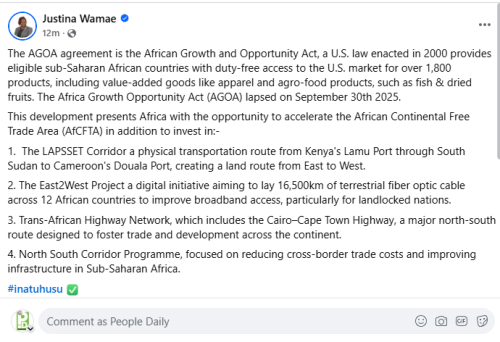
Another is the East2West Project, a digital infrastructure plan aimed at laying 16,500 kilometres of terrestrial fibre optic cable across 12 African nations to enhance broadband connectivity, particularly for landlocked states.
Wamae also emphasised the importance of the Trans-African Highway Network, which includes the Cairo–Cape Town Highway, a vital north–south route intended to promote trade and development across the continent. She further mentioned the North–South Corridor Programme, which seeks to improve regional transport infrastructure and reduce cross-border trade costs within Sub-Saharan Africa.
She noted that the combined implementation of these initiatives would help Africa achieve greater economic independence, promote industrial growth, and create sustainable employment opportunities across the continent.
Wamae concluded that the end of AGOA should not be viewed as a setback but as a strategic moment for Africa to build its own trade and industrial systems under the AfCFTA framework.
Ruto confirms AGOA extension
These come days after President William Ruto announced that AGOA has been extended for one more year after elapsing on September 30.
Speaking at Nyang’ori PAG Church Centenary in Vihiga County on Saturday, October 4, 2025, the Head of State said his recent trip to the US resulted in the deal’s renewal.
“Na ndio mliona juzi, nikiwa kule Marekani. Nimeongea na serikali ya Marekani, na sasa wametupatia extension ya ile soko ya AGOA, na sasa kwa the next one year, we will continue to export into their American market,” Ruto told the congregation.
The announcement came just four days after the 25-year-old agreement expired on September 30, raising concerns among exporters and workers in the apparel and textile industry. The extension means Kenyan products will continue to enjoy tax-free access to the vast American market.
Author
Latest News








Advertisement
More on Business