Advertisement
How new EAC import duty rates will affect Kenya’s market
Thursday 02nd July, 2026 02:29 PM|

Kenyan consumers and businesses are set to feel the impact of newly approved East African Community (EAC) import duty changes after regional ministers approved a raft of temporary adjustments to the Common External Tariff (CET), affecting everything from mobile phones and rice to baby diapers and lithium-ion batteries.
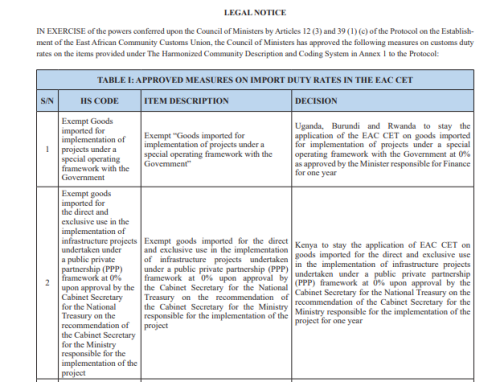
The new measures, published in the East African Community Gazette on June 30, take effect for one year and allow Partner States to temporarily depart from the standard CET to protect local industries, address supply shortages or support strategic sectors.
“The Council of Ministers has approved the following measures on customs duty rates under the EAC Customs Union Protocol,” the notice states.
Among the most notable changes is Kenya’s decision to introduce a 25 per cent import duty on mobile phones, ending the previous zero-rated tariff.
You Might Also Like



According to the gazette, “Kenya [will] stay the application of the EAC CET rate of 0% and apply a duty rate of 25% for one year,” while Uganda opted for a lower 10 per cent rate.
The move is expected to increase import costs for phone dealers, although the extent to which consumers pay higher prices will depend on retailers and distributors.
Parents could also face higher costs after Kenya, Uganda and Tanzania agreed to raise the import duty on imported baby diapers from 25 per cent to 35 per cent for one year, a measure aimed at supporting regional manufacturers.
There is some relief for households, however, through cheaper rice imports.
“Kenya [will] stay the application of the EAC CET rate of 75% or US$345/MT, whichever is higher and apply a duty rate of 35% or US$200/MT, whichever is higher for one year,” the notice reads.
The lower levy is expected to reduce import costs and could help stabilise retail rice prices if savings are passed on to consumers.

Kenya also retained its current import regime for second-hand clothing, commonly known as mitumba. Instead of adopting the regional benchmark of 35 per cent or Ksh52 per kilogram, the country will continue charging 35 per cent or Ksh26 per kilogram, whichever is higher, protecting traders from a steeper tax increase.
The clean energy sector emerged as one of the biggest beneficiaries after Kenya secured a one-year suspension of the 25 per cent import duty on lithium-ion batteries.
“Uganda and Kenya [will] stay the application of the EAC CET rate of 25% and apply a duty rate of 0% for one year,” the gazette notice reads.
The exemption is expected to lower the cost of batteries used in solar systems, energy storage and backup power solutions, supporting Kenya’s transition towards renewable energy.
Local manufacturers are also set to benefit through duty remissions on selected industrial raw materials, including inputs used in animal feed production, as the EAC seeks to strengthen regional manufacturing competitiveness.
The revised tariff schedule also reflects differing national priorities across the bloc. While Kenya opted to tax imported mobile phones more heavily, Rwanda extended zero-rated import duties on electric and hybrid vehicles as well as electric motorcycles for another year.
Author
Latest News








Advertisement
More on Business