Advertisement
How Elon Musk plans to mass-produce brain chips in 2026
Thursday 01st January, 2026 04:47 PM|
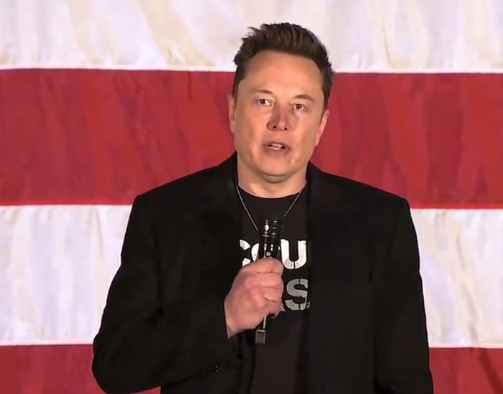
Elon Musk has announced that his company Neuralink will begin high-volume production of brain chips in 2026. The company also plans to automate the surgical procedure for implanting the devices, making it faster and safer for patients.
Neuralink, co-founded by Musk in 2016, develops brain-computer interface devices designed to help people with severe neurological conditions. The implants allow patients with paralysis, Parkinson’s or Alzheimer’s disease, or vision impairments to communicate and regain independence.
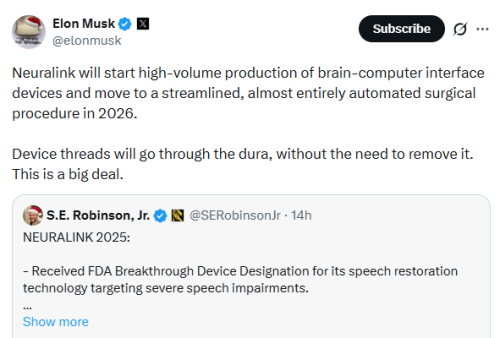
Musk said in a post on X on Thursday, January 1, 2026, that the implantation procedure will become almost entirely automated this year. Previously, a human surgeon had to remove part of the skull before a robotic arm inserted the chip.
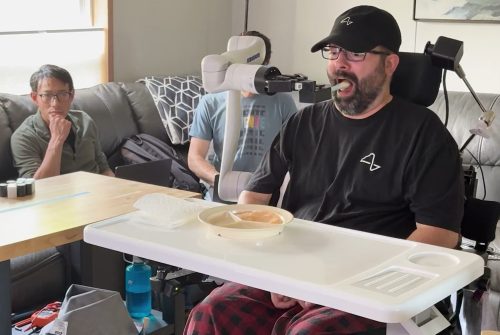
The new method will thread the device through the dura, the protective membrane around the brain, without removing bone. Musk called this change a big deal for the technology.
You Might Also Like

“Neuralink will start high-volume production of brain-computer interface devices and move to a streamlined, almost entirely automated surgical procedure in 2026. Device threads will go through the dura, without the need to remove it. This is a big deal,” he posted.
Neuralink expands human trials
The Neuralink chip is roughly the size of a coin. From it, a series of extremely thin threads, about 20 times thinner than a human hair, fan out into the brain. These threads read neural signals and send them to computers, allowing patients to control devices using only their thoughts.
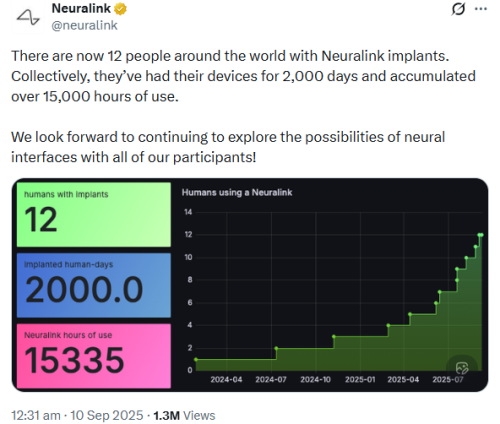
Human trials began in 2024 after Neuralink cleared FDA safety requirements, which had delayed approval in 2022. The first patient, quadriplegic Noland Arbaugh, said the implant improved his independence and helped him interact more socially. By September 2025, the company reported that 12 people worldwide had received implants and were actively using them.
Musk has said Neuralink aims to have over a thousand patients with implants by the end of 2026. To support this growth, the company has been hiring manufacturing technicians and microfabrication specialists. Musk is personally involved in the engineering work, meeting with teams twice a week.
Beyond medical use, Musk has suggested that Neuralink could eventually allow humans to merge with artificial intelligence. While this remains a long-term goal, the immediate focus is on practical applications that improve the lives of people with neurological disorders.
The mass rollout of Neuralink devices could mark a major step in making brain-computer interface technology widely available. By automating the surgical process, the company aims to scale production and reduce risks associated with manual implantation. If successful, 2026 could be a breakthrough year for Neuralink and for patients who benefit from the technology.
Neuralink remains privately held, but its progress has drawn attention across the tech and medical communities. The combination of automated surgery and high-volume production could transform treatment options for thousands of patients worldwide.
Satellite internet growth Kenya
Meanwhile, Musk’s Starlink satellite internet service has also seen growth in Kenya. As of September 2025, Starlink recorded 19,470 subscribers, the highest since launching in the country. The service grew 11.7 per cent in the third quarter of 2025, following a period of slowed sales due to a temporary suspension of new subscriptions.
Despite competition from fibre and 5G providers, Starlink maintains demand in areas where terrestrial coverage is limited.
In 2026, Starlink plans to launch its Direct-to-Cell service in Kenya through a partnership with Airtel Africa. This system will allow standard mobile phones to connect directly to satellites without special dishes, initially supporting text and limited data, with voice and full broadband coming later.
The service will help users in remote regions where network coverage is inconsistent, expanding reliable connectivity across Kenya.
Author
Kenneth Mwenda
Kenneth Mwenda is a business, sports, and politics digital writer with over seven years of experience in journalism, covering breaking news, feature stories, and in-depth analysis across a range of beats.
For inquiries, he can be reached at [email protected]
View all posts by Kenneth MwendaLatest News







Advertisement
More on Business